Cornish Crosses
Crosses
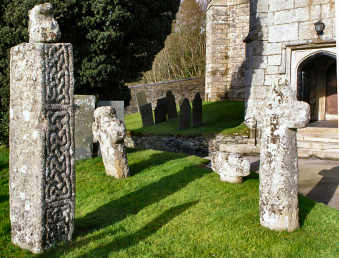
In the Dark Ages that followed the departure of the Romans in AD410, Cornwall was evangelised by missionaries from Ireland and from Wales, which itself had been converted by the Irish. Indeed, many Cornish saints (and there seem to be as many as in Wales) were of Irish origin. It is hardly surprising then that the tradition of preaching crosses should have taken root in Cornwall. Originally they were erected to mark a monk's cell or to mark a spot where Christians would gather for services. Later they came to be used as way markers, particularly on the moors. Less elaborate than their Irish counterparts, they tend to have round heads with a cross in the centre, sometimes the cross head bears an internal cross. Carving is generally simple as granite is so difficult to work. Look in almost any churchyard or on moorland roads; you will find dozens. I have photographed more than 150; I understand that there are actually more than 500.
Four of the crosses in St. Neot Churchyard
Lanivet C13 wheel cross
Longstone Cross, Minions
THE BIBLE: Anyone seriously interested in seeking out Cornwall's multitude of Cornish Crosses should consult the bible, recommended to me by Jane's old school friend, Sue Holman. She has made a serious study of Cornwall's churches and of old Cornish Crosses. The Bible is Old Cornish Crosses by Arthur G. Langdon, published originally in 1896 by Joseph Pollard of Truro. Happily all 540 pages of this massive tome are now available online.from the US Archive.
JULY 2016: In the course of my Cornish travels during July 2016, mostly visiting churches, I encountered a surprising number of Cornish Crosses, sometimes as many as four or five in one location. The most obvious example was St. Neot, seen above left, where a fifth cross, a lantern cross, stands right of the porch. Not far from St. Neot I found two more at Wenmouth Cross. I found another four at Madron, two in the churchyard, one in a field south of the church, another in a lane near Madron Holy Well. I saw two in Cardinham churchyard (and a holy well close by at Trezance Farm). There were another three in St. Mawgan churchyard, plus an empty cross base. At Lanteglos-by-Camelford there are four and inside the church is a useful information sheet about them. At Luxulyan I saw a cross on the lych gate wall and a lantern cross near the porch. Finally, I came across what looked very much like the remains of a broken up cross to the left of the porch of Tywardreath church.
NOVEMBER/DECEMBER 2016: November seemed to be my month for finding Cornish Crosses, some by intent, some by chance. I encountered three in and around Camborne Church, one at St. Enoder, one in the garden of Bodwannick Manor, and roadside ones near Higher Woodley and on the Old Coach Road above Lanivet. In St. Petroc's Chuirch Padstow I found one cross near the porch, the base and part-shaft of another by the south gate and the head of another near the font. Then in December they kept coming thick-and-fast: One at Gerrans church near Portscatho, one at St. Dennis and two at St. Stephen.
JANUARY 2017: I had more profitable days for Cornish Crosses in mid-January 2017. Heading down west I visited Zennor with its five regular crosses, two of them on William Borlase's tomb, one cross base and one lantern cross perched on an unassociated column. Next to Towednack where there are two quite different crosses by the church porch. Finally to Lelant where a plethora of crosses include two in the churchyard, 3 in the cemetery and one on the War Memorial opposite the Badger Inn. During 2017 I shall continue to search for Cornish Crosses.
The Cornish
Photographs
More in Miscellanea

Cornish Cyder Farm (now Healey's Cider Farm)
Cyder Farm (now Healey's Cider Farm)

Cornish Emblems - 1
Emblems - 1

Cornish Emblems - 2
The old Cornwall County Council coat of arms, granted in the 1940's, nicely sums up some of the history of the county. The supporters represent Cornwall's two historic trades, fishing and tin-mining. The bird is the chough, a member of the crow family, like the related raven a bird of the cliffs. Long absent from Cornwall, a captive-breeding program was recently instituted to bring it back; ironically, before the captives were released three wild choughs arrived from other Celtic parts of their own accord. The chough rests one foot on a ducal coronet, representing the Duchy of Cornwall, the inheritance of the sovereign's oldest son; in Cornwall Prince Charles is referred to as 'The Duke', just as the Queen is known as 'The Duke' in the Channel Islands in recognition of her sovereignty over them as Duke of Normandy. For many years the Dukedom of Cornwall was an Earldom. The shield carries the coat of arms of the Earls of Cornwall, adopted by the Black Prince (see above); it is surrounded by waves, as almost is Cornwall. The legend 'One and All' is claimed to represent the effort made by the Cornish to raise their Earl's ransom (see above). Perhaps, to bring it entirely up to date, it needs some additions - a swarm of emmets (ants) as summer holiday makers are known; a Cornish pasty and a cream tea, the emmet diet; and a holiday park or bed and breakfast, where most stay.