Cornish Emblems - 1
Emblems - 1
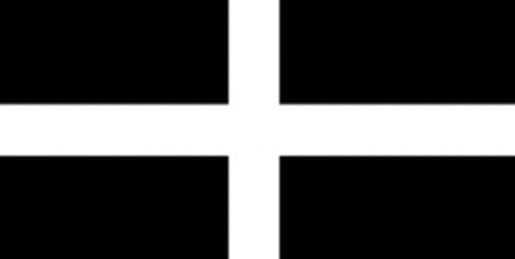
West of the Tamar you might be in another country. Indeed, to many native Cornish you are. The language, a Brythonic Celtic one, is being revived, a flag has been adopted (often obscuring the 'English Heritage' logo on tourist signs), and there is a coat of arms. Despite incomers, a strong sense of identity remains. The flag may represent St. Piran's supposed discovery of tin, white tin flowing from the black rock of his fireplace; more realistically, but not much more so, it was the flag of Dark Age King Mark. The coat of arms, adopted in 1337 by the Black Prince, shows 15 golden bezants, the ransom paid in the Crusades for his ancestor King Edward I, then Earl of Cornwall.
St. Piran's Flag, unofficial National Flag of Cornwall
The Cornish Coat of Arms
Cornish Emblems -
Photographs
More in Miscellanea

Cornish Emblems - 2
The old Cornwall County Council coat of arms, granted in the 1940's, nicely sums up some of the history of the county. The supporters represent Cornwall's two historic trades, fishing and tin-mining. The bird is the chough, a member of the crow family, like the related raven a bird of the cliffs. Long absent from Cornwall, a captive-breeding program was recently instituted to bring it back; ironically, before the captives were released three wild choughs arrived from other Celtic parts of their own accord. The chough rests one foot on a ducal coronet, representing the Duchy of Cornwall, the inheritance of the sovereign's oldest son; in Cornwall Prince Charles is referred to as 'The Duke', just as the Queen is known as 'The Duke' in the Channel Islands in recognition of her sovereignty over them as Duke of Normandy. For many years the Dukedom of Cornwall was an Earldom. The shield carries the coat of arms of the Earls of Cornwall, adopted by the Black Prince (see above); it is surrounded by waves, as almost is Cornwall. The legend 'One and All' is claimed to represent the effort made by the Cornish to raise their Earl's ransom (see above). Perhaps, to bring it entirely up to date, it needs some additions - a swarm of emmets (ants) as summer holiday makers are known; a Cornish pasty and a cream tea, the emmet diet; and a holiday park or bed and breakfast, where most stay.
Cornish Place Names
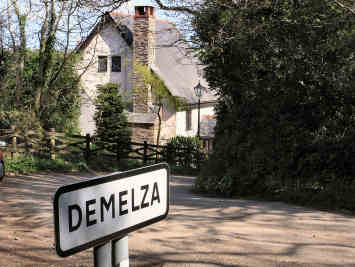
Cornish places names are a constant source of puzzlement to most visitors and, indeed, many of the Cornish. Pronunciation is a major puzzle to many, as is the close proximity of English and non-English names in some parts. For instance, on one bank of the River Camel is Wadebridge (Saxon bridge by the ford) on the other Egloshayle (Cornish church on tidal water), now forming part of Wadebridge. The answer lies in when places were named. Until Tudor times little was spoken except Cornish so most places names were in that Brythonic Celtic language. As English influence became stronger, new settlements might get English names, some old ones might be re-named. For example, Padstow was Petrocstow, the stow being a Saxon holy place; and Slaughterford, once Cornish Melorn, is the Saxon ford by the marsh. Perhaps a quarter of place names are in English, these predominantly in the more English settled north east. A few have both Cornish and Saxon elements and a very few derive from the Norman-French. And, even where settlement names are English, farm names are usually still Cornish. Among the commonest prefixes are Tre farm, Pol pool or hollow, Pen head or end, Chy and Bos dwelling, Porth cove or landing place and Ros promontory. The vast number of Saint prefixes reflects the evangelisation of Cornwall by Irish and Welsh priests in the dark ages.
Cornish Stiles
Stiles