More Thrussell and Thrussell - and even more Thrussell
Thrussell and Thrussell - and even more Thrussell
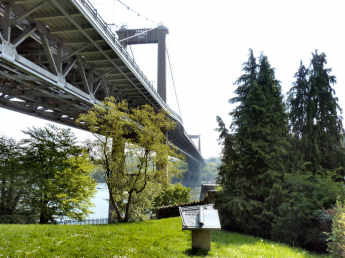
Plaque on slope below Tamar Bridge
Pensilva Primary School Tree
Wadebridge Primary School Bench
And
Photographs
More in Miscellanea
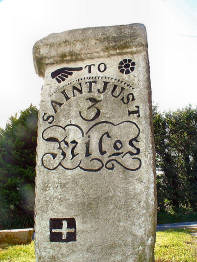
Old Direction Signs and Milestones
Signs and Milestones
Parson Hawker
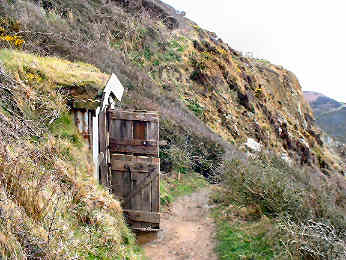
Robert Stephen Hawker was a graduate of Oxford where he won the Newdigate Poetry Prize. Vicar of Morwenstow for 40 years from 1834, he was a colourful, independent, charitable man. His relaxations were the cliff-top and poetry. The two were combined in a driftwood shack he built into a cliff near his church. Known to all as Parson Hawker, his poetry brought fame. Best known is 'Song of the Western Men', and its oft-quoted line "And shall Trelawney die?" became a Cornish anthem. His other works include an Arthurian saga 'Quest of the Sangraal'. He is also credited with introducing Harvest Festival to Britain (although Thanksgiving had long existed in the USA). From the west side of the churchyard, climb a stone stile and cross a field. Turn left to a National Trust plaque directing you down steps to Hawker's Hut. Built into the cliff, its roof covered with turf, the shack commands views of Vicarage Cliff to the north and of vicious looking Higher Sharpnose Point to the south. Walk out to Higher Sharpnose and you will understand why the 'Caledonia' was wrecked here; this part of the North Cornwall coast is a treacherous as any you will find. It is also true to say that the Cornish Coast Path around here is as tough as anywhere in its 312 miles or so.
Preaching Pits
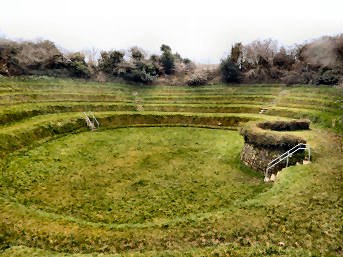
Everyone knows about the famous preaching pit, Gwennap Pit at Busveal near St. Day. This was created from the circular hollow caused by a collapsed mine shaft and became famous when John Wesley preached there to thousands on eight occasions between 1762 and 1789. Not many know that there are three others (that I know of) in Cornwall, all of them in the general area between Newquay and St. Austell. I managed to visit all three on a day in early December 2017. It was a dull day so I hope to return in sun to get better photos. All three are impressive in their own ways. St. Newlyn East is on the western edge of that village, with a wrought iron entrance gate, a stone former tea hut, an informative storyboard and six rings of seating (or standing) with modern steps down. Indian Queens is the major site with car parking (signed only as "footpath to"), storyboard, six rings of seating and a "pulpit". Whitemoor, on the very edge of Clay Country, as you might guess from its name, is an oddity; here there are only quarter rings, five of them, with a large chapel occupying much of the rest of the site. There is one other similar structure, the concrete amphitheatre in Trebah Garden being inspired by the preaching pits.