Old Direction Signs and Milestones
Signs and Milestones
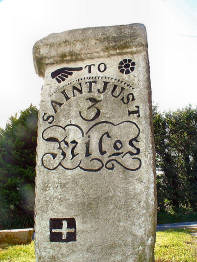
Once off main roads in Cornwall, with their totally standard British direction signs, you find a world of quite unexpected signposts, very different from those encountered anywhere else. My fear is that, in an age where authority wants to standardise everything, we may lose them. I sincerely hope not and I trust that the long ingrained Cornish sense of independence will ensure they remain with us. The very earliest direction signs were simple way markers, individual tall standing stones. In the early Christian era Cornish Crosses (a variant on the Irish Celtic Cross) began to appear as way markers, particularly on wild moorland. From the 18th century, when roads were improved in the turnpike movement, small stone markers began to give the distance to London. Modern signs are usually of metal, some rural signs in Cornwall are still of wood. Of these, my favourite stands on Treslea Down on Bodmin Moor; a granite column carries a wrought-iron bracket holding the wooden arms; one arm points to Warleggan, its name used by Winston Graham for the villain in his 'Poldark' novels; a photo is in the next item. My next favourite is the one in this picture. It stands on the Penzance-Land's End road, at the junction with a minor road to St. Just via Chapel Carn Brea. One side has conventional directions to Penzance and Land's End; I prefer the St. Just side. Next to it is an ancient Cornish Cross; behind it is a chapel converted to a home. You will see many disfigured brown tourist signs, mostly those for government owned properties, operated by English Heritage. Some Cornish nationalists like to overpaint the official logo with St. Piran's flag. I would prefer that the nationalists negotiate with authority to have St.Piran's flag accepted. I have to say that it looks most acceptable on the milestone in the picture.
Milestone at Crows-an-wra
More Old Direction Signs
More in Miscellanea
Parson Hawker
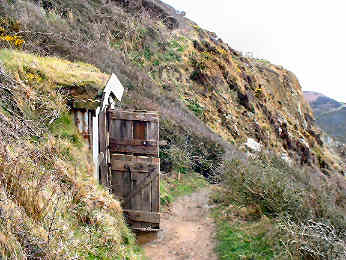
Robert Stephen Hawker was a graduate of Oxford where he won the Newdigate Poetry Prize. Vicar of Morwenstow for 40 years from 1834, he was a colourful, independent, charitable man. His relaxations were the cliff-top and poetry. The two were combined in a driftwood shack he built into a cliff near his church. Known to all as Parson Hawker, his poetry brought fame. Best known is 'Song of the Western Men', and its oft-quoted line "And shall Trelawney die?" became a Cornish anthem. His other works include an Arthurian saga 'Quest of the Sangraal'. He is also credited with introducing Harvest Festival to Britain (although Thanksgiving had long existed in the USA). From the west side of the churchyard, climb a stone stile and cross a field. Turn left to a National Trust plaque directing you down steps to Hawker's Hut. Built into the cliff, its roof covered with turf, the shack commands views of Vicarage Cliff to the north and of vicious looking Higher Sharpnose Point to the south. Walk out to Higher Sharpnose and you will understand why the 'Caledonia' was wrecked here; this part of the North Cornwall coast is a treacherous as any you will find. It is also true to say that the Cornish Coast Path around here is as tough as anywhere in its 312 miles or so.
Preaching Pits
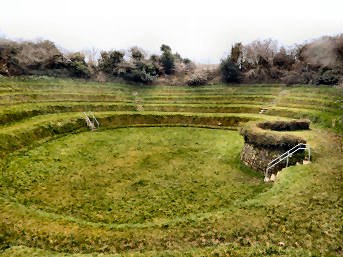
Everyone knows about the famous preaching pit, Gwennap Pit at Busveal near St. Day. This was created from the circular hollow caused by a collapsed mine shaft and became famous when John Wesley preached there to thousands on eight occasions between 1762 and 1789. Not many know that there are three others (that I know of) in Cornwall, all of them in the general area between Newquay and St. Austell. I managed to visit all three on a day in early December 2017. It was a dull day so I hope to return in sun to get better photos. All three are impressive in their own ways. St. Newlyn East is on the western edge of that village, with a wrought iron entrance gate, a stone former tea hut, an informative storyboard and six rings of seating (or standing) with modern steps down. Indian Queens is the major site with car parking (signed only as "footpath to"), storyboard, six rings of seating and a "pulpit". Whitemoor, on the very edge of Clay Country, as you might guess from its name, is an oddity; here there are only quarter rings, five of them, with a large chapel occupying much of the rest of the site. There is one other similar structure, the concrete amphitheatre in Trebah Garden being inspired by the preaching pits.
Retallack
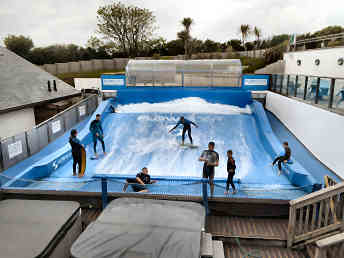
In late May 2016 we decided to have a look at, and try a meal at, the Pickwick Inn near St. Issey above the Camel Estuary upstream from Padstow. Just before noon we were greeted by a grumpy lady, mop and bucket in hand. We beat a hasty retreat and headed for Retallack Resort, just off the A39 at the Wynards Perch roundabout. This has changed radically since it was the American Wild West Theme Park, a slightly tawdry attraction. There is a lake with a wakeboarding set-up, entertaining but, compared with that at Sibleyback Lakenear Minions, quite unsophisticated. A snack-shack stands by the lake. More sophisticated is the restaurant and bar overlooking the Flow Rider (pictured left). The Flow Rider is an entertaining way of surfing without going anywhere. The rider stands on a simple board and rides the flow of water running fast up a slope. We enjoyed coffee in the restaurant, watching the activity on the Flow Rider. We haven't looked at the accommodation but, if Retallack's web site is to be believed, it appears to be of a high standard, with a variety of lodges available to purchase or for holiday rental. Retallack is owned by Galliard Homes who apparently plan much further development.