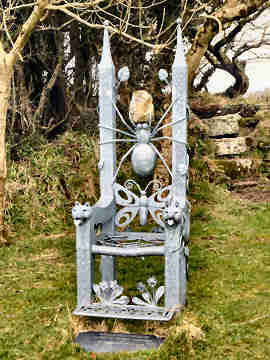
Thrussell and Thrussell - Artist Metalsmiths
I first encountered the work of the Thrussells, father and son Gary and Thomas, in 2005 when Jane and I started walking the Clay Trails, around Bugle and Wheal Martyn. At beginning of what I like to call the White River Trail -Wheal Martyn to St, Austell and, after a gap, on to Pentewan - is a small metal chimney with cleverly cut out small individual clay country features, photo below right. My next encounter, some years later was, when doing a round walk from St. Breward, I found "Arachnathrone", photo below left, on a grassy patch between the Primary School and the path to De Lank. Then Jane and I were walking on Bodmin Beacon when we discovered Thrussell benches; how pleasing to be able to rest on the work of one's favourite artist metalsmiths. Since then we have encountered their work at two pubs, the Rann Wartha in St. Austell, below, and Weatherspoons Chapel an Gansblydhen in Bodmin, and at two more primary schools, in Pensilva and Wadebridge. A favourite motif seems to be the salmon; we particularly like the one near Wenford Dries on the northernmost section of the Camel Trail. Now that I seem to be committed to seeing all the Thrussell works that we can reach in a day, I am compiling a list of those yet to see. Already I have added the Penrice Cross at Penrice Academy in St. Austell, the Archway to the Children's Playground in Carharrack - happy memories of the Redruth and Chacewater Mining Trail.and the Bandstand in Launceston. We also found an unexpected one on the slope below the Cornwall end of Tamar Bridge. If our health and fitness hold out into 2017 we hope to cross the bridge to see their work on Plymouth Hoe and on the Plym Valley Trail. The Thrussells work is not just in Cornwall and Devon; see it also in Bilston in Staffordshire and Maldon Friars in Essex.
Do visit their extensive Web Site. More Thrussell - and even more Thrussell - and yet more Thrussell
Arachnathrone, St. Breward
Rann Wartha Inn, St. Austell
Wheal Martyn Chimney
More
Photographs
More in Miscellanea
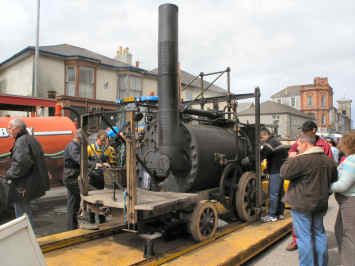
Trevithick Day in Camborne
We would have gone to Trevithick Day in Camborne in 2005 but the steam parade had been cancelled for 'health and safety' reasons. Happily, such nonsense didn't happen in April 2006 so we went then. From early morning to late afternoon the central streets were closed to traffic. The Camborne Town Band led dancers through the town; a static steam traction engine display later trundled smokily throught the streets; in Town Square we were treated to a pipe and drum band, the Holman Climax Choir, the Praze and Hayle Male Voice Choir, a circus clown, a saxophone quartet and a samba band. We also saw a rousing steel band, fairground organs, vintage fire engines, classic cars, military vehicles and a Punch and Judy show. The parades of traction engines and their miniatures were the true highlights but our small personal highlight was sitting in Town Square, eating Rowe's excellent pasties whilst enjoying multi-instrumentalist Graham Hart playing and singing his rousing version of 'Going up Camborne Hill, coming down' - which commemorates the first trial of Trevithick's 1801 Puffing Devil road loco, which the crowd of fascinated spectators were convinced was going backwards. A great day - both for steam and Trevithick enthusiasts and for the folk of Camborne. We shall go again.
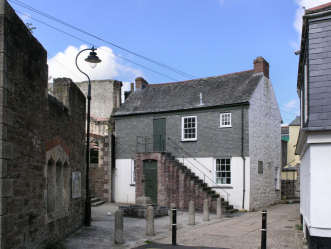
William Murdoch - Scottish born but invented in Cornwall
Murdoch - Scottish born but invented in Cornwall
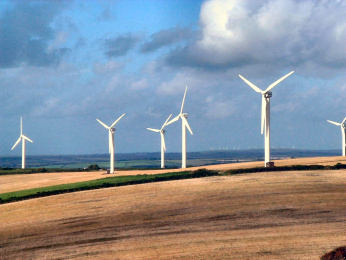
Wind Turbines - What a waste of money and effort
An unexpected and controversial feature of the Cornish landscape is the wind farm. Unexpected because you somehow assume you will find wind turbines in remote Scottish or Welsh places. Controversial because not only do some find them a terrible blot on the landscape but there is a very great deal of doubt as to whether they truly serve any useful purpose. Heavily promoted as the green answer to renewable energy production, the wind turbine produces incredibly expensive power that has to be heavily subsidised. It is far less efficient than its promoters like to suggest since it cannot operate in too little or too much wind and even has to draw power from the grid if stationary for too long. Worst of all, since it cannot be relied on, it requires 100% back-up of stand-by conventional power plant. After publication of reports in 2004, about new and safer methods of nuclear generation and waste storage, I am surprised that successive governments fail to pursue the nuclear option. Whilst we are strongly against wind turbines on practical grounds, and understand the controversy about the thrumming noise a wind farm can produce, we really don't mind the look of them. Anywhere in North Cornwall we are usually near one farm with a couple more in sight. With only a dozen or so turbines to a farm, they can look quite elegant against a background of sky or sea.