
Charlestown
Charlestown may well be familiar from such TV and movies as ‘The Eagle has Landed’, ‘Poldark’, ‘The Onedin Line’ and ‘Charles Darwin’s Voyage of the Beagle’. The harbour and picturesque village were the work of engineer John Smeaton - who built the pier at St. Ives, several canals and the famous lighthouse on Eddystone Rocks, now replaced and standing on Plymouth Hoe. He built Charlestown in 1801 for local industrialist Charles Rashleigh, mainly to export the china clay from the hills above St. Austell. China clay is no longer exported from here and now the harbour is owned by a company called Square Sail who provide ships of all periods for movie-making; their small boatyards operate on the western side of the harbour and a couple of their tall ships are usually moored by the quay. Unusually for Cornwall the harbour has a sea-lock keeping it, like Padstow, in constant water. Beech trees line the approach to the village and colourful Georgian cottages line the harbour and fetch premium prices. A Shipwreck Exhibition has a vast collection of shipwreck artefacts and displays on diving and ocean liners. There are a couple of pubs; the Rashleigh Arms, on Fore Street above the harbour, is preferred. A restaurant, in a former boathouse, is open all day and serves good local produce. Charlestown gets busy, so best to avoid school holidays.
Outside Shipwreck and Heritage Museum
Charlestown is signed from the A390 in St. Austell
**************************************************************************************
More in Museums & Galleries
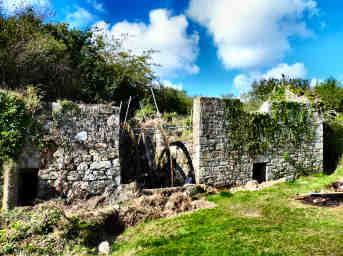
China Stone in the Tregargus Valley near St. Stephen-in-Brannel
Tregargus Valley near St. Stephen-in-Brannel

Classic Air Force - I am unsure whether this still exists at Newquay Airport
This museum was previously situated near Coventry but moved down to Cornwall in 2013. It is now on the Aerohub site on the old St. Mawgan Airfield, on the opposite side from Newquay Airport. Classic Air Force opened in Cornwall at Easter 2013 and we were lucky enough to be able to attend one of its free Easter opening days. Considering how recently the aircraft had moved down from the Midlands - there were still more to come later - everything ran surprisingly smoothly thanks to the great enthusiasm of the staff running the operation. Housed in and around a massive former RAF hangar, the collection of airplanes is impressive, ranging from simple single-engined craft such as the Auster Aristocrat and Chrislea Super Ace, through the De Havilland Dragon Rapide bi-plane, to the classic jets such as the English Electric Canberra, the Hawker Hunter and Sea Hawk, the Gloster Meteor and the Hawker Siddeley Nimrod. Many are in flying condition and some are used to give visitors air trips. While we have to claim supreme ignorance when it comes to aviation, we were impressed by the scope of the collection, the presentation and the sheer enthusiasm of the staff. Pasties and relatively simple snacks were available when we were there.
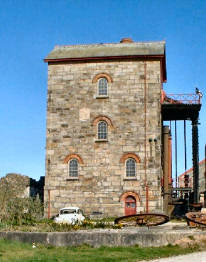
East Pool Mine at Pool - formerly Cornish Mines and Engines
Camborne was Britain's major centre of copper and tin mining during the 19th century. Around 1870, as the copper became exhausted, the 'Great Flat Lode' of tin was discovered at a lower level. New shafts were sunk, more engine houses built. Sadly only South Crofty Mine (now to be re-opened) remains capable of production but substantial relics stand in their hundreds. The National Trust and the Trevithick Trust (Richard Trevithick was the Cornish engineer who invented the high pressure engine that enabled deep mining) have restored two at Pool, not far from Trevithick's birthplace. In 2002 we toured the Discovery Centre at Taylor's Shaft and were immensely impressed by the massive Harvey's Cornish Beam Engine, one of the largest ever built. Nearby, across the road, we saw the smaller working engine in steam at Michell's Shaft. We have also enjoyed seeing Levant Engine in steam at the National Trust's site, beautifully located on a cliff-top near Cape Cornwall. We walked too - up Carn Brea Hill and past other mining relics. We report elsewhere on the 'Great Flat Lode Trail', the Coast-to-Coast Trail and the many other Mining Trails in the area.