
Classic Air Force - I am unsure whether this still exists at Newquay Airport
This museum was previously situated near Coventry but moved down to Cornwall in 2013. It is now on the Aerohub site on the old St. Mawgan Airfield, on the opposite side from Newquay Airport. Classic Air Force opened in Cornwall at Easter 2013 and we were lucky enough to be able to attend one of its free Easter opening days. Considering how recently the aircraft had moved down from the Midlands - there were still more to come later - everything ran surprisingly smoothly thanks to the great enthusiasm of the staff running the operation. Housed in and around a massive former RAF hangar, the collection of airplanes is impressive, ranging from simple single-engined craft such as the Auster Aristocrat and Chrislea Super Ace, through the De Havilland Dragon Rapide bi-plane, to the classic jets such as the English Electric Canberra, the Hawker Hunter and Sea Hawk, the Gloster Meteor and the Hawker Siddeley Nimrod. Many are in flying condition and some are used to give visitors air trips. While we have to claim supreme ignorance when it comes to aviation, we were impressed by the scope of the collection, the presentation and the sheer enthusiasm of the staff. Pasties and relatively simple snacks were available when we were there.
One of the older exhibits, the De Havilland Rapide
A3059 from A39 at St. Columb Major, ignore Airport sign
UPDATE MARCH 2015 - CLOSURE: Disappointing news is that Classic Air Force, closed during winter 2014, and due to re-open for Easter 2015, is not going to re-open after all. Lack of visitors is given as the reason. The planes will go back to Coventry.
More in Museums & Galleries
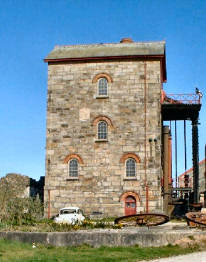
East Pool Mine at Pool - formerly Cornish Mines and Engines
Camborne was Britain's major centre of copper and tin mining during the 19th century. Around 1870, as the copper became exhausted, the 'Great Flat Lode' of tin was discovered at a lower level. New shafts were sunk, more engine houses built. Sadly only South Crofty Mine (now to be re-opened) remains capable of production but substantial relics stand in their hundreds. The National Trust and the Trevithick Trust (Richard Trevithick was the Cornish engineer who invented the high pressure engine that enabled deep mining) have restored two at Pool, not far from Trevithick's birthplace. In 2002 we toured the Discovery Centre at Taylor's Shaft and were immensely impressed by the massive Harvey's Cornish Beam Engine, one of the largest ever built. Nearby, across the road, we saw the smaller working engine in steam at Michell's Shaft. We have also enjoyed seeing Levant Engine in steam at the National Trust's site, beautifully located on a cliff-top near Cape Cornwall. We walked too - up Carn Brea Hill and past other mining relics. We report elsewhere on the 'Great Flat Lode Trail', the Coast-to-Coast Trail and the many other Mining Trails in the area.
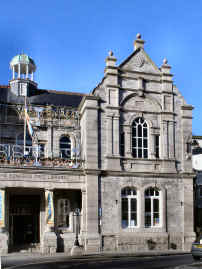
Falmouth Art Gallery
That Falmouth's art gallery has surprisingly good collections is largely thanks to South African businessman Alfred de Pass who honeymooned in Falmouth in 1888 and built a holiday home there in 1895. An avid collector, he not only gave substantial numbers of paintings to Falmouth, he also paid for the Library to be adapted and extended to house his gifts. Other donors include the local Fox family, creators of so many of Cornwall's finest gardens, including Trebah and Glendurgan.
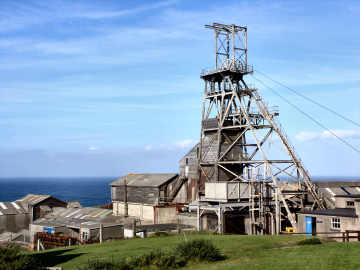
Geevor Mine Museum
Geevor is at the northern end of the massive St. Just complex of former tin mines that runs from Pendeen Watch to Cape Cornwall - Geevor, Levant, Owles, Botallack, Edward, Kenidjack, Cape Cornwall and many more. Although Geevor had been going in one form or another since around 1700, the present Geevor Mine was effectively started in 1911 by Cornish miners who had returned from South Africa during the Boer War. As a modern mine, it was a success all the while the tin price stayed high but, when the price collapsed in 1985, even a modern mine like Geevor felt the pinch and closed in 1990. It re-opened in 1993 as a museum.