Harveys Foundry of Hayle - The Great Cornish Engineers
Walking around the run-down town of Hayle these days, you would never guess that the industrial heart of Cornwall once beat strongest here. Yet in the mid-18th century Hayle boasted perhaps 5000 jobs in industry. The National Explosive Company, the Cornish Copper Company and the docks were all major employers but the greatest of them all was Harveys.
In 1779 Gwinear blacksmith John Harvey started a small works in Hayle to make hand tools and pumps for the mines. Three generations of Harveys built the country's greatest engineering company, employing geniuses like Richard Trevithick to build beam engines, locomotives and packet ships. Beam engines were the company's best known product and included the largest ever built, draining a polder at Cruquis in Holland and still in working order 150 years later. Cornish examples can be seen at Levant Mine and at Taylor's Shaft in Pool. Most remarkable ship that Harveys built was the Cornubia, an iron-built paddle steamer, originally operating as a Bristol packet boat, bought by the Confederacy as an American Civil War blockade runner, captured by the Union and used by them as a blockader of Gulf ports. Harveys final throw was to build 2nd World War landing craft.
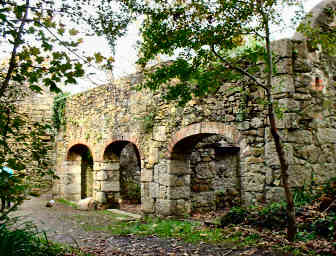
Part of Harveys Hammermill & Ropewalk complex
Remains of Harveys in the area known as Foundry in Hayle
South
More in Museums & Galleries
Heartlands
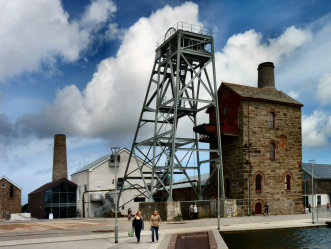
Camborne, Pool and Redruth suffered badly from mine closures. The Heartlands project has been central to plans to regenerate a run-down part of Pool. Completed at a cost of �35 million, largely lottery money, it was officially opened by the Duke and Duchess of Cornwall on a soaking wet Monday 2nd July 2012. Jane and I were luckier, we had been there the day before in sun. Heartlands is on the redundant site of South Crofty mine's Robinson's Shaft; we had walked there from Tuckingmill Valley Park by way of the Portreath Branchline Trail, taking us right past South Crofty's New Cook's Kitchen Shaft, where re-opening is expected in 2014 or 2015. This is quite an extensive site and, apart from parking and food, is free. Many old mine buildings and offices have been restored and house important machinery and exhibitions covering geology, mining and social history. There is a 270 degree wrap-around mining history film - we found it a bit 'arty'. To see the magnificent beam engine in Robinson's Shaft engine house you will have to join a guided tour but I don't think you will see it working. Highlight outside is the imaginative Diaspora Botannic Garden with individual gardens representing the countries to which Cornish miners emigrated in hard times. Already good, when mature this large and varied garden should be something special. There are also extensive lawns, a row of craft studios and shops and an impressive Adventure Playground, designed by local children.
Industrial History and Museums
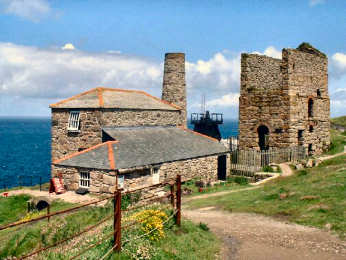
Cornwall has an incredibly rich industrial history. Tin and copper were mined from the bronze age right through the to the end of the twentieth century. Gold, silver, lead, arsenic and tungsten were found, too. Mining gave birth to a major engineering industry which included inventors like Richard Tevithick and engineering companies like the Cornish Copper Company and Harveys Foundry - both of Hayle. Harveys built beam engines, locomotives and even ocean-going ships. The remains of the mining industry can best be seen in West Penwith, near St. Agnes, in Pool, around the Great Flat Lode Trail and on south-east Bodmin Moor. China clay was discovered in 1746 by William Cookworthy. The industry is Cornwall's largest; its museum is at Wheal Martyn. Granite is still quarried, primarily at De Lank near Blisland. In the 19th and 20th centuries Cornwall again led, this time in modern communications. Cables linking Britain with the empire were laid from Porthcurno, where you can visit a museum in original buildings. Marconi made his first radio transmission from Bass Point on the Lizard and his first transatlantic transmission from Poldhu Point; both have small museums. The first satellite signals were sent to the USA from Goonhilly Earth Station on the Lizard; visitor centre here too.
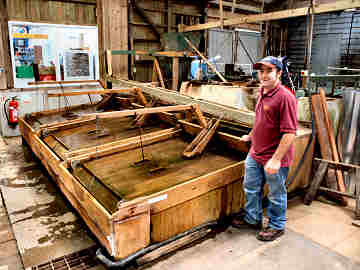
King Edward Mine near Troon
Edward Mine near Troon