Industrial History and Museums
Cornwall has an incredibly rich industrial history. Tin and copper were mined from the bronze age right through the to the end of the twentieth century. Gold, silver, lead, arsenic and tungsten were found, too. Mining gave birth to a major engineering industry which included inventors like Richard Tevithick and engineering companies like the Cornish Copper Company and Harveys Foundry - both of Hayle. Harveys built beam engines, locomotives and even ocean-going ships. The remains of the mining industry can best be seen in West Penwith, near St. Agnes, in Pool, around the Great Flat Lode Trail and on south-east Bodmin Moor. China clay was discovered in 1746 by William Cookworthy. The industry is Cornwall's largest; its museum is at Wheal Martyn. Granite is still quarried, primarily at De Lank near Blisland. In the 19th and 20th centuries Cornwall again led, this time in modern communications. Cables linking Britain with the empire were laid from Porthcurno, where you can visit a museum in original buildings. Marconi made his first radio transmission from Bass Point on the Lizard and his first transatlantic transmission from Poldhu Point; both have small museums. The first satellite signals were sent to the USA from Goonhilly Earth Station on the Lizard; visitor centre here too.
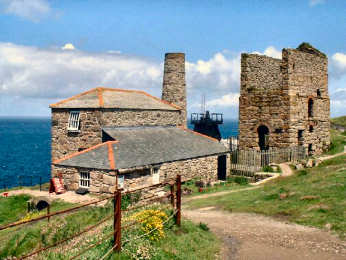
Levant Mine on a clifftop near Cape Cornwall
Industrial History and Museums Index
INDUSTRIAL
More in Museums & Galleries
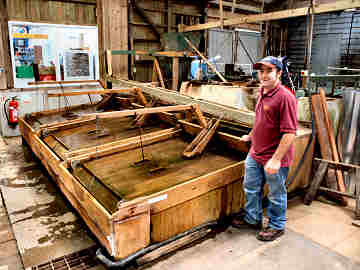
King Edward Mine near Troon
Edward Mine near Troon
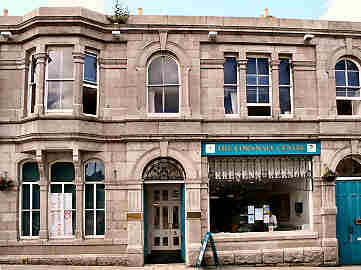
Kresenn Kernow, the Cornwall Centre in Redruth
When I walked part of the Redruth and Chacewater Trail in June 2008, I had time to spare to wander around Redruth. I was glad I did because, on Alma Place off Fore Street, I encountered the excellent Cornwall Centre. At heart the Cornish Studies Library, with a vast collection of Cornish books, pamphlets, journals and photographs, it is much more than just that. In the foyer is the local TIC with helpful staff and ample local information. In a front exhibition room I saw a good display of local crafts. For me, though, the highlights were through a door off the foyer. A corridor and stairs lead down to Market Way and the old Buttermarket. Along the corridor are the first few frames of the Tregellas Tapestry. At the foot of the stairs you come to Market Way, a small mall with a mix of shops and a caf� (all day breakfasts). Through the mall is the old Buttermarket. While the stalls here were of little interest, what took my attention was a replica of Richard Murdoch's 'Flyer' steam driven road car and the remainder of the 56 frames of the Tregellas Tapestry. Inspired and supervised by Cornish Bard Rita Tregellas Pope, the superb Tapestry covers the history of Cornwall from prehistory times to the present. A few frames deal with myth and legend - Jesus's visit to Cornwall and the story of Tristan and Iseult.
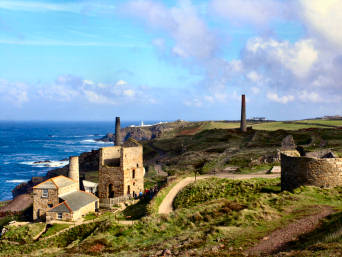
Levant Mine near St. Just in Penwith
Cornwall's oldest working beam engine lay idle for 60 years after Levant Mine closed. Built in 1840, to power lifts taking miners down 1800 feet, and tin and copper ore up, it operated continuously until Levant Mine closed in 1930. In 1935 an enthusiast purchased it for �25, founding a preservation group - later the Trevithick Society - in order to try to save it. Around 1990 a group of volunteers, known as the Greasy Gang, restored the engine, said to be the only Cornish beam engine still operating in its original engine house. The whole site is now in the care of the National Trust, which owns much of the cliff top in this part of Cornwall. Now that the beam engine is fully restored and in steam again, the site is open as a museum and is part of the Cornwall and West Devon Mining World Heritage Site. In addition to the engine, you can see a restored electric winding engine and the pumping and winding shafts, take a short underground tour and see a film. Not far south, at the old Count House at Botallack Mine, there are historical displays. Although there is parking on the site, my own view is that the best way to visit Levant Mine is in the course of a wonderful cliff-top walk between Pendeen Watch and Cape Cornwall, offering Cornwall's finest collection of mine remains in beautiful locations. Suggested round walk in the area.