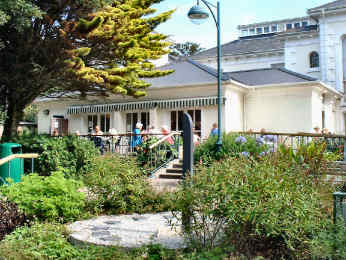
Penlee House in Penzance - Home of the Newlyn School
Built in 1865, and standing in a pleasant small park near the centre of Penzance, not far from Morrab Gardens and the seafront, Penlee House was completely refurbished in 1997. It contains West Cornwall's largest art collection, primarily the local Newlyn School of the late 19th century. Expect to see slightly romantic views of working fishermen and locals on the beach and around the harbour. Amongst the leading lights of the Newlyn School exhibited here are Stanhope Forbes, its best known name, Frank Bramley, Norman Garstin, Thomas Cooper Gotch, Walter Langley, 'Lamorna' Birch and Henry Scott Tuke. We particularly enjoy the gallery's regular special exhibitions, covering differing aspects of the Newlyn School's work. There is also a museum, founded in 1839; this covers 6000 years of Cornish history, archaeology and commerce, and has displays of fine art and the decorative arts. Also in Penzance and adjoining Newlyn you will find differing galleries at the Penzance Arts Club (may be closed now), the Exchange Gallery and the ultra contemporary Newlyn Gallery; the latter tends to put on shows which are well beyond our comprehension. More Newlyn School Paintings are found at Falmouth Art Gallery and the Royal Cornwall Museum in Truro.
Penlee House, the caf� terrace from the garden
There is an inexpensive all-day car park nearby
More in Museums & Galleries
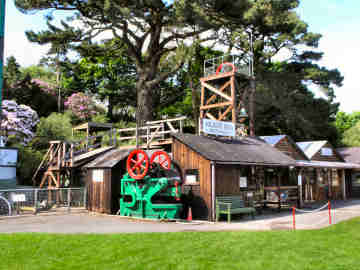
Poldark Mine at Trenear near Wendron
The history of this site as an industrial museum began in 1972 when Peter Young, intending to buy a wardrobe at auction, instead somehow bought Wendron Forge! Here he set up his collection of steam engines. Then, excavating into the hillside, he discovered the workings of abandoned Wheal Roots mine, which he opened to the public. With the success of the Poldark TV series the name of the site was changed from Wendron Forge to Poldark Mine. The present mining enthusiast owners took over in 1999. The history of mining here goes back a long way. Find a massive granite rock in the main car park and you will be looking at the famous Wendron mortar stone, where tin ore was ground before 1200BC. Look in the museum and you will see a copy of John Trenere's 1493 lease from the Duchy of Cornwall; outside is his original wheelpit. Force of circumstance - private ownership, no public funding (ever) and the need to pump vast volumes of water - means that this is an odd site. On the one hand, a genuine mine (good underground tour), wonderful machinery, a superb museum and helpful, knowledgeable staff. On the other hand, thanks to the need to keep up cashflow, there is an assortment of craft shops, shops and entertainments to bring in the the general public. But it's worth it for the real stuff. Caf� and ample parking.
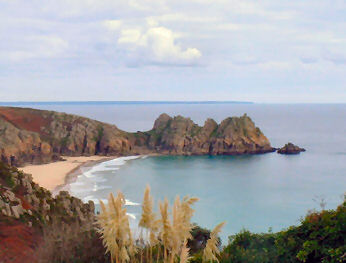
Porthcurno Telegraph Museum
Cornwall has always been in the forefront of communication technology. The first submarine cable network, the first radio transmissions by Marconi, the first transatlantic satellite station. It should be no surprise. Its position - jutting out into the Atlantic - has always offered a direct route by sea and air to the rest of the world. The first world-spanning submarine cable came into Porthcurno from India in 1870. The tiny cove grew to be the world's largest cable station, fourteen cables coming in from all parts of the world. The original Eastern Telegraph Company became the multi-national Cable and Wireless which remained here until the 1990s. The original headquarters building is now apartments but the later building and its 2nd World War tunnels now house the Porthcurno Telegraph Museum. It tells the story of submarine telegraphy and of Porthcurno's part, as a secret communications base, in World War II. Story boards are good and exhibits - many working - fascinating. But for us the best part was upstairs over the reception area. Here was a comprehensive exhibit about Isambard Kingdom Brunel's great cable laying ship, the massive 'Great Eastern'. We would have been happy if this was all we had got for the price of entry. Later we walked down to the cove to see the old Cable Hut, climbed the cliff to visit Minack Theatre and walked the coast path to Porthgwarra. There is ample parking.
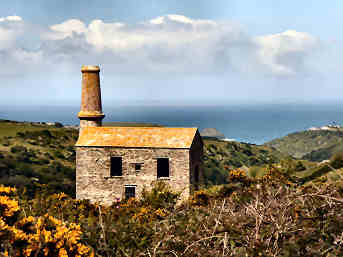
Prince of Wales Slate Quarry, Trewarmett
Prince of Wales Quarry near Trewarmett opened in 1871 but was only worked for just over 20 years., extracting blue slate from the Upper Devonian Penpethy Beds. The building housed the only beam engine in this part of Cornwall. It drove a wire ropeway that hauled the quarried slate and pumped water out of the quarry pit. When installed in July 1871 it cost �1,590. The beam engine is long gone but the engine house was well restored in 1973 by local effort. In 2015 the 45 acre site was sold at auction for �81,000. A circular path leads through the old slate tips, past the quarry pit (now a lake with a small waterfall) and up to the engine house. From the parking area head uphill, through a gate and shortly fork to climb through the slate tips. Beyond a flight of steps, the path ends in a platform which overlooks a waterfall and the lake but your view may be obscured by growth. Climb 59 steps to the top at a grassy platform above the engine house. There are great views down the valley to Dennis Point and Gull Rock, and over the quarry pit and spoil tips. For the best photographic view of the engine house, with the sea and Gull Rock beyond, go left uphill at the engine house up to about 650 feet. To return, facing out from the engine house doorway, take the narrow path to the left, down shallow slate steps and through scrub.