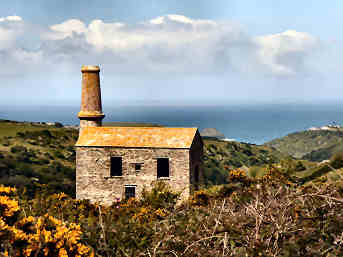
Prince of Wales Slate Quarry, Trewarmett
Prince of Wales Quarry near Trewarmett opened in 1871 but was only worked for just over 20 years., extracting blue slate from the Upper Devonian Penpethy Beds. The building housed the only beam engine in this part of Cornwall. It drove a wire ropeway that hauled the quarried slate and pumped water out of the quarry pit. When installed in July 1871 it cost �1,590. The beam engine is long gone but the engine house was well restored in 1973 by local effort. In 2015 the 45 acre site was sold at auction for �81,000. A circular path leads through the old slate tips, past the quarry pit (now a lake with a small waterfall) and up to the engine house. From the parking area head uphill, through a gate and shortly fork to climb through the slate tips. Beyond a flight of steps, the path ends in a platform which overlooks a waterfall and the lake but your view may be obscured by growth. Climb 59 steps to the top at a grassy platform above the engine house. There are great views down the valley to Dennis Point and Gull Rock, and over the quarry pit and spoil tips. For the best photographic view of the engine house, with the sea and Gull Rock beyond, go left uphill at the engine house up to about 650 feet. To return, facing out from the engine house doorway, take the narrow path to the left, down shallow slate steps and through scrub.
Prince of Wales Quarry Engine House
More information on Slate Country - Inland Walks page
*************************************************************************************
Industrial Museums
More in Museums & Galleries
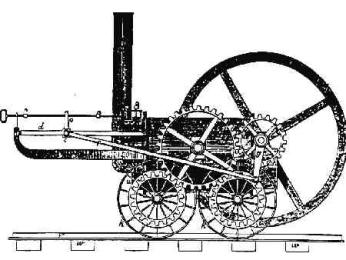
Richard Trevithick
Trevithick
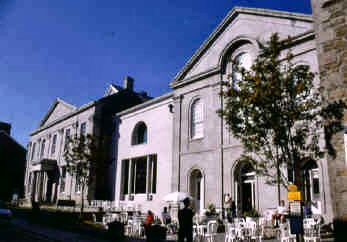
Royal Cornwall Museum in Truro
Opened in 1818, at about the time when Cornwall’s tin-mining prosperity was first beginning to wane, the Royal Institution of Cornwall was founded primarily to promote knowledge about the archaeology, history and culture of the county. Not surprisingly, its major exhibit is the internationally renowned Rashleigh Collection of Cornish Minerals - which includes the world's largest crystal of copper ore - but there are other good collections, too. Outstanding are the De Pass Collection of English and European Old Master drawings and the collection of paintings by Cornish artists including portraitist John Opie and Newlyn School member Henry Scott Tuke. Applied Arts exhibits include pewter, pottery, porcelain, scrimshaw and Japanese ivories and lacquer-work. Local History and Archaeology are both well represented - highlight is three early Bronze Age collars of beaten gold, the only such ones found in England - and there is a scale model of Trevithick's 1804 Penydaren locomotive. There is a good caf� (in its own art gallery) and a well-stocked shop. Whilst in Truro you will also find a twentieth century cathedral and plenty of good shops, caf�s and restaurants.
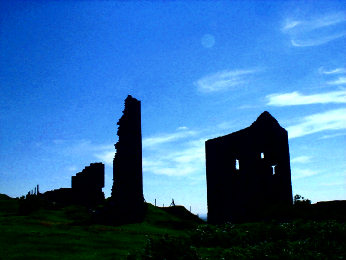
South Caradon Mine
Caradon Mine