
And Even More St. Mawgan
Mawgan
I was back in St. Mawgan again in early January 2017. This time I was there to explore parts that I had previously missed. I parked in the large public car park, behind the shop and the Falcon Inn, and walked round the church and up the steep hill towards Newquay Airport. Some way up the hill I turned left along a track with handsome Lanherne Barton and its old barn on my left. I followed the track up right. At the end I came to the Convent Tree House, an interesting timber cottage, one story below track level. Back then to Lanherne Convent and attached Church to find, directly to the SSW of the tower of St. Mawgan Church, a fine example of a Cornish Cross, crucified figure within a wheel-head, Celtic type carving on the shaft and a Saxon inscription at the bottom rear. High up, along the wall leading to the Convent are representations of the Stations of The Cross. Just before you bear left to the Convent Church and the Cornish Cross, there is a Marian Shrine on the edge of woodland. Should you be using Cornwall Council's Intractive Mapping Website, the cross appears to be shown in slightly the wrong place. In fact, it is in the loop of path just NE of the letters PW. After I had finished there, I enjoyed a good fresh coffee in front of the fire in the Falcon Inn.
Convent Church Cornish Cross
Convent and its Church, Cross right foreground
Stations of the Cross, 11
St.
Photographs
More in Towns & Villages
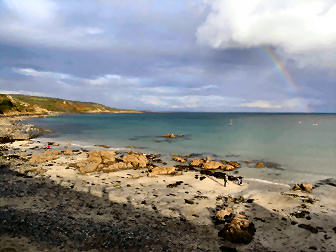
Another View of Coverack - From Tess Warburton
Hi Oliver, I was just reading your rather critical review of Coverack. I holiday in Coverack every year, along with many other families who return there each summer to enjoy beautiful surroundings and friendly inhabitants. I have been going to the village for almost twenty years and although I have travelled to many places in the south west it is still my favourite. In many ways I am pleased you don't like it. If you had stayed long enough in the village and been bothered to find out what it is really like you would have written a more far more colourful description. This would however have encouraged lots of other people to holiday there, including people like yourself (who think it is possible to understand and make judgments about a place within a paragraph). I wish you luck with your touring. However, maybe you should 'stay put' in some of the places you visit before you judge them and influence the decisions of others.
Blisland
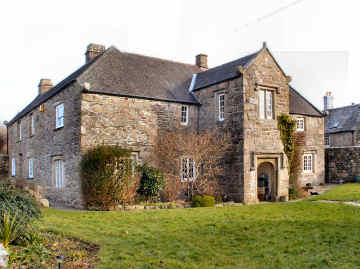
There is a lot that is both unusual and admirable about Blisland, one of Bodmin Moor's, and indeed Cornwall's, most charming villages. To take the unusual first, you don't find many proper village greens in Cornwall - but you do find one in Blisland. Roughly triangular, the church is on one side, the Blisland Inn on another, the Manor house is on the base. The church has an odd dedication, to Sts. Protus (or Pratt) and Hyacinth, and an interior like a pre-Reformation church. The Blisland Inn has a reputation for its real ales and the atmosphere of a real welcoming local pub. The Manor house has the four-square appearance of a Georgian home with a two storey Elizabethan style porch - and, most unexpectedly, on its north face two Norman windows and a Norman arch. Now for the admirable. It looked at one time as if Blisland was going the way of so many villages, dormitories with no heart, soul or amenities. But Blisland fought back and now it has not only its pub but a school and, since 2006, a community centre in the real sense of that phrase. A great effort replaced the lost village shop with a brand new convenience store, whose groceries include local produce, plus cafe, doctor's surgery and internet caf�. Pub, church, school and store make Blisland a real village.
Bodmin
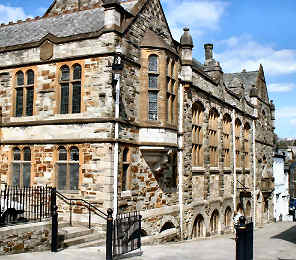
Passing through now, on the road to Wadebridge, Bodmin appears at first glance to be a rather scruffy, inconsequential town. But first appearances can deceive. Heading west into Bodmin, as you drop down into the town, look to your right and you will see Cornwall's finest and most important parish church, dedicated to St. Petroc, who founded a monastery here around AD550. Turn left by it and you will find yourself in Mount Folly Square, filled with handsome Victorian buildings: The Shire Hall housed the county's Assize Courts until 1988, the Public Rooms were once the social heart of the town. Continue past these, along the Lostwithiel Road, and you will discover former county regiment barracks and a railway station that served a line to Wadebridge, opened in 1834. Or follow the road to Wadebridge and you will see signs for Bodmin Jail and pass Westheath Park, now an upmarket housing development and technology park but once site of the county lunatic asylum. Put all these together and you will realise that this was once once a place of great significance, the County Town from 1836 to 1988. There are several things for the visitor to see and do, though little advertised. The Shire Hall houses the TIC, exhibitons and a Court Room Museum. Bodmin Jail is now a museum with restaurant. The Town Museum is in the Public Rooms. Do not miss St.Petroc's Church. Bodmin & Wenford Railway operates steam trains on the old Wadebridge line.