Bodmin
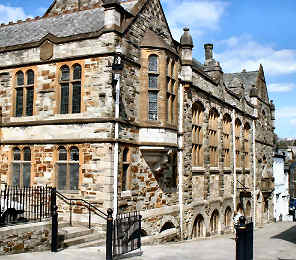
Passing through now, on the road to Wadebridge, Bodmin appears at first glance to be a rather scruffy, inconsequential town. But first appearances can deceive. Heading west into Bodmin, as you drop down into the town, look to your right and you will see Cornwall's finest and most important parish church, dedicated to St. Petroc, who founded a monastery here around AD550. Turn left by it and you will find yourself in Mount Folly Square, filled with handsome Victorian buildings: The Shire Hall housed the county's Assize Courts until 1988, the Public Rooms were once the social heart of the town. Continue past these, along the Lostwithiel Road, and you will discover former county regiment barracks and a railway station that served a line to Wadebridge, opened in 1834. Or follow the road to Wadebridge and you will see signs for Bodmin Jail and pass Westheath Park, now an upmarket housing development and technology park but once site of the county lunatic asylum. Put all these together and you will realise that this was once once a place of great significance, the County Town from 1836 to 1988. There are several things for the visitor to see and do, though little advertised. The Shire Hall houses the TIC, exhibitons and a Court Room Museum. Bodmin Jail is now a museum with restaurant. The Town Museum is in the Public Rooms. Do not miss St.Petroc's Church. Bodmin & Wenford Railway operates steam trains on the old Wadebridge line.
Bodmin's 'Public Rooms' built in 1891
Bodmin is signed from the A30 in both directions
More in Towns & Villages
Bodwen
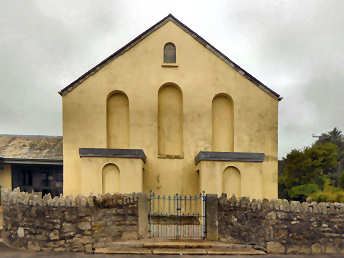
Bodwen scarcely qualifies as a Town or Village; in reality it is no more than a hamlet. You could easily miss most of Bodwen, whose name means the old dwelling. Part of it, the part of greater interest, is down an unsigned dead-end turning. Here is a small farm, a couple of converted barns and some renovated cottages. I would guess that Bodwen is a dormitory village for Bodmin. There are some cottages on the road through to Luxulyan and, at a cross roads south-east of the village, a former chapel now serves as a cold store for a food producer across the lane.
Boscastle
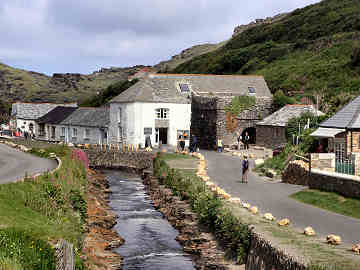
When I started this web site I didn't like Boscastle very much. I was about ready to post a critical item when the dreadful flood of August 2004 happened. That was no time for criticism so I decided to leave it until repair and restoration were complete. I am glad I did because, before and after a walk up the Valency Valley in June 2008, I took time to explore the village. Now not only am I most impressed by the way Boscastle has recovered but I also find that I now like it. It may be very tourist oriented - Visitor Centre, National Trust shop, Witchcraft Museum, art and craft galleries, gift shops, restaurants, caf�s - but it looks terrific. Scenically it is hard to beat thanks to its setting in a steep valley, the River Valency winding down to a small harbour (dry at low tide) with a few fishing boats, beyond it two high headlands, both on the coast path, and the sea. In the photo a lime kiln stands in front of the former 'pilchard palace'; the latter now houses the TIC, a National Trust shop and caf� and a Witchcraft Museum. And don't miss walking up Old Road, a narrow no-entry street, to admire its charming cottages. I can't comment on eating places as I have only had coffee here, but for sociability the Wellington Hotel bar is probably top; other pubs are the Cobweb and the Napoleon at the top of the village.

Boyton
On the last Saturday in October 2016 I headed towards the River Tamar and Cornwall's boundary with Devon. I was fortunate with a warm sunny day but disappointed when I found the first object of my expedition, St. Stephen's Church in Launceston, firmly closed. What is it about town churches that mitigates against their opening; I have had the same problem elsewhere, most notably in Lostwithiel. I continued to Yealmbridge for a photo of the attractive bridge. Built around 1350, it is considered the oldest surviving and best built of medieval Cornish bridges. Nikolaus Pevsner described it as Cornwall's "most ambitious" bridge. A pity he felt unable to visit and comment on my next port of call, Werrington Church which, most disappointingly was, like St. Stephen's, firmly locked with no indication of where a key might be found. I say disappointingly because it is suggested that the church may be one of William Kent's last works; indeed, the exterior with its pair of low towers and its statuary suggests that could well be the case. Happily, when I continued to Boyton, although the church was locked, I found the key with a helpful nearby resident. Inside both nave ansd aisle have barrel vaulted ceilings with carved roof bosses. Only a little remains of the original screen and both pulpit and chancel pews have unexpected froated glass panels. A plain circular font is probably of Polyphant stone. In the village attractive homes include the former forge and the old Post Office. Follow the road downhill, cross a recent bridge over the infant River Tamar into Devon and you come to beautifully set Boyton Mill, now an attractive home but still with mill and waterwheel intact.