Boscastle
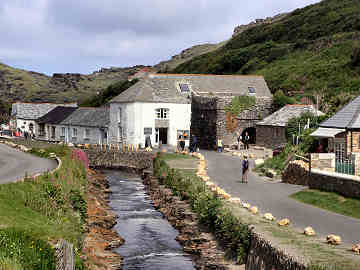
When I started this web site I didn't like Boscastle very much. I was about ready to post a critical item when the dreadful flood of August 2004 happened. That was no time for criticism so I decided to leave it until repair and restoration were complete. I am glad I did because, before and after a walk up the Valency Valley in June 2008, I took time to explore the village. Now not only am I most impressed by the way Boscastle has recovered but I also find that I now like it. It may be very tourist oriented - Visitor Centre, National Trust shop, Witchcraft Museum, art and craft galleries, gift shops, restaurants, caf�s - but it looks terrific. Scenically it is hard to beat thanks to its setting in a steep valley, the River Valency winding down to a small harbour (dry at low tide) with a few fishing boats, beyond it two high headlands, both on the coast path, and the sea. In the photo a lime kiln stands in front of the former 'pilchard palace'; the latter now houses the TIC, a National Trust shop and caf� and a Witchcraft Museum. And don't miss walking up Old Road, a narrow no-entry street, to admire its charming cottages. I can't comment on eating places as I have only had coffee here, but for sociability the Wellington Hotel bar is probably top; other pubs are the Cobweb and the Napoleon at the top of the village.
Coastal Round Walk from Boscastle includes St. Juliot church.
The River Valency and the former pilchard palace
Boscastle flood photos
More in Towns & Villages

Boyton
On the last Saturday in October 2016 I headed towards the River Tamar and Cornwall's boundary with Devon. I was fortunate with a warm sunny day but disappointed when I found the first object of my expedition, St. Stephen's Church in Launceston, firmly closed. What is it about town churches that mitigates against their opening; I have had the same problem elsewhere, most notably in Lostwithiel. I continued to Yealmbridge for a photo of the attractive bridge. Built around 1350, it is considered the oldest surviving and best built of medieval Cornish bridges. Nikolaus Pevsner described it as Cornwall's "most ambitious" bridge. A pity he felt unable to visit and comment on my next port of call, Werrington Church which, most disappointingly was, like St. Stephen's, firmly locked with no indication of where a key might be found. I say disappointingly because it is suggested that the church may be one of William Kent's last works; indeed, the exterior with its pair of low towers and its statuary suggests that could well be the case. Happily, when I continued to Boyton, although the church was locked, I found the key with a helpful nearby resident. Inside both nave ansd aisle have barrel vaulted ceilings with carved roof bosses. Only a little remains of the original screen and both pulpit and chancel pews have unexpected froated glass panels. A plain circular font is probably of Polyphant stone. In the village attractive homes include the former forge and the old Post Office. Follow the road downhill, cross a recent bridge over the infant River Tamar into Devon and you come to beautifully set Boyton Mill, now an attractive home but still with mill and waterwheel intact.
Bradoc
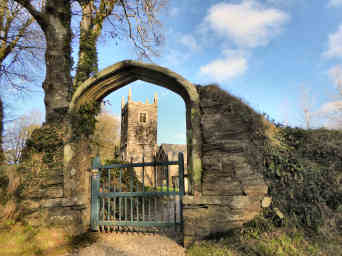
Some would spell it Bradock, some Braddock; I prefer Bradoc. Whichever way you prefer it the name is English rather than Cornish and is simply a corruption of Broad Oak. It is a very strange little place. Miles from habitation of any size, 1� miles from the nearest road (as opposed to lane), and consisting only of three proper buildings: the church, the Old Rectory and the rectory's former Coach House. It's farm, the organic Penventon, is the best part of a mile away by lane and track; further along the track is Killboy Cross. St. Mary's church consists of nave, south aisle, north transept and tower. It is attractive and has a pretty little north lych gate. When I went to see the church in January 2016 it was locked and I was unable to see the inside but got some good photos in good light. I was later able to see inside the church - see item immediately below. The building is a mix of Norman to 16th century, with original wagon roofs, a Norman font, Elizabethan pulpit and remains of a rood screen. A number of carved bench ends have been joined as a panel on the front pew. There are some unusual panels in what remains of the rood screen (the rest is in Boconnoc church), one of a woman holding a snake's tail. West, in Boconnoc Park, is the site of a civil war battle of 9 January 1643 when Hopton's Royalist forces defeated a Parliamentary army.
Breage & Sithney
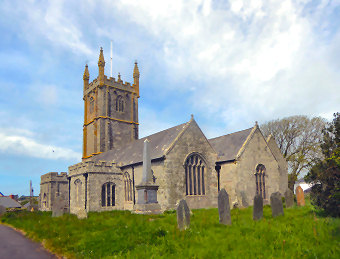
I visited Breage, on the Marazion and Penzance road beyond Helston, in mid-May 2017. My purpose was to add to my collection of Cornish Crosses by finding the one in Breage. As it turned out, the first one I found wasn't in Breage at all but on the Helston to Marazion road, on the corner of a lane heading for Trevena, opposite the car park of a garden centre. Having photographed the cross, I continued on to Breage village where there was indeed a Cornish Cross in the churchyard, near the porch. The church its, as so often in Cornwall, stands on a high mound, suggesting an older pre-Christian site. On Shute Hill, leading up to the church, there are attractive cottages; beyond the church is the Queens Arms Inn. The church itself consists of nave, two aisles and a three-stage tower. The lych gate opposite the pub lacks roof and coffin rest but does have a coffen stile. Inside, the nave is impressive and the chancel is approached beneath an elaborate rood screen, complete with rood, beyond it an elaborate reredos. On north and south walls is a fine collection of frescoes, wall-paintings, unusual for Cornwall, and an inscribed "Roman" stone stands in a corner of the south aisle. A carved stone, possibly part of a headstone, with a Christ figure, flanked by two others, stands beneath a window.