Bradoc
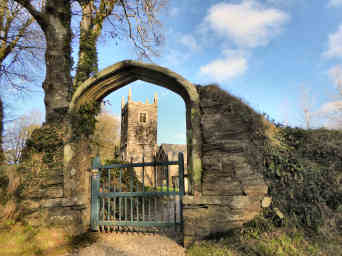
Some would spell it Bradock, some Braddock; I prefer Bradoc. Whichever way you prefer it the name is English rather than Cornish and is simply a corruption of Broad Oak. It is a very strange little place. Miles from habitation of any size, 1� miles from the nearest road (as opposed to lane), and consisting only of three proper buildings: the church, the Old Rectory and the rectory's former Coach House. It's farm, the organic Penventon, is the best part of a mile away by lane and track; further along the track is Killboy Cross. St. Mary's church consists of nave, south aisle, north transept and tower. It is attractive and has a pretty little north lych gate. When I went to see the church in January 2016 it was locked and I was unable to see the inside but got some good photos in good light. I was later able to see inside the church - see item immediately below. The building is a mix of Norman to 16th century, with original wagon roofs, a Norman font, Elizabethan pulpit and remains of a rood screen. A number of carved bench ends have been joined as a panel on the front pew. There are some unusual panels in what remains of the rood screen (the rest is in Boconnoc church), one of a woman holding a snake's tail. West, in Boconnoc Park, is the site of a civil war battle of 9 January 1643 when Hopton's Royalist forces defeated a Parliamentary army.
Bradoc Church tower through the south gate
Signed from A390, Lostwithiel - Liskeard, at West Taphouse
I returned to Bradoc in late February 2016, thanks to Churchwarden Carol Spear who very kindly met me at the church with the key. Before meeting Carol at the church I had taken the opportunity granted by a sunny morning to seek out Killboy Cornish Cross (at grid ref: 16482/62281). This is accessed by a grassy track from Polventon Farm on the Fortescue's Boconnoc estate. The cross, set into a circular base, though not long restored, is badly degraded, lichen covered and difficult to photograph, thanks to its proximity to a hedge.
More in Towns & Villages
Breage & Sithney
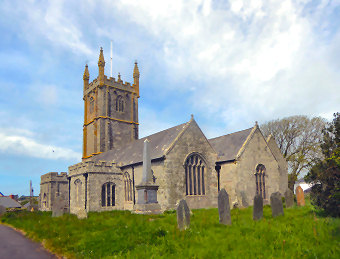
I visited Breage, on the Marazion and Penzance road beyond Helston, in mid-May 2017. My purpose was to add to my collection of Cornish Crosses by finding the one in Breage. As it turned out, the first one I found wasn't in Breage at all but on the Helston to Marazion road, on the corner of a lane heading for Trevena, opposite the car park of a garden centre. Having photographed the cross, I continued on to Breage village where there was indeed a Cornish Cross in the churchyard, near the porch. The church its, as so often in Cornwall, stands on a high mound, suggesting an older pre-Christian site. On Shute Hill, leading up to the church, there are attractive cottages; beyond the church is the Queens Arms Inn. The church itself consists of nave, two aisles and a three-stage tower. The lych gate opposite the pub lacks roof and coffin rest but does have a coffen stile. Inside, the nave is impressive and the chancel is approached beneath an elaborate rood screen, complete with rood, beyond it an elaborate reredos. On north and south walls is a fine collection of frescoes, wall-paintings, unusual for Cornwall, and an inscribed "Roman" stone stands in a corner of the south aisle. A carved stone, possibly part of a headstone, with a Christ figure, flanked by two others, stands beneath a window.
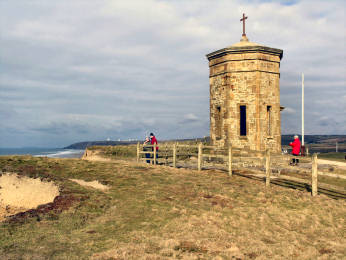
Bude - a once run-down town which gets steadily better and better
Our original 2003 report - but please read also the 2009 update box below
Callestick
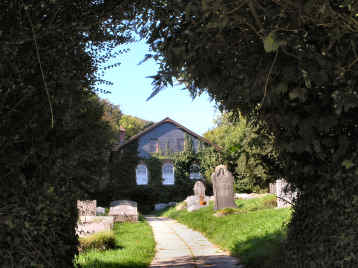
During a walk in November 2007 from Zelah to Chiverton Cross, as part of the Land's End Trail, I passed through a lot of places with the Callestick (or Callestock) name. Originally they would all have been the Callestoc recorded in Domesday Book. I counted Little Callestock, Callestick, Old Callestick Mine and Callestock Veor (Great) plus Callestick Vean (Little) which wasn't on my route. The present village of Callestick, the largest of the settlements, was presumably originally Callestock Veor. It is an attractive place in more senses than one. A handsome Georgian farmhouse, beautifully presented cottages, a former Methodist chapel converted to a home, a well kept Methodist graveyard, a small maker of quality ice cream and the Cornish Cyder Farm. I stopped at the latter for a coffee and cake when on the Land's End Trail in 2007. In September 2008 I was again walking the Land's End Trail - this time west to east - with my friend and neighbour Richard. It was a warm day and, feeling in need of refreshment, we stopped at Callestick Farm for a first-class ice cream. They also do bacon baps and cream teas. They are open all year (though in winter just Wed to Sat). I used to recommend Callestick Farm - until Jane and I were short-changed on a cream tea.