Bude - a once run-down town which gets steadily better and better
Our original 2003 report - but please read also the 2009 update box below
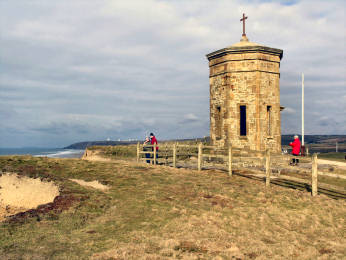
Like Portreath and Hayle, Bude is a run-down town for which we have great affection. When the railway arrived in 1898 Bude developed as as resort, with hotels and villas with sea views. After World War II, and the later loss of its railway in 1966, it went downhill and now has no quality hotel but caters rather to the lower end of the bus tour trade. However, Bude has many saving graces, not the least its superb Summerleaze Beach, where the tide recedes a full quarter mile. A sea lock there is the start of the Bude Canal (2 miles restored) that once carried sand inland. Behind the beach look out for the Bude Light, which remembers Sir Goldsworthy Gurney who lived in the castle, built a steam road vehicle in 1829, and devised a complex system of arc lights and mirrors which lighted Parliament for 60 years before electricity. Above the beach, to the south side, the Pepper Pot stands high on Efford Down, its sides marked with the points of the compass, some 7 degrees out of true; good views. Little good eating, except at the bar of the Falcon Hotel by the canal. An easy round walk takes in Bude, Widemouth Bay and the Canal. It follows the coast from the Pepper Pot to Widemouth Bay, crosses fields to the excellent Weir caf�/bistro at Helebridge, then follows the canal back into Bude
Pepper Pot on Efford Down overlooks the town
Signed from A39 'Atlantic Highway'
BUDE UPDATE JULY 2009 When my sister May stayed with us in July 2009 we spent a day in Bude, a place we always enjoy. In the morning we walked the beaches, then lunched at the Castle. In the afternoon we walked the canal and had tea at Woodlands Tea Rooms at Helebridge (2013, now superceded by The Weir). We found that, even since our last visit, Bude had improved. The storm damaged canal sea lock has been restored and more work done on the canal. The Quay is smarter, the Castle is now Heritage Centre, gallery, museum and restaurant.
More in Towns & Villages
Callestick
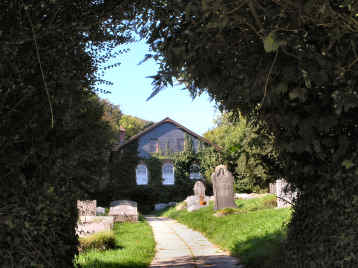
During a walk in November 2007 from Zelah to Chiverton Cross, as part of the Land's End Trail, I passed through a lot of places with the Callestick (or Callestock) name. Originally they would all have been the Callestoc recorded in Domesday Book. I counted Little Callestock, Callestick, Old Callestick Mine and Callestock Veor (Great) plus Callestick Vean (Little) which wasn't on my route. The present village of Callestick, the largest of the settlements, was presumably originally Callestock Veor. It is an attractive place in more senses than one. A handsome Georgian farmhouse, beautifully presented cottages, a former Methodist chapel converted to a home, a well kept Methodist graveyard, a small maker of quality ice cream and the Cornish Cyder Farm. I stopped at the latter for a coffee and cake when on the Land's End Trail in 2007. In September 2008 I was again walking the Land's End Trail - this time west to east - with my friend and neighbour Richard. It was a warm day and, feeling in need of refreshment, we stopped at Callestick Farm for a first-class ice cream. They also do bacon baps and cream teas. They are open all year (though in winter just Wed to Sat). I used to recommend Callestick Farm - until Jane and I were short-changed on a cream tea.
Callington
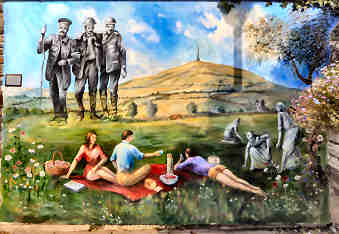
I was in Callington on a mid October 2016 day when I also looked at Merrymeet, St. Ive Churchtown, West Harrowbarrow and Dupath Holy Well. It is a very ordinary small town with a populatrion of around 5,000. I had hoped to see inside St. Mary's Church, fairly impressive from the outside, but it was locked so I had to content myself with views of a much-weathered lantern cross and the adjacent clink, once the town lock-up, now home to a small business. Opposite the church a lane leads to the Pannier Market. In Well Street s the old Pipe Well, once the town's water supply. The town holds a Honey Fair on the first Wednesday of October; it is a major street fair but I haven't been able to discover its origins. The two most noticeable features of Callington are the occasional view north to Kit Hill and a series of murals, three of which are seen below. The town hall has a mural trail leaflet.

Calstock
I revisited Calstock in early February 2018, after seeing St. Dominica's Church. I had hoped to look inside St. Andrew's Church, half a mile up the hill from Calstock itself; sadly, like too many Cornish churches, it was locked. So I headed down the hill to the village. I note from the Church of England's web site that the church should be open each day between 12 and 2. I was there at 1.30 so I have emailed the incumbent to ask for more information on opening days and hours. Anyway, I enjoyed my visit to Calstock village, where the sun was shining and the Tamar sparkling. Last time I was in Calstock was with Jane, when we walked along the river from Cotehele and enjoyed a pleasant light lunch sitting in the sun on the terrace of the Tamar Inn. At one time Calstock was a very prosperous port, serving local tin and copper mines. Now it is a quiet spot most of the time, its former wealth shown only by some big three storey homes and a main street that was once clearly full of shops and inns. Near the water, the Tamar Inn, quite ordinary when we first encountered it, has much improved with good food and a pleasant outside seating area. An annual regatta remembers the days of the pilot boats that guided the ships into the wharves. Probably best to avoid Calstock at holiday times and summer weekends; it then turns into a bustling resort.