Callington
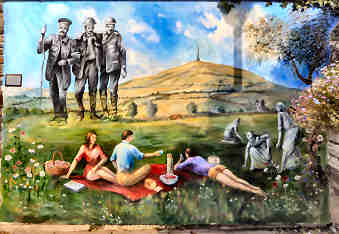
I was in Callington on a mid October 2016 day when I also looked at Merrymeet, St. Ive Churchtown, West Harrowbarrow and Dupath Holy Well. It is a very ordinary small town with a populatrion of around 5,000. I had hoped to see inside St. Mary's Church, fairly impressive from the outside, but it was locked so I had to content myself with views of a much-weathered lantern cross and the adjacent clink, once the town lock-up, now home to a small business. Opposite the church a lane leads to the Pannier Market. In Well Street s the old Pipe Well, once the town's water supply. The town holds a Honey Fair on the first Wednesday of October; it is a major street fair but I haven't been able to discover its origins. The two most noticeable features of Callington are the occasional view north to Kit Hill and a series of murals, three of which are seen below. The town hall has a mural trail leaflet.
Kit Hill Mural
Return of King Alfred Mural
Honey Fair Mural
Photographs
More in Towns & Villages

Calstock
I revisited Calstock in early February 2018, after seeing St. Dominica's Church. I had hoped to look inside St. Andrew's Church, half a mile up the hill from Calstock itself; sadly, like too many Cornish churches, it was locked. So I headed down the hill to the village. I note from the Church of England's web site that the church should be open each day between 12 and 2. I was there at 1.30 so I have emailed the incumbent to ask for more information on opening days and hours. Anyway, I enjoyed my visit to Calstock village, where the sun was shining and the Tamar sparkling. Last time I was in Calstock was with Jane, when we walked along the river from Cotehele and enjoyed a pleasant light lunch sitting in the sun on the terrace of the Tamar Inn. At one time Calstock was a very prosperous port, serving local tin and copper mines. Now it is a quiet spot most of the time, its former wealth shown only by some big three storey homes and a main street that was once clearly full of shops and inns. Near the water, the Tamar Inn, quite ordinary when we first encountered it, has much improved with good food and a pleasant outside seating area. An annual regatta remembers the days of the pilot boats that guided the ships into the wharves. Probably best to avoid Calstock at holiday times and summer weekends; it then turns into a bustling resort.

Camborne
Last time I was in Camborne town, as opposed to the many locations round and about such as Heartlands and Carn Brea, was when Jane and I attended Trevithick Day there in April 2006. This time, in November 2016, I was there to pursue my imterest in the works of the Thrussells. Unlike all their other work that I have seen, this was indoors: a thorn tree in the middle of the raised area in the vast Wetherspoons, the John Francis Basset (mining magnate). This building was once the New Market House, later housing St. George's Hall and the Scala Cinema. Round the corner is St. Meriadoc's church, where there was a Christmas Tree Festival in progress, dozens of decorated trees spread around the nave and aisles. My main interest here was the churchyard where there are two fine, and very different, Cornish Crosses. Until the 19th century Camborne was a tiny hamlet but the tin and copper boom of that century saw rapid growth. The last mine closed in 1991 although it is hoped (2016) to re-open Wheal Crofty soon. Good public buildings include the Josiah Thomas Memorial Building and the Centenary Wesleyan Church. Outside the Passmore Edwards Library, at the foot of Basset Street, stands a statue of Camborne's most famous son, Richard Trevithick. His childhood home in Penponds, open on occasion in summer, is now in the care of the National Trust.
Carharrack
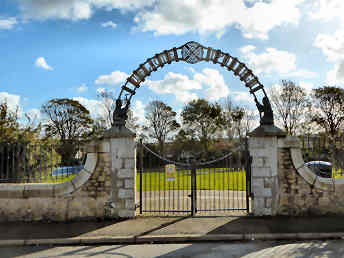
I had been through Carharrack on several previous occasions when researching the Redruth and Chacewater Mining Trail, though the very first time was on a walk from Lanner Hill to Bissoe, led by Mark Kaczmareck and Kingsley Rickard. That was one of the relatively few guided walks we have ever joined but one which we were glad to be part of because it gave us our first proper, and most informative, introduction to Cornish Mining and the Mining Trails. On this occasion, in early November 2016, I was pursuing my interest in the marvellous metalwork of father and son team Gary and Thomas Thrussell which brought me to Carharrack Park Playground. What I came to see in the archway in the photo on the left. But I was amazed and delighted to find there was much more in the playground: Mosaic work, butterflies and bees in the path, giant wooden mayfly and spider and other work worthy in its way of the Thrussells. In an odd way my favourite piece was a waste bin in the form of a blue dotted yellow mushroom. There were also stacked wooden cubes carved with entertaining speed statistics. Although I was disappointed that the church was locked, my visit to Carharrack was rounded off by spotting a modern Cornish Cross on the road junction opposite. From Carharrack I continued to St. Day, Gwennap and Gwennap Pit.