
Camborne
Last time I was in Camborne town, as opposed to the many locations round and about such as Heartlands and Carn Brea, was when Jane and I attended Trevithick Day there in April 2006. This time, in November 2016, I was there to pursue my imterest in the works of the Thrussells. Unlike all their other work that I have seen, this was indoors: a thorn tree in the middle of the raised area in the vast Wetherspoons, the John Francis Basset (mining magnate). This building was once the New Market House, later housing St. George's Hall and the Scala Cinema. Round the corner is St. Meriadoc's church, where there was a Christmas Tree Festival in progress, dozens of decorated trees spread around the nave and aisles. My main interest here was the churchyard where there are two fine, and very different, Cornish Crosses. Until the 19th century Camborne was a tiny hamlet but the tin and copper boom of that century saw rapid growth. The last mine closed in 1991 although it is hoped (2016) to re-open Wheal Crofty soon. Good public buildings include the Josiah Thomas Memorial Building and the Centenary Wesleyan Church. Outside the Passmore Edwards Library, at the foot of Basset Street, stands a statue of Camborne's most famous son, Richard Trevithick. His childhood home in Penponds, open on occasion in summer, is now in the care of the National Trust.
More images of Camborne
The John Francis Basset in New Market House
Camborne Vestry or Clink
Camborne Centenary Wesleyan Chapel
Dolcoath Wheal Harriett Wheel
Photographs
More in Towns & Villages
Carharrack
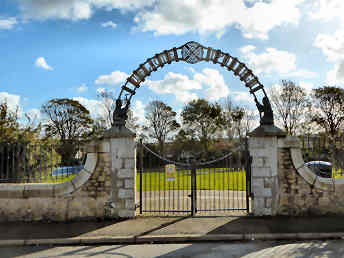
I had been through Carharrack on several previous occasions when researching the Redruth and Chacewater Mining Trail, though the very first time was on a walk from Lanner Hill to Bissoe, led by Mark Kaczmareck and Kingsley Rickard. That was one of the relatively few guided walks we have ever joined but one which we were glad to be part of because it gave us our first proper, and most informative, introduction to Cornish Mining and the Mining Trails. On this occasion, in early November 2016, I was pursuing my interest in the marvellous metalwork of father and son team Gary and Thomas Thrussell which brought me to Carharrack Park Playground. What I came to see in the archway in the photo on the left. But I was amazed and delighted to find there was much more in the playground: Mosaic work, butterflies and bees in the path, giant wooden mayfly and spider and other work worthy in its way of the Thrussells. In an odd way my favourite piece was a waste bin in the form of a blue dotted yellow mushroom. There were also stacked wooden cubes carved with entertaining speed statistics. Although I was disappointed that the church was locked, my visit to Carharrack was rounded off by spotting a modern Cornish Cross on the road junction opposite. From Carharrack I continued to St. Day, Gwennap and Gwennap Pit.

Charlestown
I deal with Charlestown in some detail on my Museums page, under maritime museums, largely because of the Shipwreck and Heritage Centre there. But it is certainly worth an entry in its own right and another photo. Originally known as West Polmear, you might normally expect that the name of Charlestown would have been acquired in the 17th century and would reflect a connection with King Charles I or II. But the man it is named for is Charles Rashleigh, landowner with interests in mines, china clay and railways. Employing engineer John Smeaton, during the early 19th century he transformed a small fishing harbour into what you now see. The surprise is that Charlestown has retained its Georgian flavour so strongly, despite the presence of 21st century tourism. There are a couple of pubs; the Rashleigh Arms, on Fore Street above the harbour, is preferred, particularly since its make-over. There are several restaurants and caf�s, most open all day and serving good local produce. Charlestown is a lovely place to visit but it can get very busy, so you would do best to avoid the height of the holiday season. The village is signed from the halfway along the A390 St. Austell by-pass, a busy and often congested road; given the choice and a nice day I would always prefer to approach it along the coast path.

Coombe
Once part of the Stowe estate of the Grenvilles, the hamlet of Coombe is now owned by the Landmark Trust, which specialises in restoring interesting buildings of historic and architectural importance and letting them as up-market holiday rentals. The surrounding land is part of the National Trust’s Stowe Barton estate. The hamlet consists of a tall watermill, once known as Stowe Mill, the mill house, two semi-detatched cottages and a couple of converted barns. All, apart from the mill, are rentable. The mill is intact, including all its machinery and a large waterwheel, but large a colony of bats prevents its conversion at present. However, the Landmark Trust hopes to use the mill to provide Coombe’s electricity. The hamlet is divided by a small river with a shallow paved ford and a footbridge. Cottages are thatched and whitewashed, all are quite charming and easy to photograph. One pair of cottages is known as Hawker’s Cottages. For a while Rev. Stephen Hawker, rector of Morwenstow, lived in the left-hand one. Coombe is just half-a-mile from the coast at Duckpool but, if on foot, the most enjoyable way to approach is from Stowe Barton, on a path through broadleaf woodland. You can do this as part of a round walk from Northcott Mouth.