
Coombe
Once part of the Stowe estate of the Grenvilles, the hamlet of Coombe is now owned by the Landmark Trust, which specialises in restoring interesting buildings of historic and architectural importance and letting them as up-market holiday rentals. The surrounding land is part of the National Trust’s Stowe Barton estate. The hamlet consists of a tall watermill, once known as Stowe Mill, the mill house, two semi-detatched cottages and a couple of converted barns. All, apart from the mill, are rentable. The mill is intact, including all its machinery and a large waterwheel, but large a colony of bats prevents its conversion at present. However, the Landmark Trust hopes to use the mill to provide Coombe’s electricity. The hamlet is divided by a small river with a shallow paved ford and a footbridge. Cottages are thatched and whitewashed, all are quite charming and easy to photograph. One pair of cottages is known as Hawker’s Cottages. For a while Rev. Stephen Hawker, rector of Morwenstow, lived in the left-hand one. Coombe is just half-a-mile from the coast at Duckpool but, if on foot, the most enjoyable way to approach is from Stowe Barton, on a path through broadleaf woodland. You can do this as part of a round walk from Northcott Mouth.
Coombe, thatched cottage by the ford
Near the coast, on the way to Steeple Point
More in Towns & Villages
Coverack
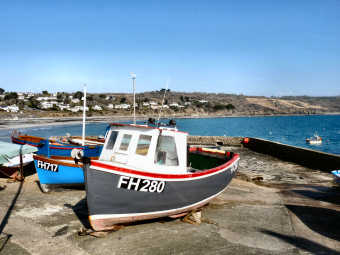
When I posted this report, back in October 2005, I never expected the furious response I received from lovers of Coverack. So, in December 2010, I am updating my report. Personally, and that's what this site is all about, I still don't much like the village. The feeling I get from many visits is of drabness but clearly I am in a minority so I shall now try to be fairer. Many families holiday here year after year and love it. The beach can be more rock than sand, even at low tide, but that varies from year to year. I have often noticed wind-surfers here, the sheltered bay makes a good spot for that. There are several attractive thatched cottages on and off the main street. Views are a bit restricted but are best from Dolour Point. Coverack's one serious claim to fame was its lifeboats which, over the centuries, saved countless lives, many from ships wrecked on the dreaded Manacles reef. In 1898 the SS Mohegan was wrecked there with the loss of 106 lives. The following year American liner SS Paris went aground on Dolour Point but no lives were lost. The village's pleasant pub, the Paris Hotel, commerorates the occasion. Sadly, there is no longer a lifeboat in Coverack and the former lifeboat station is now a restaurant (good reputation for its fish). Harbour Lights caf� is open all year. Below is an email from my first critic, her view supported in 2010 by Matt Tonkins of St. Keverne.

Coverack_Revisited_2017
of Coastal Round Walks, one by Proustock and St. Keverne, the other by Porthkerris, Porthallow and St. Keverne. On Tuesday 8th July 2017 there was heavy overnight rainfall followed by disastrous flooding which was reported even on national television. It may not have been as bad as the notorious Boscastle flood of 2004 but a great deal of damage was done. The large car park and the road into the village were torn up but Cornwall Council and their engineering agency Cormac pulled out all the stops and within a very few days access was fully open again. We felt we should show solidarity so on 1st August we made the almost 2 hour trip (the return took much less time) to Coverack to see how it was faring. The (honesrty box) car park was fully open and you would never guess that the road had been torn torn up only three weeks before. The sun was shining as we walked down into the village and everywhere was looking lovely, far better than my memory of the place. On the way we stopped at Elizabeth's (below left). I had a well filled bacon bap, Jane crab sandwiches - excellent. When I had been in Coverack previously, each time the weather had been dull. and photographs had disapppointed; this time the day was ideal and I got some really good images.

Crantock
Jane and I were in Truro in Mid-October 2017 and, having finished our business early, decided to follow up a news item we had heard on local radio recently and visit the village of Crantock, just to the south-west of Newquay. The news item concerned St. Carantoc's Holy Well and we were able to park close by. The well is right in the centre of the village, in a small enclosure alongside attractive Well Cottage. The well itself has a small wooden door; sad that there was no water. We then walked round to the church, standing in a large graveyard; an abundance of crosses but no old Cornish Crosses. St. Carantoc's is an odd looking church, seemingly added to randomly over the centuries. After such a lowly exterior, the rich interior is a great surprise. As you enter, you face a carved St. Christopher. To your left is a Norman font, heads at each corner. To your right, the rood screen immediately stands out, richly carved. with its rood intact and a curve of painted ceiling above. Sadly, there are no original bench ends, though a gilded one is displayed in the chancel. The minister's stall and choir stalls are attractive. Just a short distance away by a road past the church is Crantock Beach, a vast stretch of pristine sand between Pentire Points East and West, where the Gannel River joins the sea. From May to September a ferry crosses from the Fern Pit cafe on the Newquay side. At low neap tide you can walk along the shore of the river to a wooden footbridge to the Newquay side.