
Coverack_Revisited_2017
of Coastal Round Walks, one by Proustock and St. Keverne, the other by Porthkerris, Porthallow and St. Keverne. On Tuesday 8th July 2017 there was heavy overnight rainfall followed by disastrous flooding which was reported even on national television. It may not have been as bad as the notorious Boscastle flood of 2004 but a great deal of damage was done. The large car park and the road into the village were torn up but Cornwall Council and their engineering agency Cormac pulled out all the stops and within a very few days access was fully open again. We felt we should show solidarity so on 1st August we made the almost 2 hour trip (the return took much less time) to Coverack to see how it was faring. The (honesrty box) car park was fully open and you would never guess that the road had been torn torn up only three weeks before. The sun was shining as we walked down into the village and everywhere was looking lovely, far better than my memory of the place. On the way we stopped at Elizabeth's (below left). I had a well filled bacon bap, Jane crab sandwiches - excellent. When I had been in Coverack previously, each time the weather had been dull. and photographs had disapppointed; this time the day was ideal and I got some really good images.
Elizabeth's Tea Cottage Boats in Coverack Harbour Return to Towns and Villages
Photographs
More in Towns & Villages

Crantock
Jane and I were in Truro in Mid-October 2017 and, having finished our business early, decided to follow up a news item we had heard on local radio recently and visit the village of Crantock, just to the south-west of Newquay. The news item concerned St. Carantoc's Holy Well and we were able to park close by. The well is right in the centre of the village, in a small enclosure alongside attractive Well Cottage. The well itself has a small wooden door; sad that there was no water. We then walked round to the church, standing in a large graveyard; an abundance of crosses but no old Cornish Crosses. St. Carantoc's is an odd looking church, seemingly added to randomly over the centuries. After such a lowly exterior, the rich interior is a great surprise. As you enter, you face a carved St. Christopher. To your left is a Norman font, heads at each corner. To your right, the rood screen immediately stands out, richly carved. with its rood intact and a curve of painted ceiling above. Sadly, there are no original bench ends, though a gilded one is displayed in the chancel. The minister's stall and choir stalls are attractive. Just a short distance away by a road past the church is Crantock Beach, a vast stretch of pristine sand between Pentire Points East and West, where the Gannel River joins the sea. From May to September a ferry crosses from the Fern Pit cafe on the Newquay side. At low neap tide you can walk along the shore of the river to a wooden footbridge to the Newquay side.

Crantock
While so many Cornish villages sadly have little or nothing left of the facilities that villages once had, Crantock retains many of the features that make a village - church, village stores and post office, tea garden and art and craft gallery, and two pubs, the Old Albion and the Cornishman. Oddly church (described and pictured on my Holy Sites page), and pubs are away from the circle that appears to be the village centre; fortunately a sign points down a tiny lane towards them. The circle in question is a small garden, enclosed by hedges. Equally oddly, for such a small village, there are two pubs, the Old Albion and the Cornishman. When I visited the village and church in November 2018, I enjoyed lunch at the Old Albion. From the village a lane leads out to West Pentire headland, another down to quiet, sandy Crantock Beach at the mouth of the Gannel estuary, a lovely spot with a handy large National Trust car park.
Creed
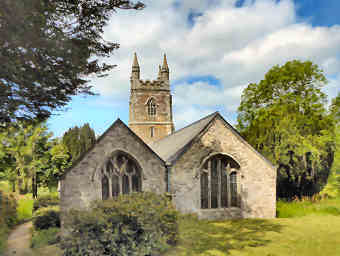
Jane and I visited Creed for an NGS open garden day way back in August 2006. Spotting that the garden opens in mid-June this year, 2016, we decided to make another visit. But first, I decided I would return to re-visit the church and to look around the nearby village of Grampound. I had a fine sunny day for it and was able to get some good photos. Oddly, while you might reasonably expect that tiny Creed, a mile south of Grampound, would be no more than an adjunct to it, it is Creed which is the original settlement, with the major church, while Grampound's church is no more then a Chapel of Ease. There is very little to Creed, just the handsome airy church, the big house, Creed House, and its lodge east of the church, Creed Farm, one of it's barns converted to a dwelling, and a small but handsome old barn with tallet steps abutting the churchyard. Creed House has a pleasant garden with fine specimen trees. I had always known that my father's cousin Bertie had, as Rev. A. E. Coulbeck, been rector of St. Just in Roseland. In 2006 it came as a surprise to me that he had previously been rector here and that Creed House had been his rectory. Notable figures connected with Creed were William Gregory, discoverer of titanium, and Parliamentarian John Hampden who represented Creed and Grampound in the time of Cromwell.