Creed
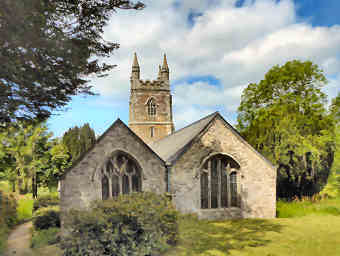
Jane and I visited Creed for an NGS open garden day way back in August 2006. Spotting that the garden opens in mid-June this year, 2016, we decided to make another visit. But first, I decided I would return to re-visit the church and to look around the nearby village of Grampound. I had a fine sunny day for it and was able to get some good photos. Oddly, while you might reasonably expect that tiny Creed, a mile south of Grampound, would be no more than an adjunct to it, it is Creed which is the original settlement, with the major church, while Grampound's church is no more then a Chapel of Ease. There is very little to Creed, just the handsome airy church, the big house, Creed House, and its lodge east of the church, Creed Farm, one of it's barns converted to a dwelling, and a small but handsome old barn with tallet steps abutting the churchyard. Creed House has a pleasant garden with fine specimen trees. I had always known that my father's cousin Bertie had, as Rev. A. E. Coulbeck, been rector of St. Just in Roseland. In 2006 it came as a surprise to me that he had previously been rector here and that Creed House had been his rectory. Notable figures connected with Creed were William Gregory, discoverer of titanium, and Parliamentarian John Hampden who represented Creed and Grampound in the time of Cromwell.
In Grampound, on A390, a small sign points south to Creed
St. Andrew's church, Creed
More in Towns & Villages

Crowan and Clowance
In mid-May 2017 I visited Crowan and Clowance. I had only been here previously when walking the Land's End Trail in 2009 and had not then lingered in either place. This time I was in search of Cornish Crosses. First I visited Crowan Church where I found a cross head on a plinth near the porch. Inside the church the rood stairs are still in place but, of course no rood loft. There is some colourful stained glass and an elaborate St. Aubyn memorial. Down the road towards Clowance is a former mill, still with its water-wheel in place. Then I parked in the car park near Clowance House and spent a couple of hours walking the estate, primarily in search of more Cornish Crosses. There are three stone crosses, one near the Golf View Apartments, one behind cabin number 17 and a third, sadly invisible, on an island in the lake. By the path, to the north-west of the lake, a sign explains the Cornish Crosses and has a few words about Cornish saints, too. I walked around the lake and took photos of its little boathouse. There is an entertaining feature in the grounds to the west of the house: a Greek temple, one side of it a chess board, the other draughts.
Devoran
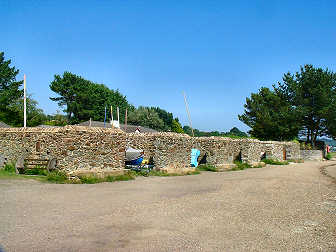
A charming village, tucked quietly away from the busy Truro to Falmouth road, Devoran's present belies its past. Now a quiet and beautiful creek-side village, boasting a fair number of small-boat sailors, Devoran was once a busy commercial port, shipping copper ore from mines on the Great Flat Lode around Redruth, linked by the horse drawn Redruth and Chacewater Railway, now part of a Coast to Coast trail. When you see how the creek has silted up - ironically with mine spoil - it is hard to imagine how any cargo boats ever got as far as Devoran - let alone Bissoe further upstream. The old village is a triangle of streets, Quay Street and the higher St. John's Terrace linked by Market Street. Along Quay Street several homes are interesting conversions of old warehouses or of former port worker's cottages. On the Quay, a series of odd stone enclosures are the old ore hutches where the copper ore awaited shipment. West down Restronguett Creek there are some mining related remains and at low tide you can see an odd causeway of stepping stones. The Old Quay Inn has an enjoyable local atmosphere; food is fairly ambitious gastro-pub. We have eaten there on several occasions and have always liked it. If there is no space in the pub's car park, you should be able to park by the village hall at the start of Quay Street. A round walk from Devoran
Duloe
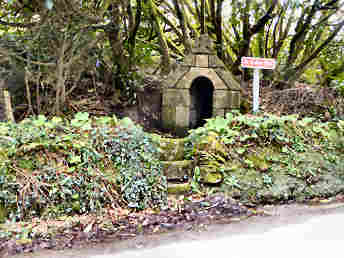
Unusually, this entry appears on three different pages: here under towns and villages but also on my antiquities page and my churches and holy places page. The reason is that, for such a small village, there is so much variety of interest. The form of the church, while not unique to Cornwall, is most unusual. It consists of nave, north aisle, south transept and a strange leaning tower attached to the south transept. The tower was once taller but the top stage was replaced by a pyramidal roof in the 19th century. It leans northwards at a sharper angle than the Leaning Tower of Pisa; fortunately the rest of the church holds it up. Inside, behind an elaborate parclose screen, possibly made from the former rood screen, the chancel aisle was built as the Colshull family chapel and contains Sir John Colshull's tomb, his recumbent effigy on it, and several elaborate slate memorials. The rood loft may be gone but the stair and loft doors remain. About 600 yards south of the church, alongside the road to Looe, is St. Cuby's Holy Well. What is claimed to be his original font was moved from the well site and now stands in the church. A few yards north of the church a sign directs you to Duloe Stone Circle, a small circle of 8 stones, believed by some once to have enclosed a cairn. A storyboard, somewhat weathered, stands by the hedge behind the circle.