Duloe
Unusually, this entry appears on three different pages: here under towns and villages but also on my antiquities page and my churches and holy places page. The reason is that, for such a small village, there is so much variety of interest. The form of the church, while not unique to Cornwall, is most unusual. It consists of nave, north aisle, south transept and a strange leaning tower attached to the south transept. The tower was once taller but the top stage was replaced by a pyramidal roof in the 19th century. It leans northwards at a sharper angle than the Leaning Tower of Pisa; fortunately the rest of the church holds it up. Inside, behind an elaborate parclose screen, possibly made from the former rood screen, the chancel aisle was built as the Colshull family chapel and contains Sir John Colshull's tomb, his recumbent effigy on it, and several elaborate slate memorials. The rood loft may be gone but the stair and loft doors remain. About 600 yards south of the church, alongside the road to Looe, is St. Cuby's Holy Well. What is claimed to be his original font was moved from the well site and now stands in the church. A few yards north of the church a sign directs you to Duloe Stone Circle, a small circle of 8 stones, believed by some once to have enclosed a cairn. A storyboard, somewhat weathered, stands by the hedge behind the circle.
Duloe is on B3254, about 4 miles south of A38 at Liskeard
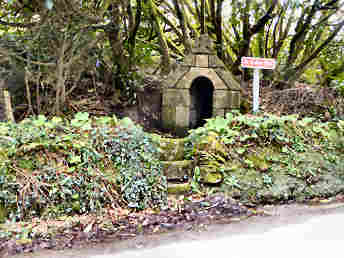
St. Cuby's Holy Well on the road to Looe
More in Towns & Villages
East and West Portholland
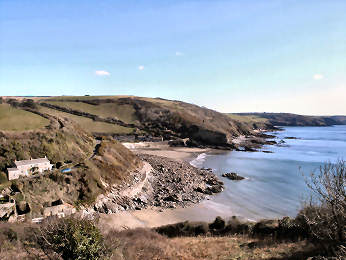
Portholland
Falmouth
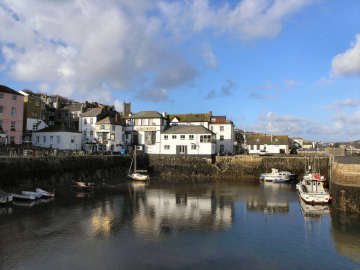
There are really several distinct Falmouths. Approaching from the north, first the boatyards and marinas of Penryn, once a separate fishing village. Next Dunstanville Terrace, its grand sea captains' homes looking across the water to Flushing. Next the much improved cobbled High Street leads to the diminished interest of Market Street and up-and-coming Church Street, its shops improving. Then opposite the Tudor manor of the Killigrews is a vast timber shed, looking to Flushing and across Carrick Roads to St. Mawes; this is the superb Maritime Museum, beyond it the dockyard. Next is fortified Falmouth, Pendennis Castle high on its headland. Finally, the sandy beaches of resort Falmouth, lined with hotels and apartments. A good Art Gallery is near High Street in the centre of town. What surprises about Falmouth is that, despite the world's third largest natural harbour and its ideal situation for international shipping, there was no such place until the 17th century. There were just three small settlements - with Penryn to the north, the Killigrew manor of Arwennack below Pendennis Head, and Henry VIII's Pendennis Castle. But when Falmouth grew it grew fast and by 1688 was the main Packet Ship port. The port declined with the advent of steam but from 1863 the railway brought tourists. Now cruise ships take advantage of the deep water to anchor here.

Feock
Pill Creek