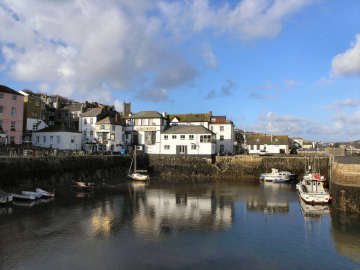
Falmouth
There are really several distinct Falmouths. Approaching from the north, first the boatyards and marinas of Penryn, once a separate fishing village. Next Dunstanville Terrace, its grand sea captains' homes looking across the water to Flushing. Next the much improved cobbled High Street leads to the diminished interest of Market Street and up-and-coming Church Street, its shops improving. Then opposite the Tudor manor of the Killigrews is a vast timber shed, looking to Flushing and across Carrick Roads to St. Mawes; this is the superb Maritime Museum, beyond it the dockyard. Next is fortified Falmouth, Pendennis Castle high on its headland. Finally, the sandy beaches of resort Falmouth, lined with hotels and apartments. A good Art Gallery is near High Street in the centre of town. What surprises about Falmouth is that, despite the world's third largest natural harbour and its ideal situation for international shipping, there was no such place until the 17th century. There were just three small settlements - with Penryn to the north, the Killigrew manor of Arwennack below Pendennis Head, and Henry VIII's Pendennis Castle. But when Falmouth grew it grew fast and by 1688 was the main Packet Ship port. The port declined with the advent of steam but from 1863 the railway brought tourists. Now cruise ships take advantage of the deep water to anchor here.
Falmouth's tranquil inner harbour
Ferries operate to St. Mawes, Flushing, Trelissick and Truro
More in Towns & Villages

Feock
Pill Creek
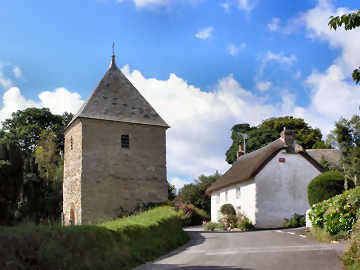
Feock on the broad River Fal
When I started this entry I couldn't claim to have explored Feock properly, having just stopped off briefly on my way to Trelissick for a Fal Creek walk. However, I returned in late September 2016 for a more thorough exploration. The village proper is inland; to its south is Loe Beach with seasonal parking, a slipway and a seasonal beach caf�. To the west, with a small car park above, is Pill Point, about the only public access to the expensive looking Pill Creek. Above Feock church, said to have been founded by St. Feoca, are its detached bell tower, some attractive white painted cottages and a book exchange in the old phone box. Beyond the church is the Old Vicarage, now a private home. There are upper and lower lych gates - the lower has a room above it - a massive yew by the east end and a fine Cornish Cross by the porch. Inside the church are hatchments of local notable families, a 12th century font of blue Cataclews stone, a wall banner of a 1576 map of Cornwall, a low marble (or alabaster) chancel screen, a carved wooden pulpit, a colourful chancel ceiling and an elaborat reredos. A charming village (there is actually much more of it, very expensive looking) with an equally charming church and churchyard, well worth a visit. Leaving Feock, I took a wrong turn looking for Kea and spotted an old toll house just off the Playing Place roundabouts.
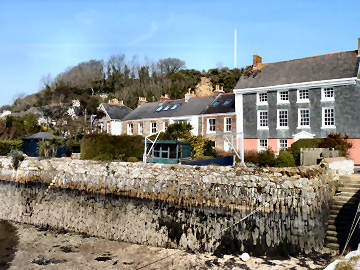
Flushing
Originally called Nankersey, the village acquired its present name when Dutch engineers were employed to build the village’s quays. They were from Vlissingen, known to the British as Flushing. Oddly there is another Flushing on Gillan Creek south of Falmouth; no connection is known. This Flushing is an attractive village with some big houses on St. Peter’s Hill and Trefusis Street, many once the homes of Falmouth ship’s captains, now probably homes of commuters to Falmouth or Truro. One such, Rockside on Trefusis Street, looks like a handsome Georgian house but, according to Pevsner, it is a converted warehouse. Flushing is very much a small boat sailing village and an important annual regatta week is held in summer, complete with swimming and bath-tub racing as well as sailing. According to Wikipedia Henry VIII had planned to build a castle on Trefusis Point to complement those at St. Mawes and Pendennis in guarding Falmouth but never did. Flushing is no longer the fishing village it once was but there are still a few commercial boats. And, sadly, many of the houses are now, like so many in Cornwall’s more attractive villages, used as second homes. Happily there are still two pubs, the Royal Standard and the Seven Stars, and there is a nicely located restaurant on The Quay, the Waterside with tables outside. The Trefusis Estate, in which you walk much of the way to Mylor Churchtown, is part of Devon-based Clinton Estates; the Trefusis family holds the title Baron Clinton. St. Peter's Church