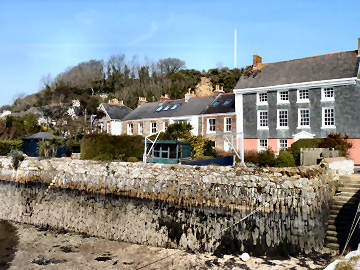
Flushing
Originally called Nankersey, the village acquired its present name when Dutch engineers were employed to build the village’s quays. They were from Vlissingen, known to the British as Flushing. Oddly there is another Flushing on Gillan Creek south of Falmouth; no connection is known. This Flushing is an attractive village with some big houses on St. Peter’s Hill and Trefusis Street, many once the homes of Falmouth ship’s captains, now probably homes of commuters to Falmouth or Truro. One such, Rockside on Trefusis Street, looks like a handsome Georgian house but, according to Pevsner, it is a converted warehouse. Flushing is very much a small boat sailing village and an important annual regatta week is held in summer, complete with swimming and bath-tub racing as well as sailing. According to Wikipedia Henry VIII had planned to build a castle on Trefusis Point to complement those at St. Mawes and Pendennis in guarding Falmouth but never did. Flushing is no longer the fishing village it once was but there are still a few commercial boats. And, sadly, many of the houses are now, like so many in Cornwall’s more attractive villages, used as second homes. Happily there are still two pubs, the Royal Standard and the Seven Stars, and there is a nicely located restaurant on The Quay, the Waterside with tables outside. The Trefusis Estate, in which you walk much of the way to Mylor Churchtown, is part of Devon-based Clinton Estates; the Trefusis family holds the title Baron Clinton. St. Peter's Church
From Penryn, on old A39 follow signs for Flushing
Trefusis Street in Flushing
More in Towns & Villages
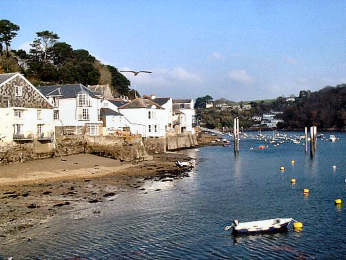
Fowey
An attractive small town with very narrow streets and a one-way system. However, its quaint and scenic attractions are less easy to enjoy than those of St. Ives and St. Mawes, comparably pretty waterside towns. While they both cluster around a harbour and have walkable waterfronts, Fowey has no harbour as such but depends on its deep tidal river. And while St. Ives and St. Mawes face the water, Fowey's buildings back on to the river and almost nowhere can you walk by the water. There are attractive shops in Fore, North and Lostwithiel Streets and pretty alleyways climb the steep hill. Of the several pubs, the King of Prussia is best known and there are now some boutique hotels. The town has a long maritime history. In medieval times it provided ships for the Crusades and for the wars with the French. Henry VIII considered it of sufficient importance to fortify it with a pair of castles and a chain across the River Fowey. Now there are yachts, fishing boats and a china clay terminal up-river and, thanks to the deep water of the Fowey River, cruise ships visit occasionally. A major regatta takes place in August. Don't expect to park in the centre, instead follow car park signs on the periphery and be prepared to walk. A round walk - Lantic Bay and Polruan

Golant
I first encountered Golant many years ago, at a time when Jane and I were first looking for a home in Cornwall, she as a returnee, I as an incomer. Then we stayed at the Cormorant Hotel, in a room overlooking the Fowey River. And not just the river: A railway passed in front of the hotel as well, carrying china clay to the deep-water terminal on the river just north of the Fowey to Bodinnick ferry. I next encountered Golant when walking the Saints Way, a thirty mile walking route from Padstow on the north coast to Fowey on the south. Golant is a slightly odd place, its church way out of the village, almost half-a-mile north up a steep hill. Golant itself is a sailing place with two pools separated from the river by the railway line; to get to the river proper boats have to pass under the railway. The Fishermans Arms is a pleasant pub, with views over the river, where I have enjoyed lunch when walking the Saints Way. Their online menu looks attractive, comprehensive and reasonably priced featuring, at lunchtime, Cornish pasties, burgers, sandwiches, panini and ploughmans. There is a Kayak hire business, a cafe and two art galleries, not bad for a village with a population of little more than 200.

Golden
I would never have thought of visiting Golden, were it not that, when operating my touring business for visiting Americans, I drove Kenneth and Anne Golden from San Diego, California. His Morley ancestors were from Minstead in the New Forest and I took them there. By remarkable coincidence, not far from MInstead was a Golden Farm but there was no connection. Kenneth believed that his Golden ancestors were from Cornwall but had no idea where. This tiny hamlet must have been his ancestors' Cornish home. Golden is an odd and unexpected little place. A sign on the road from Grampound Road to Tregony points to Golden Mill. On the way down the hill, first comes Golden, consisting of Golden Manor Farm, its farmyard and a massive former chapel, now used as a barn. At the bottom of the hill, just before you come to the little River Fal, is Golden Mill itself with a range of buildings, including Manor Farm Cottage and some handsome barns. One barn, with the "Vicar and Spaniel" sign in the photo below, may have been the miller's house and is now where the hunt takes its refreshments. This is all part of the Galsworthy's Trewithen Estate and is a centre for the Trewithen Hunt. There is a large car park used by the hunt on shoot days, when the game is pheasant - and all sorts of wildfowl, as well as woodcock and partridge.