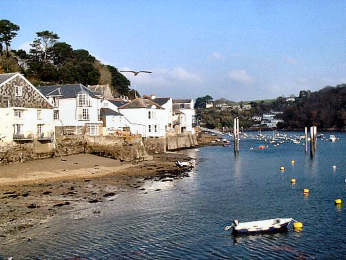
Fowey
An attractive small town with very narrow streets and a one-way system. However, its quaint and scenic attractions are less easy to enjoy than those of St. Ives and St. Mawes, comparably pretty waterside towns. While they both cluster around a harbour and have walkable waterfronts, Fowey has no harbour as such but depends on its deep tidal river. And while St. Ives and St. Mawes face the water, Fowey's buildings back on to the river and almost nowhere can you walk by the water. There are attractive shops in Fore, North and Lostwithiel Streets and pretty alleyways climb the steep hill. Of the several pubs, the King of Prussia is best known and there are now some boutique hotels. The town has a long maritime history. In medieval times it provided ships for the Crusades and for the wars with the French. Henry VIII considered it of sufficient importance to fortify it with a pair of castles and a chain across the River Fowey. Now there are yachts, fishing boats and a china clay terminal up-river and, thanks to the deep water of the Fowey River, cruise ships visit occasionally. A major regatta takes place in August. Don't expect to park in the centre, instead follow car park signs on the periphery and be prepared to walk. A round walk - Lantic Bay and Polruan
Fowey Waterfront
Signed from A390 from just west of Lostwithiel. More Fowey
There are also many literary associations. Kenneth Graham is said to have gained inspiration for 'Wind in the Willows' here whilst guest of Sir Arthur Quiller-Couch. Daphne du Maurier stayed at Ferryside House in Bodinnick and lived at three rented homes (one was Menabilly, her 'Manderley'). A Du Maurier Festival is held in May
Although I have been in Fowey many times since the above report, in April 2016 I decided it was time to revisit with a view to producing a further report. Here it is. I parked at Caffa Mill, where the Bodinnick ferry leaves from, much eassier to use than Fowey's other car parks. I was amused by the promotional hoardings for a new apartment development now being constructed on the north side of the car park. It promotes itself as having "beautiful estuary views". I hope someone like the Advertising Standards Authority will take Acorn Blue Developments to task over that: At that point the Fowey is river not estuary and, except from the upper floors, the view will be of the car park. I enjoyed wandering along Passage, North and Fore Streets to reach the heart of town. I admired the old buildings including Scallop Shell House (the former Post Office), the Well House, Noah's Ark, the Town Hall, the King of Prussia pub and the Ship Inn. I spent some time in St. Nicholas church (also dedicated to St. Fimbarrus) and admired the screen, the pulpit, the font, some fine bench ends, John Rashleigh's tomb and other Rashleigh memorials. Outside, high on the wall to the left of the porch, I spotted the head of, I think, a bearded fisherman. I ate my sandwiches on Town Quay, watching the activity on the water, then enjoyed coffee in the Galleon.
St. Nicholas (or Fimbarrus) church
Photographs
More in Towns & Villages

Golant
I first encountered Golant many years ago, at a time when Jane and I were first looking for a home in Cornwall, she as a returnee, I as an incomer. Then we stayed at the Cormorant Hotel, in a room overlooking the Fowey River. And not just the river: A railway passed in front of the hotel as well, carrying china clay to the deep-water terminal on the river just north of the Fowey to Bodinnick ferry. I next encountered Golant when walking the Saints Way, a thirty mile walking route from Padstow on the north coast to Fowey on the south. Golant is a slightly odd place, its church way out of the village, almost half-a-mile north up a steep hill. Golant itself is a sailing place with two pools separated from the river by the railway line; to get to the river proper boats have to pass under the railway. The Fishermans Arms is a pleasant pub, with views over the river, where I have enjoyed lunch when walking the Saints Way. Their online menu looks attractive, comprehensive and reasonably priced featuring, at lunchtime, Cornish pasties, burgers, sandwiches, panini and ploughmans. There is a Kayak hire business, a cafe and two art galleries, not bad for a village with a population of little more than 200.

Golden
I would never have thought of visiting Golden, were it not that, when operating my touring business for visiting Americans, I drove Kenneth and Anne Golden from San Diego, California. His Morley ancestors were from Minstead in the New Forest and I took them there. By remarkable coincidence, not far from MInstead was a Golden Farm but there was no connection. Kenneth believed that his Golden ancestors were from Cornwall but had no idea where. This tiny hamlet must have been his ancestors' Cornish home. Golden is an odd and unexpected little place. A sign on the road from Grampound Road to Tregony points to Golden Mill. On the way down the hill, first comes Golden, consisting of Golden Manor Farm, its farmyard and a massive former chapel, now used as a barn. At the bottom of the hill, just before you come to the little River Fal, is Golden Mill itself with a range of buildings, including Manor Farm Cottage and some handsome barns. One barn, with the "Vicar and Spaniel" sign in the photo below, may have been the miller's house and is now where the hunt takes its refreshments. This is all part of the Galsworthy's Trewithen Estate and is a centre for the Trewithen Hunt. There is a large car park used by the hunt on shoot days, when the game is pheasant - and all sorts of wildfowl, as well as woodcock and partridge.
Gorran Haven and Gorran Churchtown
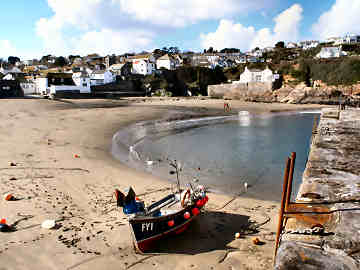
Jane and I had been here in 2002 on a round walk from Porthluney Cove. Then we thought little of Gorran. I repeated the walk in March 2008 and lingered long enough to revise my impressions somewhat. Gorran Haven is attractive with nice old fishing related buildings clustered around the harbour. Facing south-east, the harbour dries out at low tide and provides a safe bathing beach with a seasonal caf�. Some narrow old streets climb the hill from the harbour and there is a lot of recent development beyond. Undoubtedly many of the houses are second homes and holiday rentals. On the way up the hill is the little St. Justus Church, a chapel of ease once used as a fish cellar and net store. Further up, the former Llawnroc Inn is now the boutiquey Lawnwroc Hotel. Keep going for another mile and you come to Gorran Churchtown. Here is the Barley Sheaf Inn (restored and re-opened 2012 by a descendant of the 1837 founder) and the handsome St. Goran's Church. St. Goran (or Goranus) is probably the Guron of Bodmin, who moved here when St. Petroc arrived there. His 13th to 15th century church is typically Cornish with its crenellated and pinnacled porch, a fine collection of original bench ends and some good modern wood carvings. Outside there is an unexpected vault dated WSG 1813 and, when I was there, a lovely display of daffodils.