
Manaccan
Although the Lizard is the best part of an hour and a half's journey from Wadebridge I decided it was high time I visited and reported on several churches down there. I was in Manaccan and St. Anthony in mid February 2019. In addition to these I propose to report on Mawgan-in-Meneage and St. Martin-in-Meneage. An odd word "Meneage", it means "Monk's land" so would have been the property of a monastic settlement. Manaccan is a pleasant small village on a hill not far from the eastern end of Gillan Creek. At one time the village had pub, shop and post office. All closed in 2014 but, in a remarkable show of co-operation, the villagers got together to save and re-open the pub. After some more ups and downs, the New Inn is open again and is a pleasant spot, serving good food; on an adjacent wall are mounting steps. A couple of hundred yards away is St. Manacca's church. The first thing you notice is a fig tree growing out of the west end of the south wall, believed to be 250 years old and surely unique in Cornwall. The next thing you notice is the unusual south doorway, essentially Norman although the arch above has been remodelled. Inside is a plain font, believed by Pevsner to be a late-medieval copy of a Norman original. Stained glass appears medieval but is late Victorian. A simple pulpit may be 20th century. In the chancel two chairs are made from 15th century timber, taken from the former rood screen. A surprise is the carved and colourful ceiling bosses, undoubtedly modern since they include a butterfly and a terrier.
Manaccan , St. Manacca's Church
New Inn, Manaccan
Photographs
More in Towns & Villages
Marazion
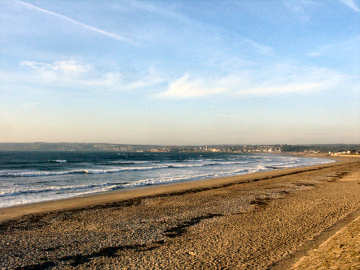
Marazion is not a place you pass through on the way to anywhere. So all who go there do so for a purpose. Mostly that purpose is to visit Saint Michael's Mount or to enjoy the beach with its view of the Mount and of the broad sweep of Mount's Bay. But Marazion is an interesting place in its own right. A narrow main street curves down from the east, from the Helston to Penzance main road, petering out soon after it passes the main car park. Along its way are attractive cottages, a charming small square, a couple of pubs, tearooms, shops (including Philps Bakery, renowned for its pasties), and several art and craft galleries. Pubs are the Godolphin Arms, also a hotel, and the King's Arms. We enjoy the view from the bar of the Godolphin but find it impersonal. We far prefer the cozy King's Arms with its friendly welcome and good value food. Marazion has a remarkable history and may be one of Britain's oldest towns. It and St. Michael's Mount may have been known to the Romans, who would have traded for tin here, as Ictis, though some authorities dispute this. The major town of West Cornwall, from 1170 it returned two members to Parliament. It was incorporated by royal charter in 1257, a charter reaffirmed by Elizabeth I in 1595. Its importance is seen in its two former markets, the marhas vean (little market) and marhas yow (Thursday market), the latter giving the town its name.
Marhamchurch
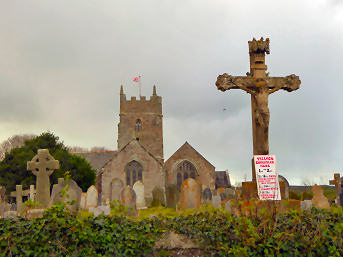
A couple of miles south-east of Bude, Marhamchurch is a fairly large village of some 700 souls. It stands at the top of a long hill which mirrors the line of the former Bude Canal inclined plane. The broad main street seems to have no name. There is a primary school, a church, a shop, the Bullers Arms pub, and attractive cottages near the church. I was first there when exploring the route of the old Bude Canal, which ran for 10 miles from Lower Tamar Lake to Bude; a very pleasant walk, interrupted here and there where the canal has been lost to private land. On this occasion I went to look at the church. It consists of nave, aisle, transepts and three-stage pinnacled tower. A simple lych gate, with a pyramidal slate roof, leads to the church. Inside are typically Cornish wooden barrel vault ceilings with carved bosses, a wooden pulpit with an unexpected tester, and a large Royal Coat of Arms. The wooden roof of the north aisle is 15th century, the others 19th century. There is a fine 17th century pulpit with tester. The Royal Coat of Arms is large and of plaster work. In the main street, the Bray Institute is in Arts and Crafts style and a former National School incorporates granite doorways from demolished almshouses.. Cottages near the church are attractive.

Mawgan-in-Meneage
Meneage