Marhamchurch
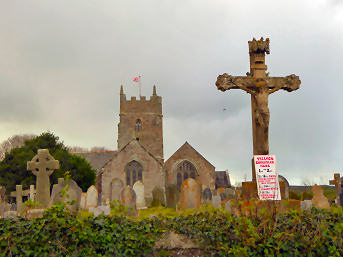
A couple of miles south-east of Bude, Marhamchurch is a fairly large village of some 700 souls. It stands at the top of a long hill which mirrors the line of the former Bude Canal inclined plane. The broad main street seems to have no name. There is a primary school, a church, a shop, the Bullers Arms pub, and attractive cottages near the church. I was first there when exploring the route of the old Bude Canal, which ran for 10 miles from Lower Tamar Lake to Bude; a very pleasant walk, interrupted here and there where the canal has been lost to private land. On this occasion I went to look at the church. It consists of nave, aisle, transepts and three-stage pinnacled tower. A simple lych gate, with a pyramidal slate roof, leads to the church. Inside are typically Cornish wooden barrel vault ceilings with carved bosses, a wooden pulpit with an unexpected tester, and a large Royal Coat of Arms. The wooden roof of the north aisle is 15th century, the others 19th century. There is a fine 17th century pulpit with tester. The Royal Coat of Arms is large and of plaster work. In the main street, the Bray Institute is in Arts and Crafts style and a former National School incorporates granite doorways from demolished almshouses.. Cottages near the church are attractive.
St. Marwenna's Church
Signed from A39 at Helebridge
Mawgan-in-
More in Towns & Villages

Mawgan-in-Meneage
Meneage
Menheniot
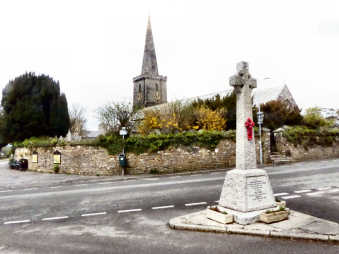
I only discovered Menheniot [the name means Hyniet's land according to Craig Weatherhill, St. Neot's place according to Julyan Holmes - take your choice] towards the end of April 2016. Jane wanted to see an exhibition of Norman Hartnell's designs and materials, being held in the church. I drove her there and quite liked the look of the village so, a week later, I had an outing to explore the village. It was a dull day so photos were disappointing but I still enjoyed the village. There are some good homes and cottages: I particularly liked the Poads Trust cottages and the old Police Station. The church is typically Cornish in that it has nave and two aisles, Perpendicular windows and fine wagon roofs with carved bosses. Less typical is the spire, not seen on many Cornish churches, set on a tower old than the body of the church. Sadly, inside little that is original remains thanks to over zealous Victorian restoration. However, the font, of Caen stone, is medieval and a brass by the pulpit dates from 1386, perhaps Cornwall's oldest. Memorials mostly commemorate Trelawneys. The churchyard is of little interest - no Cornish Crosses - but does contain a grand Vestry building. There is, apparently a holy well to the south of the church but somehow I missed it.
Merrymeet and St. Ive
St. Ive