Old Kea
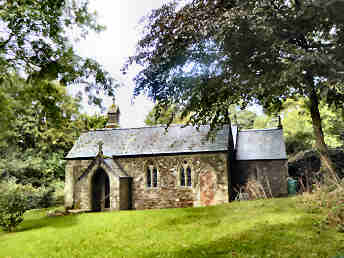
Late in September 2016 I made an expedition to the other side of Truro to look at Loe Beach, Feock village and church, Old Kea and Kea, tha latter two no more than hamlets. Loe Beach may sound promising but is a great disappointment. In season, a car park, caf� and slipway; out of season, a boat park, no car park or caf�, and a poor quality beach. It is saved only by views down Carrick Roads. Old Kea, however, is well worth a visit. It consists only of Churchtown Farm, the ivy-clad tower of the former medieval church, and a charming small Victorian church in the photo to the left. Outside the porch is the shaft of an old Cornish Cross. The free-standing tower is all that remains of a monastery, founded in the 13th century on the site of St. Kea's original monastery, and then important enough that its 7000 acre estate extended to Baldhu, Chacewater and Scorrier. Inside is a simply carved early font and a newly (October 2016) dedicated stained glass window in the tiny chancel. This is a charming spot, well off the beaten track. I first encountered it in the course of a Fal Creeks walk from the National Trust''s Trelissick estate. Kea: Kea church was a disappointment. I was unable to gain access to the Victorian building (a notice in the porch said "Welcome", so why was the door firmly locked). The exterior has little to commend it, except for an attractive lead-covered spire, unusual for Cornwall.
Charming little Old Kea Church
From A39 S of Truro, difficult turn E to Porth Kea and Old Kea
More in Towns & Villages
Padstow
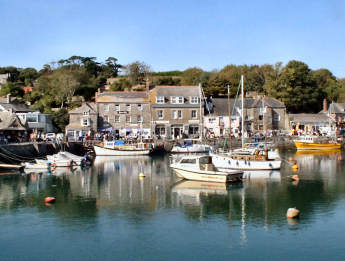
To first-time visitors this may perhaps seem like unchanging Cornwall. But to Jane, remembering Padstow from the 1940s, things have changed greatly. The railway has gone - it's now a hiking and cycling trail; restaurants and shops concentrate on tourists; foodies have arrived, enticed by Rick Stein's seafood empire. Fishing boats do still land their catches (though much of it is exported) and the restaurants specialise in seafood. The views across the Camel estuary are to the village of Rock and a little landing craft type ferry carries hikers and holiday makers. Cream teas are all you expect; try the lounge of the Metropole. Some of the Cornish pasties are good, too, especially at the Chough bakery by the harbour and at Rick Stein's delicatessen. Wander around narrow, steep streets; walk up the hill behind the town to visit the 'great house', Prideaux Place. For all this, we no longer much like Padstow. In the season it heaves with people and cars; out of season it seems deserted, caf�s and restaurants closed, many shops deserted. Thanks to second homers, housing is very expensive so less and less native Padstonians actually live there. It should be a lovely small harbour town but now it disappoints us. The Camel Trail starts here, offering cyclists an 18 mile trail to Wenford Bridge on level hard surfaces. The Saints Way also starts here - 30 miles to Fowey.
Paul
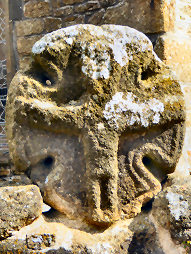
Paul tends to be ignored by visitors, inland as it is from well known destinations such as Penzance, Newlyn and Mousehole. The first three things that strike you are the uncovered lych gate, the Cornish Cross head to the left of it and the memorial to Dolly Pentreath of Mousehole who died in 1777 and was believed to be the last person to speak Cornish as a first language. Inside there is a reasonable amount of interest. The font is unusual with octagonal base and square bowl supported by four slim pillars. The octagonal pulpit is unusual, too, entirely of carved stone and supported on slim stone pillars. Box pews are unexpected though disappointingly there are no carved bench ends. However the lectern is quite striking with its carved wood and angel finials. The screen between chancel and aisle is unusual, its centrepiece depicting the 1595 Spanish raid on Penzance, Mousehole and Paul. There is an elaborate memorial to Captain Stephen Hutchens and another to Lieutenant General Robyns. Opposite is a large car park, at one end of it the Kings Arms where we enjoyed coffee. A path off the car park leads to the former graveyard, now a pleasant spot with views to Mount's Bay and St. Michael's Mount.

Pelynt
Pelynt - the name is said to mean "the parish of St. Non" - straddles the fairly busy B3359 to Looe. Witrh a couple of exceptions, there is little of interest to be found within the village. The first exception is the church, perched high on what may be an ancient site. Outside the churchyard, a tiny patch of green, proclaiming itself to be the "village green", bears a modern Cornish Cross, celebrating the millennium, as does a clock on the southern face of the tower. Due to its dour exterior, I had little expectation of the interior of the church. I was pleasantly surprised, thanks to the Trelawney Chapel, filled with memorials to the famous local family from Trelawne. Trelawneys had strong royal and church connections, counting a Bishop and a Governor of Jamaica among their number - as well as a Caribbean pirate. My favourite Trelawney epitaph is that to Edward Trelawney: "Here lyes an honest lawyer, wot you wat, a thing for all the world to wonder at." Also noteworthy are a Buller memorial and several more Trelawney memorials. As you enter, a striking and unusual stained glass window faces you. Nearby is a damaged Cornish Cross. At the other end of the village is the pleasant Jubilee Inn, where I enjoyed an excellent doorstep bacon sandwich. A mile or so to the south-east is Trelawne, once home to the Trelawneys. Dour looking, it is in a sad state, its grounds now occupied by a large holiday park.