
Pelynt
Pelynt - the name is said to mean "the parish of St. Non" - straddles the fairly busy B3359 to Looe. Witrh a couple of exceptions, there is little of interest to be found within the village. The first exception is the church, perched high on what may be an ancient site. Outside the churchyard, a tiny patch of green, proclaiming itself to be the "village green", bears a modern Cornish Cross, celebrating the millennium, as does a clock on the southern face of the tower. Due to its dour exterior, I had little expectation of the interior of the church. I was pleasantly surprised, thanks to the Trelawney Chapel, filled with memorials to the famous local family from Trelawne. Trelawneys had strong royal and church connections, counting a Bishop and a Governor of Jamaica among their number - as well as a Caribbean pirate. My favourite Trelawney epitaph is that to Edward Trelawney: "Here lyes an honest lawyer, wot you wat, a thing for all the world to wonder at." Also noteworthy are a Buller memorial and several more Trelawney memorials. As you enter, a striking and unusual stained glass window faces you. Nearby is a damaged Cornish Cross. At the other end of the village is the pleasant Jubilee Inn, where I enjoyed an excellent doorstep bacon sandwich. A mile or so to the south-east is Trelawne, once home to the Trelawneys. Dour looking, it is in a sad state, its grounds now occupied by a large holiday park.
Pelynt Church and Millenium Cross
Pelynt is on the B3359 to Looe
SONG OF THE WESTERN MEN: Parson Stephen Hawker wrote his famoue "Song of the Western Men" about the trials and tribulations of Bishop Jonathan Trelawney.
More in Towns & Villages
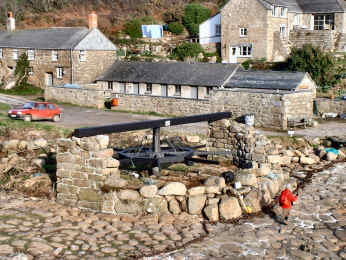
Penberth Fishing Cove
The National Trust, which owns so much of Cornwall's coastline, also owns the little hamlet of Penberth and its fishing cove. A cluster of cottages, owned by the Trust but leased to fishermen, surrounds the cove and small fishing boats are drawn up on the slipway by electric winch. In the old days they were pulled up by hand operated capstan. The Trust has restored the capstan but it is no longer in use. The old fish cellars are still there but superseded by a modern store built by the Trust. Above the cove small fields, protected by hedges of willow, hawthorn and escallonia, remind you of the daffodil fields of Scilly; at one time the fishermen supplemented their summer living by growing daffodils, violets and early potatoes - sadly no longer. These things may have changed but the fishing hasn't except that the boats are now motorised. The main catch is crab and lobster but bass and mackerel are still caught by hand-line. It is a delightful spot and one of the most photographed in Cornwall. Although a lane runs down from Treen village, there is little or no parking. Park in the privately owned car park in Treen and take a footpath for the half-mile to the cove. There is great walking west along the cliffs to Porthcurno. Along the way are Treen Cliffs, Treryn Dinas, an iron age cliff castle, and the famous Logan Rock.
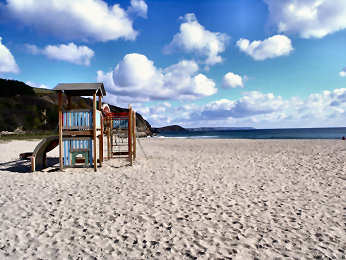
Pentewan, its Trailer Park and its Unexpected Industrial History
Imagine my surprise, walking through Pentewan for the first time, to discover a historic port and more. From early times the stone quarries supplied such homes as Antony with superb silvery grey stone. A small fishing port, at the mouth of the St. Austell River, it came to handle cargoes of tin, stone, sand and grain. A proper harbour was constructed in 1744 and it was the first port to handle the local china clay. However, when the Rashleighs built their new port at nearby Charlestown in 1801, Pentewan's Hawkins family owners struggled to keep it open, eventually closing. The harbour remains intact and still has its sea-lock but access to the sea is blocked. Remains of industrial buildings moulder to the south of the harbour. Substantial houses and cottages line the main street. Walk up Pentewan Hill and follow the coast path sign to find the colonial looking Terrace and a Georgian church. Behind the beach is a large and orderly looking holiday trailer park. The beach, owned by the holiday park, is private but public access is granted. The Ship Inn is a pleasant place, with simple good value food, but gets busy from the holiday park in summer. Two cafes in the village, one in the holiday park. The Pentewan Valley Trail follows the White River
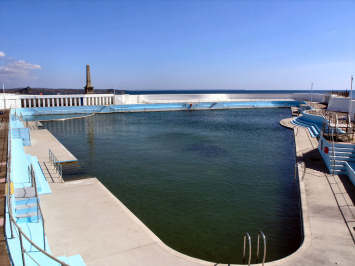
Penzance
First developed as a resort in Victorian times, first impressions suggest that Penzance is not generally very attractive. However, stray into the streets between the main shopping street and the seafront and you will discover that there are parts well worth seeking out. Chapel Street is known for its art galleries and antique shops and for its attractive Georgian homes and shops - do not miss the Egyptian House and the Admiral Benbow Inn. At the top of Chapel Street the old Market Hall is now a bank; outside stands a statue of Humphrey Davy, inventor of the miners' safety lamp. He looks down Market Jew Street, corruption of the Cornish Marghas Yow or Thursday Market. Morrab Road and the small streets at its north end are charming as is Regent Terrace and Western Promenade, part of the seafront. If you like the Newlyn School artists, you should visit Penlee House Gallery near the top of Morrab Road, a first class art gallery and small museum with regularly changing exhibitions and a fine core permanent collection; also take a look at sub-tropical Morrab Gardens nearby; ther's a Cornish Cross there. If your taste in art is more modern, try the Exchange Gallery in the former telephone exchage building. A passenger ferry operates from Penzance to the Isles of Scilly and Skybus flies from Newquay and Land's End. Sadly the helicopter service to Tresco finished at the end of October 2012.