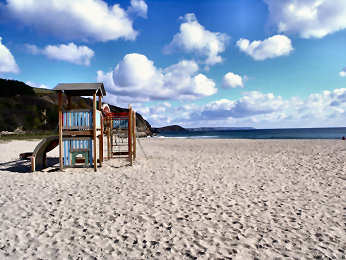
Pentewan, its Trailer Park and its Unexpected Industrial History
Imagine my surprise, walking through Pentewan for the first time, to discover a historic port and more. From early times the stone quarries supplied such homes as Antony with superb silvery grey stone. A small fishing port, at the mouth of the St. Austell River, it came to handle cargoes of tin, stone, sand and grain. A proper harbour was constructed in 1744 and it was the first port to handle the local china clay. However, when the Rashleighs built their new port at nearby Charlestown in 1801, Pentewan's Hawkins family owners struggled to keep it open, eventually closing. The harbour remains intact and still has its sea-lock but access to the sea is blocked. Remains of industrial buildings moulder to the south of the harbour. Substantial houses and cottages line the main street. Walk up Pentewan Hill and follow the coast path sign to find the colonial looking Terrace and a Georgian church. Behind the beach is a large and orderly looking holiday trailer park. The beach, owned by the holiday park, is private but public access is granted. The Ship Inn is a pleasant place, with simple good value food, but gets busy from the holiday park in summer. Two cafes in the village, one in the holiday park. The Pentewan Valley Trail follows the White River
A round walk from Pentewan includes woodland, Mevagissey and coast
Pentewan Sands
Off B3273 Mevagissey road from A390 at St. Austell
PENTEWAN UPDATE AUGUST 2011: There are plans to dredge the blocked channel to the harbour and re-open it as a fishing cove. ROWS (Revival of Working Sail) is the brainchild of local wooden boat enthusiasts Allan Proctor, Lee Moody and Paul Welch. They visualise a small fleet of boats, sailing and oared, handlining for fish such as sea bass. They hope also to establish shore based businesses such as chandler, smokehouse, boatbuilder, sailmaker and blacksmith. They have the support of Cornwall Council and the owners of the harbour, Pentewan Sands Holiday Park. I really hope it works, it would be wonderful to see Pentewan come back to real working life again. JAN 2016 - Nothing happened
More in Towns & Villages
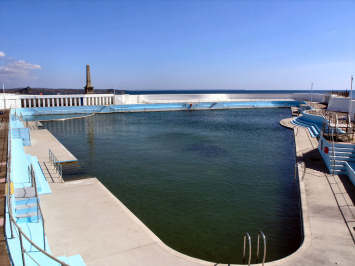
Penzance
First developed as a resort in Victorian times, first impressions suggest that Penzance is not generally very attractive. However, stray into the streets between the main shopping street and the seafront and you will discover that there are parts well worth seeking out. Chapel Street is known for its art galleries and antique shops and for its attractive Georgian homes and shops - do not miss the Egyptian House and the Admiral Benbow Inn. At the top of Chapel Street the old Market Hall is now a bank; outside stands a statue of Humphrey Davy, inventor of the miners' safety lamp. He looks down Market Jew Street, corruption of the Cornish Marghas Yow or Thursday Market. Morrab Road and the small streets at its north end are charming as is Regent Terrace and Western Promenade, part of the seafront. If you like the Newlyn School artists, you should visit Penlee House Gallery near the top of Morrab Road, a first class art gallery and small museum with regularly changing exhibitions and a fine core permanent collection; also take a look at sub-tropical Morrab Gardens nearby; ther's a Cornish Cross there. If your taste in art is more modern, try the Exchange Gallery in the former telephone exchage building. A passenger ferry operates from Penzance to the Isles of Scilly and Skybus flies from Newquay and Land's End. Sadly the helicopter service to Tresco finished at the end of October 2012.

Philleigh
Towards the end of September 2017 I headed down to the Roseland to pay visits to three churches, at Philleigh, Ruan Lanihorne and Lamorran. Philleigh is an attractive small village with an interesting church and a popular pub, the Roseland Inn, with its own brewery. The approach to St. Filius church is attractive in summer, along an avenue of hydrangeas to the lych gate. The church consists just of nave, aisle and a three stage tower, the third stage short and crenellated. Inside is a 13th century font and striking panels carrying Charles I message to Cornwall, thanking the Cornish for their support in the Civil War. Where the ceiling springs from the nave arcade painted shields carry coats of arms. Round the corner from the church is the most attractive house in the village, the substantial slate hung The Glebe, by much-admired architect Sir John Soane, and described by Pevsner as Georgian but looking more Queen Anne.
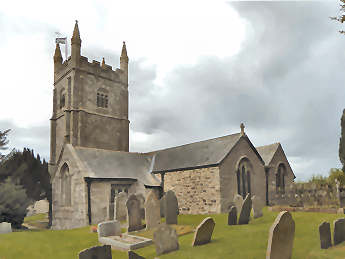
Pillaton
It may be in Cornwall, albeit not far west of the Tamar, but its name is not Cornish but Old English, pila tun meaning "the settlement defended by stakes". Not that there is any sign of any defensive works there today. A small village, with a population of less than 500, Pillaton nevertheless can boast plenty of interest. The Weary Friar hotel claims 12th century origins as a coaching inn. It has 12 letting rooms, bar and restaurant and a fairly extensive menu. I only had coffee but found the staff very pleasant. Next to the Weary Friar is St. Odulphus Church, basically a 13th century building with three-stage tower, nave, aisle and south transept. The porch has a wagon roof with carved bosses. The interior of the church is fairly plain, notable only for the memorials in the Tillie Chapel in the transept. This is the Tillie family of Pentillie Castle which stands high above the Tamar. One wonders why Tillies should be commemorated here when there are several churches much nearer the home. I also visited Quethiock and Tideford, the latter often mispronounced as spelt but really Tiddyford for its river, the Tiddy.