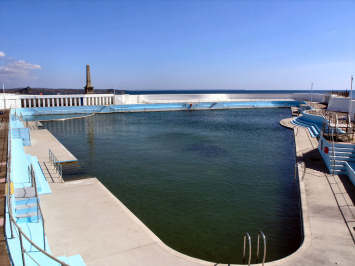
Penzance
First developed as a resort in Victorian times, first impressions suggest that Penzance is not generally very attractive. However, stray into the streets between the main shopping street and the seafront and you will discover that there are parts well worth seeking out. Chapel Street is known for its art galleries and antique shops and for its attractive Georgian homes and shops - do not miss the Egyptian House and the Admiral Benbow Inn. At the top of Chapel Street the old Market Hall is now a bank; outside stands a statue of Humphrey Davy, inventor of the miners' safety lamp. He looks down Market Jew Street, corruption of the Cornish Marghas Yow or Thursday Market. Morrab Road and the small streets at its north end are charming as is Regent Terrace and Western Promenade, part of the seafront. If you like the Newlyn School artists, you should visit Penlee House Gallery near the top of Morrab Road, a first class art gallery and small museum with regularly changing exhibitions and a fine core permanent collection; also take a look at sub-tropical Morrab Gardens nearby; ther's a Cornish Cross there. If your taste in art is more modern, try the Exchange Gallery in the former telephone exchage building. A passenger ferry operates from Penzance to the Isles of Scilly and Skybus flies from Newquay and Land's End. Sadly the helicopter service to Tresco finished at the end of October 2012.
Just off A30 10 miles before Land's End
The art deco swimming pool on the sea-front
Update 2014: Jubilee pool, pictured here, was severely damaged in winter storms. Happily, almost �2 million of central governmeent funding has been made available, plus a further �1 million of local funding.
It re-opened in Summer 2016..
More in Towns & Villages

Philleigh
Towards the end of September 2017 I headed down to the Roseland to pay visits to three churches, at Philleigh, Ruan Lanihorne and Lamorran. Philleigh is an attractive small village with an interesting church and a popular pub, the Roseland Inn, with its own brewery. The approach to St. Filius church is attractive in summer, along an avenue of hydrangeas to the lych gate. The church consists just of nave, aisle and a three stage tower, the third stage short and crenellated. Inside is a 13th century font and striking panels carrying Charles I message to Cornwall, thanking the Cornish for their support in the Civil War. Where the ceiling springs from the nave arcade painted shields carry coats of arms. Round the corner from the church is the most attractive house in the village, the substantial slate hung The Glebe, by much-admired architect Sir John Soane, and described by Pevsner as Georgian but looking more Queen Anne.
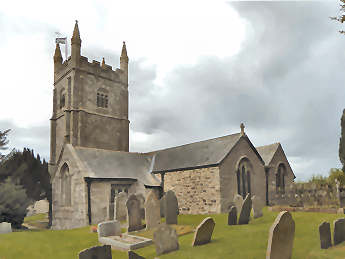
Pillaton
It may be in Cornwall, albeit not far west of the Tamar, but its name is not Cornish but Old English, pila tun meaning "the settlement defended by stakes". Not that there is any sign of any defensive works there today. A small village, with a population of less than 500, Pillaton nevertheless can boast plenty of interest. The Weary Friar hotel claims 12th century origins as a coaching inn. It has 12 letting rooms, bar and restaurant and a fairly extensive menu. I only had coffee but found the staff very pleasant. Next to the Weary Friar is St. Odulphus Church, basically a 13th century building with three-stage tower, nave, aisle and south transept. The porch has a wagon roof with carved bosses. The interior of the church is fairly plain, notable only for the memorials in the Tillie Chapel in the transept. This is the Tillie family of Pentillie Castle which stands high above the Tamar. One wonders why Tillies should be commemorated here when there are several churches much nearer the home. I also visited Quethiock and Tideford, the latter often mispronounced as spelt but really Tiddyford for its river, the Tiddy.
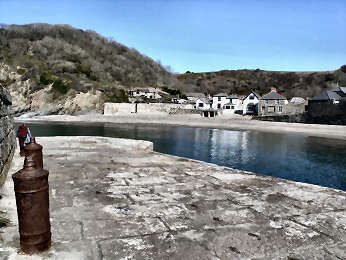
Polkerris
What a contrast to Par, just a mile away across St. Austell Bay. Par is heavily industrial, its waterfront dominated by the vast former china clay works and its associated harbour, and by a holiday park set immediately above the beach. Polkerris might be another world entirely. Both are in the old parish of Tywardreath - it means 'House on the Strand' and was the inspiration for Daphne du Maurier's novel. Polkerris is reached down a narrow steep lane off the road from Par to Fowey. Parking in the village is non-existent, unless you are a resident or are lunching in the Rashleigh Arms and are lucky enough to get a space in their small car park. Happily there is a large car park a few hundred yards back up the hill, a clear sign that Polkerris gets very busy in season. I visited in March 2005, and even then the car park was fairly well used. The village has a long fishing history, though it no longer has a fleet. As far back as Elizabethan times, however, it could boast the largest pilchard cellars in Cornwall, still there. Also there is the harbour wall and quay built by the Rashleigh family, on whose estate, Menabilly, it stood, in the 18th century. Prosperity didn't last and now Polkerris relies on its pub, caf�s and summer visitors. The Rashleigh Inn is open all year. Sams on the Beach is recommended for its food