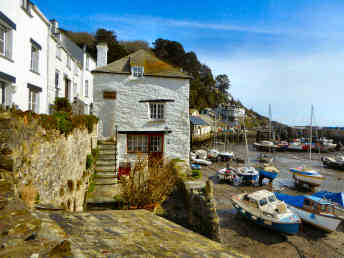
Polperro Revisited - 2016
In March 2016 I decided it was high time I revisited Polperro. I was last there in 2009 and that was only a matter of passing through when nearing completion of my Cornish Coast Path project. So I was back there on a sunny day in March 2016. I would have liked to be there at high tide - it always seems to be low tide when I am there - to see the harbour in water but no luck. I shall have to go back again. One major problem with that, the extortionate cost of parking: a minimum charge of �4, a bit strong if you only want to be there for an hour or so. And for that price you have a half mile walk to the harbour. Disgracefully Polperro's web site mentions parking but fails to mention the cost. But then Polperro is generally an expensive place, probably because it has such a captive audience and takes full advantage of its luck. Many of the eating places charge more than their equivalents elsewhere and I found it a little odd that the Polperro Bakery, which had very reasonable take away prices, should charge twice as much to eat in their courtyard. I made a good choice of eating place, the Old Millhouse Inn, where a masive bacon butty and a good coffee cost me just �5. Despite my criticism, I think Polperro a lovely, if rather deliberately quaint, village. It's not a place to visit when the holiday crowds are out in force but a sunny day around high tide in spring or autumn should be ideal. Back to original Polperro entry
The Old Watch House overlooks the harbour
From A38 at Middle Taphouse follow signs Looe then Polperro
More in Towns & Villages

Polruan
Fowey on the west bank and Polruan on the east bank of the Fowey River together guard what was once a strategically important deep water harbour. Fowey and Polruan have between them a long maritime history. In medieval times they provided ships for the Crusades and for the wars with the French. Henry VIII considered them of sufficient importance to fortify them with a pair of castles and a chain across the River Fowey. Now there are yachts, fishing boats and a china clay terminal up-river and, thanks to the deep water of the Fowey River, cruise ships visit occasionally. A major regatta takes place on the river and estuary in August. There is a boat repair yard in Pulruan and, indeed, the town has a long history of boat building. Oddly, the town is part of the parish of Lantegos-by-Fowey, oddly because Polruan is a small town while Lanteglos consists of little more than church and farm. Polruan is a steep village. As you enter from the east, Fore Street descends steeply to The Quay where you will find the Lugger Inn; the Russell Inn is nearby. From The Quay a small passenger ferry crosses the Fowey River to Fowey Town. You can leave on Battery Lane, passing the massive Blockhouse, one of Henry VIII's coastal defences, paired with a similar on the Fowey side. At the top of the hill is the remains of medieval St. Saviour's Chapel and there is ample parking. Halfway down Fore Street, look to your left for remains of a granite Latin Cross, perching on top of a shaft of Pentewan stone.
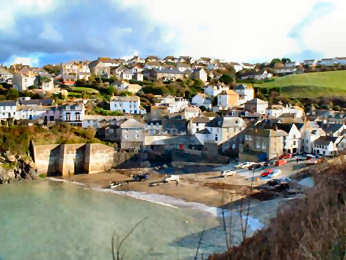
Port Isaac
Jane remembers Port Isaac, from her early childhood, as a quiet remote small harbour village with little activity other than the busy fishing fleet. It is very different these days, having been discovered not only by the holiday trade but also by the second homers from the big city. It may now be far busier than she remembers but it is also, thanks to the influx of incomer money, more colourfully attractive. The old part of Port Isaac is crammed into a tight steep valley leading down to a tiny fishing harbour where crab and lobster are landed. Do not try to drive down to the harbour; you will be unable to park there. You should park in the official car park at the top of the hill and walk down, enjoying the delightful views; the narrow streets can be very difficult to negotiate in a car, even away from school vacation times. Small cottages, closely packed together, have white washed or tile hung walls. There are still fish cellars on the west side of the harbour where you can buy fresh fish and shellfish but the crab and lobster, the main catch, mostly leave the harbour and head uphill for immediate distribution. Even so, we can strongly recommend the crab. Since 2004 Port Isaac has become best known as the location for 'Doc Martin', a TV series shot in and around the village; an odd show, at first comedy, later melodrama and packed with great location shots.
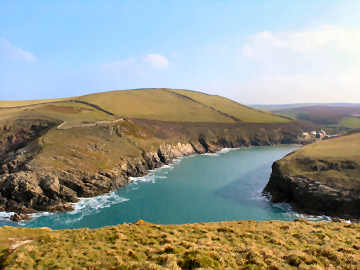
Port Quin
Port Quin is one of those places that you would be lucky to find if you didn't know it was there, although coast path walkers would encounter it. Tucked away down a narrow steep lane, not far from the better known Polzeath and Port Isaac, it is a former fishing hamlet on a quiet cove and, except for one cottage, is all owned by the National Trust and mostly let as holiday cottages. It must have been a bustling little place at one time because one row of cottages was formerly fish cellars for processing the pilchards, once Cornwall's great marine harvest. Eat at the nearby Port Gaverne Hotel (near Port Isaac) for the excellent local crab sandwiches. If you are walking the coast path in these parts, beware, this section offers some of the toughest walking you will find anywhere along the north coast, with a lot of steep climbs - but it's well worth it for the glorious scenery. Just south along the coast is tiny Doyden Castle, built around 1830 by Samuel Symons as a high-life retreat and now an unusual National Trust rental; it was used a Dwight Enys home in the original BBC television series of Winston Graham's Poldark books. There is a small car park down by the harbour but don't expect to find any other facilities, thanks to the National Trust's policies.