Port Quin
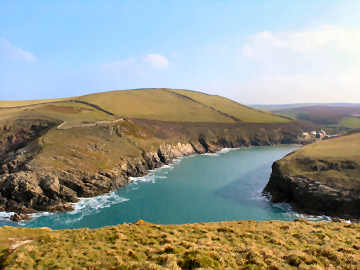
Port Quin is one of those places that you would be lucky to find if you didn't know it was there, although coast path walkers would encounter it. Tucked away down a narrow steep lane, not far from the better known Polzeath and Port Isaac, it is a former fishing hamlet on a quiet cove and, except for one cottage, is all owned by the National Trust and mostly let as holiday cottages. It must have been a bustling little place at one time because one row of cottages was formerly fish cellars for processing the pilchards, once Cornwall's great marine harvest. Eat at the nearby Port Gaverne Hotel (near Port Isaac) for the excellent local crab sandwiches. If you are walking the coast path in these parts, beware, this section offers some of the toughest walking you will find anywhere along the north coast, with a lot of steep climbs - but it's well worth it for the glorious scenery. Just south along the coast is tiny Doyden Castle, built around 1830 by Samuel Symons as a high-life retreat and now an unusual National Trust rental; it was used a Dwight Enys home in the original BBC television series of Winston Graham's Poldark books. There is a small car park down by the harbour but don't expect to find any other facilities, thanks to the National Trust's policies.
A round walk from Port Quin to Port Isaac and back
Signed from B3314 from Wadebridge
Port Quin, view up the natural harbour from Doyden
More in Towns & Villages
Porthleven
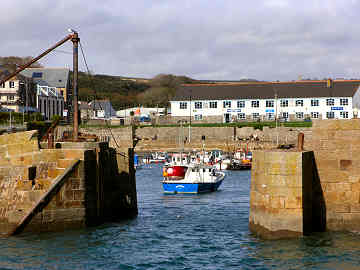
Porthleven is an attractive small town on Cornwall's south coast, three miles to the south-west of Helston. The long narrow harbour is a haven to both fishermen and yachtsmen. It is overlooked on its west side by an attractive pub, the Ship, and on its east side by Bay View, a long curving and very handsome row of Victorian homes, and the clock tower of the Institute, familiar from storm pictures. Since we first encountered Porthleven things have changed a great deal. We remember it as being a bit dreary and with almost no activity out of the summer holiday season. Now it seems to be full of second homes, many of them new but reasonably in character, and many of the former fisherman's cottages are now holiday rentals. Indeed, along the east side of the harbour, and up Cliff Road towards Loe Bar, restorations and new builds are almost all second homes or holiday rentals. Eating places in town have improved in response to this change and there are now many more of them. Latest addition is a fish and chip shop, opened in 2007 by a chatty incomer from Newcastle. In 2008 we enjoyed a meal from Roland's Happy Plaice, eaten sitting on the harbour wall. A pleasant short walk to the south-east takes you to remarkable Loe Bar. An attractive and enjoyable place but, like many harbour villages, this gets very busy in summer. A Rick Stein restaurant on the west side has now closed permanently. Round Walk from Helston.
Porthoustock and Porthallow
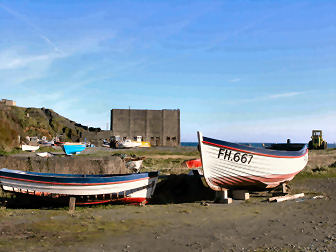
Jane and I were fascinated by Porthoustock when we visited a few years ago. Now I have been back I am even more taken with the place. I was there in November 2005 in the course of a walk that took in St. Keverne, Porthoustock, Porthkerris and Porthallow. While on Porthoustock beach I had a long chat with retired fisherman Roy Curnow and learned a lot about the locality. Four miles of coast here is riddled with stone quarries and it is they which have very much determined the character of Porthoustock, Porthkerris and Porthallow. Beaches have been formed by longshore drift of dark quarry spoil; that at Porthoustock rose gradually by eight feet when a massive groyne was built with a stone hopper on it to load ships. Former winch huts are now used for storage, a tractor draws boats up the beach. An earth mover maintains the height of the beach. Most cottages were once quarrymens homes; some are still lived in by descendants who make a small living from the sea but many are now second homes. There is a lovely thatched terrace just up the valley. West of England quarry still operates but St. Keverne quarry closed in 1958. Until the 1970s two cotils, small steep south facing fields were used to grow early potatoes, harvested in March or April. Porthallow, too, is now largely second home territory. Its claim to fame is as the halfway point on the South West Coath Path.
Portloe
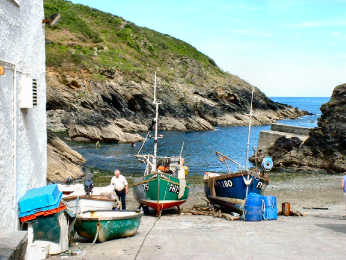
Portloe, on the south coast between Gorran Haven and Portscatho, is expensive territory - inhabited largely by wealthy second home owners - and no wonder. It is a total delight. To get the best out of just driving through, approach from the east so the steep narrow hill down gives you an overview of the tiny fishing cove. Leave westwards towards Veryan. But you will never do Portloe justice by merely driving through. Instead, approaching from the east, park in the only car park, way up the hill. Walk its narrow street and enjoy the charming cottages, with a couple of exceptions no longer fishermen's cottages. Wander down to the cove where you will see evidence of the crab and lobster still caught by the fishermen. The buildings on the cove are mostly part of the Lugger Hotel, one of Cornwall's best. Get an expensive but good lunch here (they do have a car park) or walk up the Veryan road for a pub lunch in the ancient Ship Inn. If you are slightly adventurous, and properly shod, you can enjoy a delightful view from the coast path in either direction. To the east, walk between the Lugger and its car park, follow the cove, take some steps down, cross a tiny stream and the slipway of the former Lifeboat Station ( now a home with a view) and you will come up onto the coast path. Continue a little way and you will come to an amazing shack that was once the Coastguard lookout. Great views from here.