Porthoustock and Porthallow
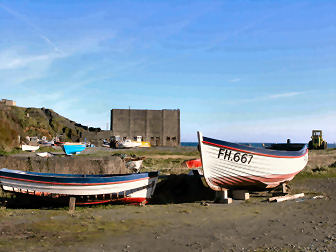
Jane and I were fascinated by Porthoustock when we visited a few years ago. Now I have been back I am even more taken with the place. I was there in November 2005 in the course of a walk that took in St. Keverne, Porthoustock, Porthkerris and Porthallow. While on Porthoustock beach I had a long chat with retired fisherman Roy Curnow and learned a lot about the locality. Four miles of coast here is riddled with stone quarries and it is they which have very much determined the character of Porthoustock, Porthkerris and Porthallow. Beaches have been formed by longshore drift of dark quarry spoil; that at Porthoustock rose gradually by eight feet when a massive groyne was built with a stone hopper on it to load ships. Former winch huts are now used for storage, a tractor draws boats up the beach. An earth mover maintains the height of the beach. Most cottages were once quarrymens homes; some are still lived in by descendants who make a small living from the sea but many are now second homes. There is a lovely thatched terrace just up the valley. West of England quarry still operates but St. Keverne quarry closed in 1958. Until the 1970s two cotils, small steep south facing fields were used to grow early potatoes, harvested in March or April. Porthallow, too, is now largely second home territory. Its claim to fame is as the halfway point on the South West Coath Path.
Boats with Porthoustock's Stone Hopper behind
From Helston, A3083 and B3293 to St. Keverne and follow signs
More in Towns & Villages
Portloe
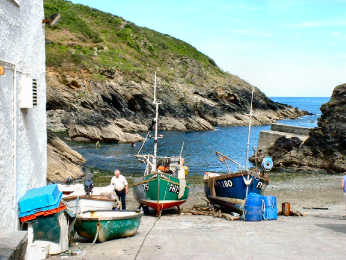
Portloe, on the south coast between Gorran Haven and Portscatho, is expensive territory - inhabited largely by wealthy second home owners - and no wonder. It is a total delight. To get the best out of just driving through, approach from the east so the steep narrow hill down gives you an overview of the tiny fishing cove. Leave westwards towards Veryan. But you will never do Portloe justice by merely driving through. Instead, approaching from the east, park in the only car park, way up the hill. Walk its narrow street and enjoy the charming cottages, with a couple of exceptions no longer fishermen's cottages. Wander down to the cove where you will see evidence of the crab and lobster still caught by the fishermen. The buildings on the cove are mostly part of the Lugger Hotel, one of Cornwall's best. Get an expensive but good lunch here (they do have a car park) or walk up the Veryan road for a pub lunch in the ancient Ship Inn. If you are slightly adventurous, and properly shod, you can enjoy a delightful view from the coast path in either direction. To the east, walk between the Lugger and its car park, follow the cove, take some steps down, cross a tiny stream and the slipway of the former Lifeboat Station ( now a home with a view) and you will come up onto the coast path. Continue a little way and you will come to an amazing shack that was once the Coastguard lookout. Great views from here.
Portreath
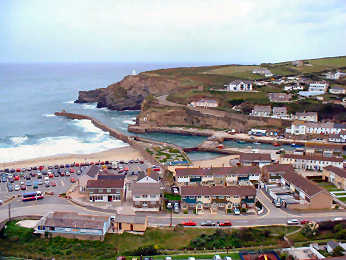
Jane remembers Portreath from wartime when her father used to explain why the village was closed. When we visited in 2003, I was taken by the long narrow harbour, almost unused, and by postwar housing occupying a level V-shaped section between harbour and cliffs. Portreath is now a very ordinary down-market little resort, blessed by a safe sandy family beach but I wanted to find out something of its history. It turns out that it was an 18th and 19th century port, a major player in the tin and copper trade, serving mines around Redruth and Camborne. An important tramway ran from Redruth and is now part of the Coast-to-Coast Mining Trail. A steep inclined plane also ran down from the western side. The port declined in the 20th century and the harbour is now used by a small fishing fleet and by pleasure boats. In World War II Portreath changed beyond recognition. The military took over, clearing away warehouses, and the port served a top secret airfield and weapons storage facility high on the east side at Nancekuke. The warehousing area now has late 20th century housing on it, most of it frankly quite unattractive, while chalets line the cliffs. The airfield remains closed and teams still search for unspecified but apparently deadly hidden weaponry. Below, Portreath's Industrial History
Portreath's Industrial History
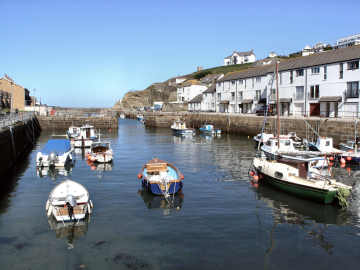
At a glance you would be hard put to guess at Portreath's great industrial history. Nowadays it is a combination of dormitory town for industrial Redruth and Camborne and a scruffy looking small beach and surf resort. Yet in the past it has been one of Cornwal's most important ports. The clues are there: a long well constructed double harbour, a mineral tramway trail that runs to the mine sites and on to Devoran, and the remains of an inclined plane heading steeply south from near the harbour. Construction of the harbour began in 1760 and by 1800 it was bustling with copper ore heading for South Wales and coal returning. By 1819 a tramway had been built to bring copper ore from the mines around Poldice and St. Day. In 1836 the Portreath Branchline was built, linking to the important Hayle Railway. By now ships were being built here, too, and fishing was also important. The 20th century saw gradual decline. Tin streaming ceased when the Red River was diverted in 1933. After WWII the harbour lost its industrial trade and the railway closed. The harbour became home to just a small fleet of crabbers and to pleasure boats. The busy industrial area by the harbour was developed for housing. Few clear signs remain of Portreath's former importance except on the north side of the harbour and in the remains of the Branchline's inclined plane.