Portscatho and Gerrans
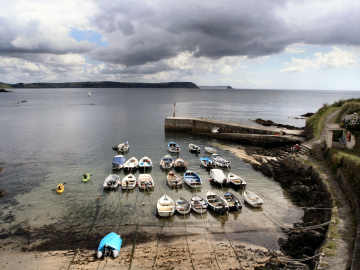
I have a special affection for Portscatho because that's where Jane lived for many years. She still has good friends there are likes to visit from time to time, often for charity coffee mornings. When she went in late July 2007 I went with her and wandered around taking photographs - what else? I was particularly pleased with the somewhat atmospheric one on the left, of the harbour with a distant view of Nare Head and the Dodman. Portscatho is really two villages that have become joined as thay have expanded. Down by the water and along the cliff is Portscatho. Above, originally straggling along the road to St. Anthony Head, is Gerrans, where the church and the Victory pub are. There is still a garage there but the shop and tearooms are gone. Activity has largely migrated down the hill to Portscatho where, partly supported by second and holiday homes, are the Plume pub, a general stores, a couple of art galleries (representing the small colony) and a tea shop. Portscatho harbour remains intact but I doubt if there is any commercial fishing; instead small leisure boats fill the little harbour. Despite visitors there is a strong sense of community and gardens are opened for charity on a day in summer. There is some good walking. A path leads down to Polingey creek and the Percuil river. The coast path to Portloe is of moderate grade; to St. Anthony Head is easy.
A round walk from Porth Farm includes Percuil, Gerrans and Portscatho
Portscatho's small harbour and the view to Nare Head
Signed from A3078 St. Mawes road
More in Towns & Villages
Poughill
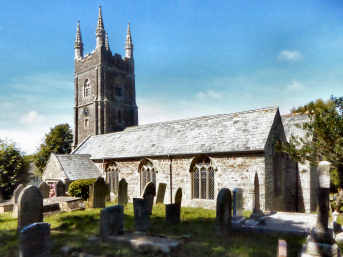
Poughill -pronounced Puffle, is tucked away on a quite lane, leading to Northcott Mouth, on the north side of Bude. It is a steep village and the lane is narrow but, fortunately, there is a good sized car park below the church. There are some attractive cottages, particularly Church Cottage and St. Olaf's Cottage. St. Olaf's Church, dedicated to the Nowwegian King and Martyr, stands on a knoll, perhaps suggestive of an ancient site. The (unused) oak tower door has an impressive surround. The porch, in it a slate memorial in Latin, has an ancient studded oak door. Inside, wagon roofs have carved bosses. The frescoes of St. Christopher are a remarkable survival; whitewahed at the Reformation, they were rediscovered in 1894. The elaborately carved pulpit is unusual for its open fretwork. A wall plaque commemorates Sir Goldsworthy Gurney, Wadebridge doctor, builder of Bude Castle, inventor of a fast steam road carriage, whose limelight lighted the houses of Parliament for 60 years. As at Kilkhampton, there is a fine collection of early bench ends. The attractive looking Preston Gate Inn, which also calls itself a caf�, is open 11 to 11 every day and does interesting sounding food lunchtime and evening. Produce is mostly local and there are fish and chips on Friday, roasts on Sunday and the occasional curry evening.
Poundstock
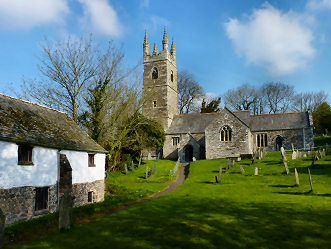
Less than half-a-mile from the busy A39, the so-called Atlantic Highway, Poundstock is a remarkable little hamlet. A lane loops through it from the A39 but otherwise goes nowhere. Yet this was once an important place, mentioned in Domesday Book but in existence as a manor for long before that. Even if you include nearby Trekinnard and Bangors the population is tiny yet the impressive church, set in a lovely sloping churchyard, might seem to belong to a much larger village than this. The church as it is today dates largely from the fifteenth century, though there are scant Norman remains. It is dedicated to St. Winwaloe; can this really be the same Winwaloe as on the Lizard, at Towednack and at St. Germans? Confusingly, a nearby well is dedicated to St. Neot, as in Bodmin Moor. There are some treasures inside: a late Norman font, an octagonal Jacobean pulpit, a panel from the original rood screen, a 16th century chest, parts of a wall painting, saved and exhibited against the north wall, and some early inscribed slate tomb slabs. Sadly there are almost no bench ends but there is an interesting bench in the chancel. Perhaps the greatest treasure of all is at the south end of the graveyard, a restored late medieval gildhouse (church hall), the only example in Cornwall. In the churchyard are more early inscribed slate tomb slabs. St Neot’s Well is off a track that heads NNW to Great Wanson. Up the lane to Bangors is a large free car park.
Praa Sands - Surf and Sand Resort between Helston and Penzance
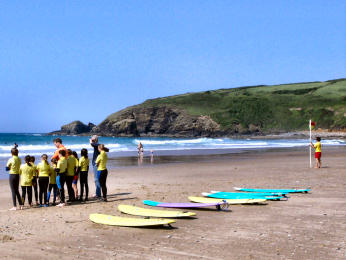
To us, who live on Cornwall's north coast, surfing automatically means Bude, Newquay's Watergate Bay and Fistral Beach, Porthtowan, Portreath and Whitesand Bay near Land's End. So, when I walked between Prussia Cove and Porthleven, it was something of a surprise to discover a good surfing beach on the south coast. The original settlement here was half-a-mile inland at Pengersick where the remnant of a great Tudor fortified manor still stands. It was the late 19th century advent of the railway in Cornwall that brought Victorian sun seekers in search of good beaches. In the 20th century a small settlement of holiday chalets grew up above the beach and a holiday park opened. The village of Praa Sands is not very prepossessing but the beach is glorious. A curving mile of soft sand stretches from Sydney Cove to Lesceave Rocks. In the summer this is part family beach holiday territory and part young surfers paradise. The beach is well served by lifeguards and divided between surfers, bodyboarders and swimmers. There is a surf shop in the village and a small surf school trains youngsters. There is ample parking and just above the beach is Beachcombers beach caf�, a decent pub and a restaurant.