Praa Sands - Surf and Sand Resort between Helston and Penzance
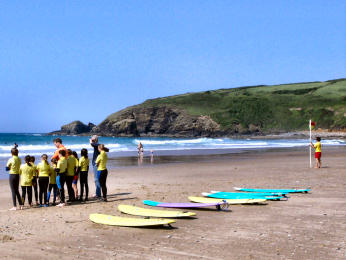
To us, who live on Cornwall's north coast, surfing automatically means Bude, Newquay's Watergate Bay and Fistral Beach, Porthtowan, Portreath and Whitesand Bay near Land's End. So, when I walked between Prussia Cove and Porthleven, it was something of a surprise to discover a good surfing beach on the south coast. The original settlement here was half-a-mile inland at Pengersick where the remnant of a great Tudor fortified manor still stands. It was the late 19th century advent of the railway in Cornwall that brought Victorian sun seekers in search of good beaches. In the 20th century a small settlement of holiday chalets grew up above the beach and a holiday park opened. The village of Praa Sands is not very prepossessing but the beach is glorious. A curving mile of soft sand stretches from Sydney Cove to Lesceave Rocks. In the summer this is part family beach holiday territory and part young surfers paradise. The beach is well served by lifeguards and divided between surfers, bodyboarders and swimmers. There is a surf shop in the village and a small surf school trains youngsters. There is ample parking and just above the beach is Beachcombers beach caf�, a decent pub and a restaurant.
Signed down lane off A394 halfway tween Helston and Penzance
Young learner surfers on Praa Sands
More in Towns & Villages
Probus
What sticks most strongly in my mind, and upsets me most, about Probus, is the destruction of the wonderful Demonstration Garden that stood at the east end of the village. Trelawney Garden Centre of Wadebridge bought the site, complete with garden, with promises to open a garden centre, keeping and improving the Demonstration Garden. In 2014 they repeated their promise and said the work was just about to start. Now, in July 2020 there has been little action on the site. What is due to happen is unclear. I just hope that, in addition to a new garden centre, they will keep their promise about the garden. At present, the site is a wreck.
Quethiock
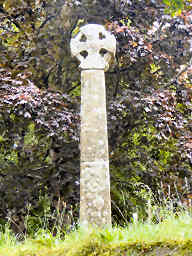
This does seem to be an oddly named village, but less oddly when you understand that it is a variation on "coit" and therefore means wood or woodland, not that there is much woodland here these days. According to Genuki, the name was originally Gwydhek and, in its present form, is pronounced "Gwithick". I was there, in mid-September 2017, essentially to see the Cornish Cross, a tall wheel-headed cross in three sections, probably medieval rather than earlier. In the event I was pleasantly surprised by the church interior which retains some early features. Behind the altar is an elaborate and colourful reredos. The nave and aisle ceilings are wagon roofed with carved bosses; the chancel ceiling is wonderfully patterned and coloured. Most unusually the rood stairs are still in place, though the loft and screen are long gone. In the chapel in the south transept a number of brasses are displayed, the oldest, to Roger Kyngdon, of 1471. Another brass is to Johann Rooke Fletcher. The quire pew has an elaborately carved back, scenes including the crucifixion. I also visited Pillaton and Tideford, the latter often mispronounced as spelt but really Tiddyford for its river, the Tiddy.
Redruth
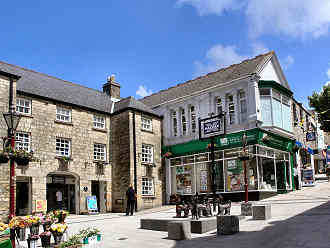
What a change since I first knew Redruth. I remember it from the 1950s when heavy holiday traffic clogged the main streets and the whole place had an air of poverty and deprivation. Unsurprising since the town's one-time wealth was based on copper and tin mining. The collapse of the mining industry might have spelled the death knell for Redruth but, when I took time to walk around in June 2008, after a walk on the Redruth and Chacewater Trail, I was amazed at how attractive a town it now is. Thankfully, the main east-west street, Fore Street, is now pedestrianised; along it are a famous clock tower and sculptures of a miner and of dogs made of boots. Alma Place has the Victorian buildings - the old Miners Exchange and Coffee Tavern and the Cornwall Centre, home to the Tregellas Tapestries, beneath it Market Way and the Buttermarket. Cross Street nearby is the location of Murdoch House, once home to Richard Murdoch, who lighted his home with the world's first gas light and built a steam locomotive before Richard Trevithick. There are handsome homes on West End and in Coach Lane off it. The mother church, oddly, is almost a mile away at Churchtown, in the shadow of Carn Brea. A new weekly Farmer's Market operates on Fridays under the clock tower on Fore Street. Also on Fore Street look out for the striking art deco Regal cinema.