Quethiock
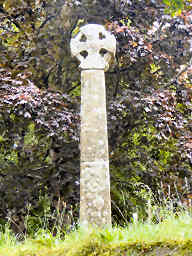
This does seem to be an oddly named village, but less oddly when you understand that it is a variation on "coit" and therefore means wood or woodland, not that there is much woodland here these days. According to Genuki, the name was originally Gwydhek and, in its present form, is pronounced "Gwithick". I was there, in mid-September 2017, essentially to see the Cornish Cross, a tall wheel-headed cross in three sections, probably medieval rather than earlier. In the event I was pleasantly surprised by the church interior which retains some early features. Behind the altar is an elaborate and colourful reredos. The nave and aisle ceilings are wagon roofed with carved bosses; the chancel ceiling is wonderfully patterned and coloured. Most unusually the rood stairs are still in place, though the loft and screen are long gone. In the chapel in the south transept a number of brasses are displayed, the oldest, to Roger Kyngdon, of 1471. Another brass is to Johann Rooke Fletcher. The quire pew has an elaborately carved back, scenes including the crucifixion. I also visited Pillaton and Tideford, the latter often mispronounced as spelt but really Tiddyford for its river, the Tiddy.
Quethiock Cornish Cross
Quethiock Church
Quethiock Chancel Ceiling
Photographs
More in Towns & Villages
Redruth
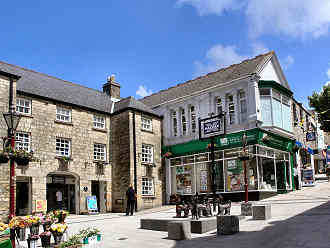
What a change since I first knew Redruth. I remember it from the 1950s when heavy holiday traffic clogged the main streets and the whole place had an air of poverty and deprivation. Unsurprising since the town's one-time wealth was based on copper and tin mining. The collapse of the mining industry might have spelled the death knell for Redruth but, when I took time to walk around in June 2008, after a walk on the Redruth and Chacewater Trail, I was amazed at how attractive a town it now is. Thankfully, the main east-west street, Fore Street, is now pedestrianised; along it are a famous clock tower and sculptures of a miner and of dogs made of boots. Alma Place has the Victorian buildings - the old Miners Exchange and Coffee Tavern and the Cornwall Centre, home to the Tregellas Tapestries, beneath it Market Way and the Buttermarket. Cross Street nearby is the location of Murdoch House, once home to Richard Murdoch, who lighted his home with the world's first gas light and built a steam locomotive before Richard Trevithick. There are handsome homes on West End and in Coach Lane off it. The mother church, oddly, is almost a mile away at Churchtown, in the shadow of Carn Brea. A new weekly Farmer's Market operates on Fridays under the clock tower on Fore Street. Also on Fore Street look out for the striking art deco Regal cinema.

Roche
Oddly for Cornwall, the name Roche, pronounced Roach, is neither Cornish nor English but is from the Norman French La Roche, meaning The Rock: the reason why, to anyone looking at the central photograph below of Roche Rock, will be obvious. The Cornish name was Tregarrek, meaning "Farm or hamlet by the rock". It is a large village with a population of around 4000 and it has many of the facilities which go with that: a couple of pubs, a post office, a primary school, a fish and chip shop, kebabs. The church is of little interest, except for a fine carved 12th century Pentewan stone font and a tall Cornish Cross in the graveyard. Just a mile or so away, just off the main A30, is Cornwall Services, a major highway service areas with petrol stations. In a vast modern building are several food outlets, including Rowe's Bakery, pizza, Macdonalds, Costa Coffee, burgers and hot dogs. There are also a Saltrock clothing shop, a climbing wall, and a children's 'soft play' area.
Rock, on the Camel Estuary
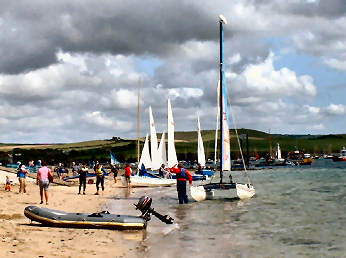
If Newquay is Cornwall's down-market playground, the Camel Estuary is its distinctly up-market counterpart. This is where the seriously rich gather - the permanent rich all year, the vacationing rich in the season. Come here in the summer and you might be in 'Kensington-on-Sea', an impression especially strong a few years ago when the royal princes regularly holidayed with their friends in Rock. The main activity is sailing and the estuary is often crowded with small boats. Highlight is when the Cornish Crabbers or the small brown-sailed Drascombe Luggers (working-boat look-alikes) are out. Windsurfers congregate downstream at Daymer Bay - though not in summer as it's a family beach then - surfers downstream again at Polzeath. Social life centres around the sailing club, St. Enodoc Hotel and - for the drinkers - the Mariners and the Rock Inn down by the water. Golfers enjoy St. Enodoc Golf Club, one of Cornwall's best - and most expensive! During the day coast path walkers cross the water here, by ferry to and from Padstow. In the evening the foodies cross to Padstow for Rick Stein's famed Seafood Restaurant and several other top spots. One of our favourite short walks takes us from Polzeath via Daymer and across the springy turf to Rock; a short, and legal, golf course detour takes in St. Enodoc church and the nearby Jesus Well. See also Porthilly on my Churches page.