St. Gennys
Gennys
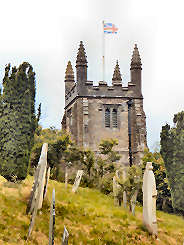
I was last in St. Gennys way back in 2009, when I was walking the complete Cornish Coast Path from the Devon border in the north at Welcombe Mouth to the Tamar ferry crossing at Cremyl opposite Plymouth. At that time I didn't pay any attention to St. Gennys as I was keen to get on into Crackington Haven. This time, in mid June 2018, I had a churches day, revisiting Lesnewth and St. Juliot and looking inside St. Gennys for the first time. St. Gennys is just to the north of Crackington Haven but where the latter usually bustles, St. Gennys is a tranquil spot an consists only of the church, Churchtown Farm, Churchtown Cottages, and the former School House, now holiday apartments. If you follow the National Trust sign to the Coast Path you soon come to Pencannow Point, from whose high and vertical cliff there are fine views to Crackington Haven below and on to towering Cambeak Point with its folded rock strata. St. Gennys Church is tucked away in a small valley, its neighbour the old School House. A filled-in coffen stile leads through a wrought iron gate next to a post box and in to the churchyard. Immediately ahead of you is what may have been the base of a Cornish Cross. The earliest part of the church, the lower two stages of the tower, and the walls of the chancel, are from Norman times; the tower is topped by striking crocketed pinnacles. Notable features inside include a fairly crude 12th century font, a fine altar cloth, slate wall memorials, an interesting, possibly medieval, chest, a simple pulpit on a stone base, remains of altar rails and some 20th century stained glass.
Church Tower
The Old School House
Churchtown Cottages
Photographs
More in Towns & Villages
St. Germans
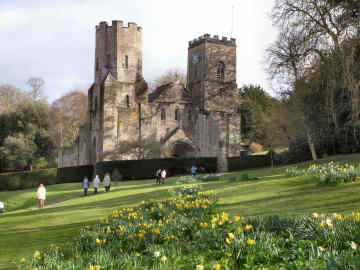
Tucked away, just off the main Liskeard to Plymouth road, on the tidal River Lynher - but with relatively little obvious access to the water - is the straggling village of St. Germans, once the estate village to Port Eliot house, stately home of the Earls of St. Germans. As you enter the village, you pass charming Tudor Moyles Almshouses with ambulatories on both floors but the real surprise is the church at the far end of the village. A cathedral in Saxon times, then an Augustinian priory under the Normans, its domestic buildings are now the heart of Port Eliot house. The church has two west towers, one square, one octagonal, and a superb Norman west door. Inside is glass by William Morris and Burne Jones and a grossly 'over-the-top' Eliot memorial by sculptor Rysbrack. Port Eliot house holds a literary festival in summer, proving to be more successful each passing summer. Until 2008 the house was not open to the public but, as a result of an inheritance tax gift in lieu, it is now open from March to mid-June. In addition to the house, with its John Soane rooms, its fine furniture and collection of Joshua Reynolds portraits, you can wander freely in 600 acres of gardens and grounds. The Eliot Arms pub looks attractive and claims fine food but, when we visited the house in March 2008, we had already eaten at the disappointing Crooked Spaniards at Cargreen.
St. Issey
Issey
St. Ives
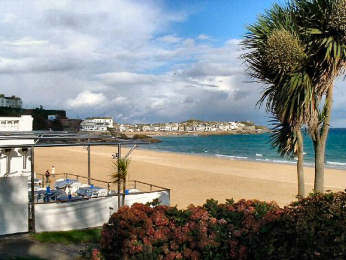
Cornwall's best known harbour town is on the north coast of West Penwith, just a dozen miles from Land's End. On its north side is Porthmeor, the surfers beach, above it a good beach caf� and the Tate Gallery. Porthminster is on its south side with a bathing beach of golden sand and a rather classy beach caf�. Between is The Island, topped by St. Nicholas Chapel and with Porthgwidden beach below, the tidal fishing and boating harbour. The pier that encloses the harbour was built by John Smeaton in 1767–70; at its end stands a small lighthouse. Behind the beaches and harbour are steep narrow streets crammed with tiny picturesque cottages and loads of art and craft studios, galleries and shops. Above P:orthmeor beach stands the Tate Modern art gallery. The artistic connection continues with a Barbara Hepworth Sculpture Garden and galleries with changing exhibitions in the former Mariners Church. Near the latter is the Sloop Craft Market. Towards the edge of town, the former Bernard Leach Pottery is now both Pottery and Musem. The harbour front is full of cafes and restaurants - and carry-out Cornish pasty shops and cream teas. St. Ives may be very touristy but we enjoy its artistic connections - and just wandering. Parking can be difficult and expensive but, if you arrive early, the car park by the station is quite convenient.