St. Germans
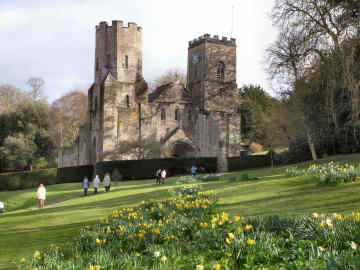
Tucked away, just off the main Liskeard to Plymouth road, on the tidal River Lynher - but with relatively little obvious access to the water - is the straggling village of St. Germans, once the estate village to Port Eliot house, stately home of the Earls of St. Germans. As you enter the village, you pass charming Tudor Moyles Almshouses with ambulatories on both floors but the real surprise is the church at the far end of the village. A cathedral in Saxon times, then an Augustinian priory under the Normans, its domestic buildings are now the heart of Port Eliot house. The church has two west towers, one square, one octagonal, and a superb Norman west door. Inside is glass by William Morris and Burne Jones and a grossly 'over-the-top' Eliot memorial by sculptor Rysbrack. Port Eliot house holds a literary festival in summer, proving to be more successful each passing summer. Until 2008 the house was not open to the public but, as a result of an inheritance tax gift in lieu, it is now open from March to mid-June. In addition to the house, with its John Soane rooms, its fine furniture and collection of Joshua Reynolds portraits, you can wander freely in 600 acres of gardens and grounds. The Eliot Arms pub looks attractive and claims fine food but, when we visited the house in March 2008, we had already eaten at the disappointing Crooked Spaniards at Cargreen.
St. Germans Church from the grounds of Port Eliot
By B3249 off A38 near Tideford. St. Germans revisited 2016
St.
Germans Revisited
When we visited St. Germans in 2008 it was only to look around Port Eliot House and Garden, a visit we enjoyed, especially for the superb Soane's Room, decorated by the remarkable late Robert Lenkiewicz. Next time I was there was June 2016 when I wen to look around the rest of the village. I explored four separate parts of the village, which straggles roughly parallel to the main railway line from London Paddington to Penzance, mostly on its north side but with a western extremity on its south side. There are two routes down to the river. First I took Quay Road that leads down to the River Tiddy. Here are the Sailing Club, some attractive cottages, lime kilns and an impressive view of the railway viaduct. I then took Old Quay Lane, leading down to the other side of the viaduct. On the way down I passed an almost hidden well and a stile to nowhere. At the bottom was Battery Cottage, an impressive collection of cannon in its garden. Back up in the village, I spent some time in the church, vast but disappointing, then headed for the west end of town. Here are the unusual but quite striking Moyle's Almshouses, pictured right, Memorial Cottage, commemorating the 6th Earl of St. Germans, clearly a man of many parts, and the Eliot Arms, a pleasant pub with bar snacks at lunchtime and a full restaurant menu in the evening.
Unusual Moyle's Almshouses in St. Germans
St.
Photographs
More in Towns & Villages
St. Issey
Issey
St. Ives
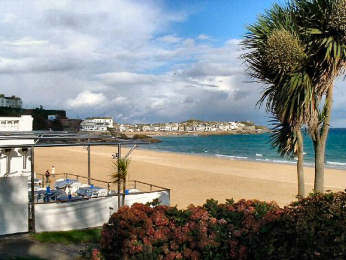
Cornwall's best known harbour town is on the north coast of West Penwith, just a dozen miles from Land's End. On its north side is Porthmeor, the surfers beach, above it a good beach caf� and the Tate Gallery. Porthminster is on its south side with a bathing beach of golden sand and a rather classy beach caf�. Between is The Island, topped by St. Nicholas Chapel and with Porthgwidden beach below, the tidal fishing and boating harbour. The pier that encloses the harbour was built by John Smeaton in 1767–70; at its end stands a small lighthouse. Behind the beaches and harbour are steep narrow streets crammed with tiny picturesque cottages and loads of art and craft studios, galleries and shops. Above P:orthmeor beach stands the Tate Modern art gallery. The artistic connection continues with a Barbara Hepworth Sculpture Garden and galleries with changing exhibitions in the former Mariners Church. Near the latter is the Sloop Craft Market. Towards the edge of town, the former Bernard Leach Pottery is now both Pottery and Musem. The harbour front is full of cafes and restaurants - and carry-out Cornish pasty shops and cream teas. St. Ives may be very touristy but we enjoy its artistic connections - and just wandering. Parking can be difficult and expensive but, if you arrive early, the car park by the station is quite convenient.
St. Just in Penwith
Just in Penwith