St. Kew
Kew
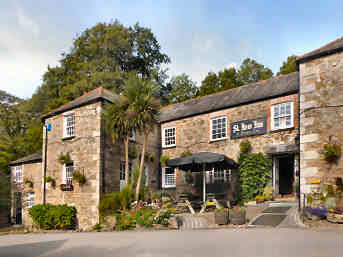
St. Kew is the 'churchtown' of an extensive but little populated parish in North Cornwall. Now of little importance, except for its excellent eponymous hostelry, in medieval times it was a centre of some importance. The names of its relatively few buildings bear witness to this former importance. The church of St. James the Great - an unusual dedication - is believed once to have been the site of a Celtic monastery and indeed is apparently mentioned as early as the 6th century. Consisting of nave, two aisles and a tall three stage tower, it is noteworthy for its three wagon roofs, its stained glass (much admired by Pevsner), its original rood stairs, its much later elaborate rood screen, its elaborately carved font. There is a handsome pulpit, remains of a lantern cross and an unusual stone carved in Latin and Ogham scripts. Outside is a tall but damaged Celtic Cross and elaborate triple bank of steps up from the road. Adjacent is the admired St. Kew Inn, itself probably originally of the 15th century; a fairly elaborate evening menu is counter-balanced by simpler lunchime snacks. Southeast of the inn is the large former vicarage. Other interesting buildings include The Barton, Barton Farm and The Grange. John Alden includes a walk from St. Kew in his iwalkcornwall but when I tried it stiles were almost impassable for mud and barbed wire.
The hansdome St. Kew Inn
Signed from St. Kew Highway on A39 Wadebrisge to Camelford.
St.
More in Towns & Villages
St. Keyne
Keyne
St. Mabyn
Mabyn
St. Mawes
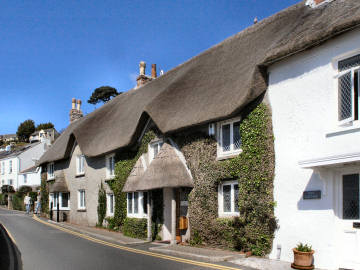
Rock, on the Camel Estuary on Cornwall's north coast, is the sailing village that gets all the attention from the media, perhaps partly thanks the well-connected youngsters who holiday and party there in summer. St. Mawes has always been a great deal more discreet but has always been a home for serious wealth. It is a bright and colourful sailing village with white-washed cottages under slate roofs - and a little thatch - with flowers everywhere enhancing its charms. Above the village one of Henry VIII's coastal castles looks across Carrick Roads to its twin atop Pendennis Point high above Falmouth. On Upper Castle Road, above St. Mawes Castle a sign points to Lamorran House Garden, a delight open two days in week in summer. Hotels abound; of these, Tresanton is undoubtedly the best, the Idle Rocks next best, while the Rising Sun is an attractive inn. Pub afficianados will enjoy the Victory Inn. Walkers who enjoy a garden should park by the castle and follow the water north to find the tiny village of St. Just with its delightful churchyard garden. Ferries run from St. Mawes, one crosses Carrick Roads to Falmouth, the other crosses the Percuil River to Place on the St. Anthony peninsula.