Talland and Porthallow
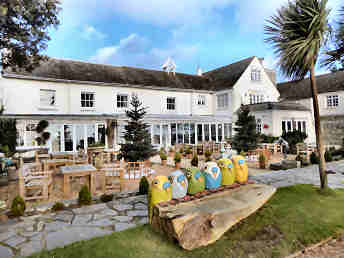
The nearest I had previously been to Talland and Porthallow was when walking the Cornish Coast Path between Polperro and Looe in April 2010. The path passes through the two coves of Talland Bay; the tiny villages of Talland and Porthallow [not to be confused with Porthallow on the Lizard] are up a steep hill inland from Talland Bay. There are some attractive cottages in the villages and the child and dog friendly Talland Bay Hotel in Porthallow village is strongly recommended for its location and lunchtime light food. The church of St. Tallanus is in Talland village. It's a most unusual church, set into a steeply sloping graveyard. As you enter the porch, the body of the 13th to 15th century church, uniquely dedicated to St. Tallanus, is to your right, the detached tower is up steps to your left. Inside are some good memorials and a very fine collection of carved bench ends, mostly of the 16th century. Down in the bay, one cove has a car park and beach caf�, the other a large car park, at its top, behind Smugglers Cottage, the Smugglers Rest caf�. We visited in 2015, between Christmas and New Year. Car parks and toilets in the coves were closed for the winter. There is a path between hotel and beach but we opted to drive the steep hill between the two. The hotel was dressed inside and outside to entertain children in the festive season. It entertained us, too.
Talland Bay Hotel with Christmas Budgies
Turn S from A38 at East Taphouse, by Pelynt then S on lane
More in Towns & Villages
Tintagel
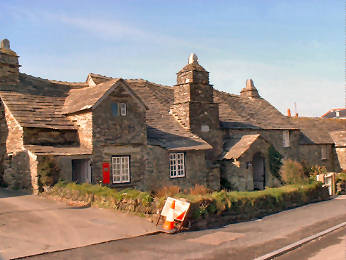
At first we hated Tintagel as an awful tourist trap. Now we know it better we find we can ignore the tat and concentrate on the interest. Most people come to seek King Arthur and his Tintagel Castle. For that, park in the designated car park, walk to the Island, climb it, enjoy the views and drink your fill of history, real or mythical. Dedicated Arthurians will also look almost opposite the National Trust's Old Post Office for King Arthur's Halls, an odd mix of Pre-Raphaelite mythology and modern audio-visual. The Old Post Office is really a small 14th century manor house, used in Victorian times as the local mail receiving office. Away from the village, high on cliffs to the west, St. Materiana's church is worth seeing in its own right; close by are ravishing coastal views. On the way there, look out for the Vicarage; enter its ancient gatehouse to find a simple chapel, once a 13th century cottage; look over its garden wall for a medieval dovecote. We enjoy Tintagel for all these things and now think it a shame that most people are unable to see beyond the tourist traps. The village has improved greatly (it cost �2.4 million) but shops, caf�s and restaurants are still mostly aimed at the worst end of the tourist trade and almost all rely on the Arthurian connection. Our preferred eating place is the Olde Malthouse Inn.

Tregony
Tregony is a less than 10 miles from Truro but a world apart. Rather like Grampound it is virtually a one-street village and is on a hill. However, its hill is a great deal steeper than Grampound's, climbing altogether about 200 feet in its half-mile length from the River Fal at the bottom to St. Cuby's Church and the Primary School at the top. At one time the River Fal was navigable all the way up to Tregony, 15 miles from the sea. In those times it was an important port. In the early 17th century King James I gave Tregony free borough status and it was entitled to return two elected representatives to Westminster; no longer of course. Tregony lost its importance thanks essentially to the silting up of the River Fal, due primarily to run off from the chia clay pits and tin mines It is however a delightful village; or is it a small town? It certainly has some of the attributes: Anglican church, Methodist chapel, post office, shop, primary school, and pub, the excellent Kings Arms. Fore Street is lined with attractive cottages, looking 18th century, and there are a few Victorian villas. Notable features include the clock tower, the small square with its parish water pump, and its galleried almshouses, pictured left. These were built in 1896 by M.P. Hugh Boscawen and greatly restored in 1995. Their purpose was "to house poor housekeepers, who must be over sixty and have lived in a 2 mile radius of Tregony for 2 years".
Tresillian
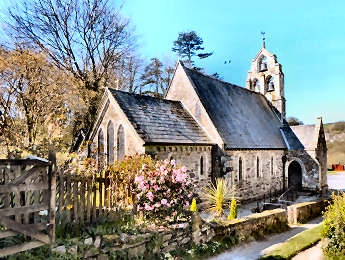
We drive through Tresillian every time we visit Truro or points west of there. As you approach from the east (our direction) what you see as you enter Tresillian, and prepare to turn sharp right across a bridge over the Tresillian River, is the formal, and normally unused, gates to the northern end of a four mile drive to Tregothnan, ancestral home of the Boscawens, Lords Falmouth. The village straggles along the main road. Along the way is the attractive Wheel Inn and some motor deakers on the left, a former toll house and an old maltings on the right. At the Truro end of the villlage a signed footpath takes you through a small marshy area and on to a firm path which follows the west side of the Tresillian River. The river itself, leading to attractive St. Clement is tidal; at low tide it is almost entirely mud. In spring daffodils line the south side of the road. Before you turn right over the river on the main road, to your left is the Anglican church, dull from the front but attractive from up the track alongside it. To my surprise, a Cornish Cross sits on the kerbside in front of the church. The Victorian church was firmly locked when I was there; I doubt if I missed much, Pevsner is not exactly complimentary. The lane alongside the church leads to St. Michael Penkevil and Tregothnan.