Trevalga
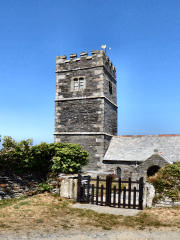
I was back in Trevalga in July 2018. Parking is not easy; you could park in a small lay-by on the main road but these days that means more walk than I can sometimes cope with. Happily I found a small usable space close to the gate to the churchyard. Previously I had not been inside the church; this time I did and report on it on my Churches page.
Trevalga Church
Cornish Cross in Churchyard
Carved Bench End
Photographs
More in Towns & Villages
Treverbyn
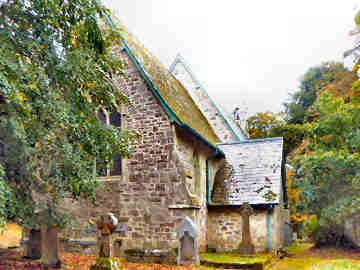
I visited St. Peter's Treverbyn in mid-October 201`9. At first I thought I was out of luck as the church was locked. However, in the village hall over the road I found churchwarden Rod Phillips who kindly opened up the church and gave me a guided tour. Thank you, Rod. There is not much to Treverbyn village which, as near as makes no difference, is part of Stenalees, the southern continuation of Bugle, towards the eastern edge of Cornwall's China Clay Country. However, a little surprisingly, Treverbyn is the main parish of this part of Clay Country and includes Bugle, Stenalees and Penwithick, Trethurgy, Scredds and Carthew within its extended parish boundaries. Treverbyn itself consists of little more than church, old vicarage, new vicarage, school, village hall, a farm and some recreational facilities. Appropriately for a Clay Country church, Clay Country settlements being mostly relatively recent, St. Peter's in Treverbyn dates from 1848 and was the work of prolific Victorian architect G E Street. This was only his second Cornish church, the first being St. Mary's Par at Biscovey. Pevsner rates this as "good early Street with strong design, simple detail and skilled use of local materials." The exterior is modest with steeply pitched slate roofs. Windows in the north and south walls have Decorated tracery to 2-light windows. The east and west ends have larger 4-light windows. The interior is bold, lofty and spacious. The nave is rather barn-like with its arch-braced roof and a soaring chancel arch. The sanctuary ceiling is boarded and painted. Careful lighting gives prominence to the altar. Stained glass includes two windows on the south wall of the nave. The 1897 windows of the north wall are all by E R Suffling. There are good contemporary wrought-iron gates to the churchyard. Nearby are a few other buildings by Street; his 1858 former vicarage, described by Pevsner as "solid and workmanlike," has a circular stair turret. The school room and school house are also by Street.
Troon
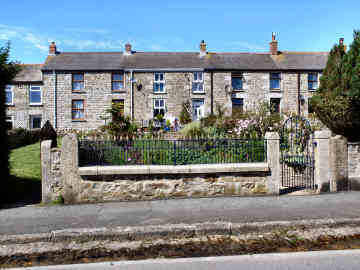
Although I had been near Troon - south of Camborne - on several occasions when seeking mining relics in the area, it was not until August 2007 that I actually drove through the village. On my way from Carwynnen Quoit to King Edward Mine, I found myself in what I think is Treslothan Road, part of the Pendarves Estate mining settlement. Although I know nothing else about the village - except that it boasts (or certainly has in the past) a great cricket team, I was so struck by the lovely terraced cottages and their long front gardens that I had to include an image of the street.
Truro
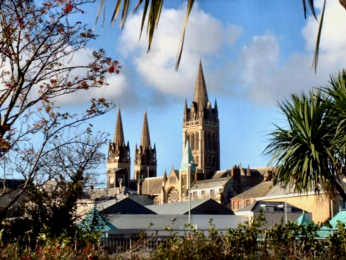
One of England's smallest cities stands where three streams meet to become the Truro River. From early times Truro was important, its port serving Cornwall's tin and copper trades - the Coinage Hall in the middle of the city is a reminder of those days. By 1130 it had a royal charter, was a stannary town, regulating the tin trade, and had prosperous merchant guilds. The port has gone but Truro is now county town of Cornwall with a cathedral. It is an attractive small city with a confusing street pattern, some fine Georgian terraces, attractive back-streets and alleyways, some pleasant parks and gardens and handsome old granite buildings. There is a daily 'Pannier Market' on Lemon Quay, and two farmer's markets. Shopping is good and there are many good restaurants, caf�s and pubs. Hall for Cornwall hosts theatre and music. We have attended a number of concerts there; seating is good but sound balance can vary. Best hotel is The Alverton, a comfortable country house only a few hundred yards from the centre of town. If you feel like exploring further on foot, you can follow the river for a couple of miles to Malpas, where the Heron Inn (there is a heronry in the woodland along the river) serves good food. Alternatively, you could take the water-bus which runs to Malpas, Trelissick and Falmouth. A mile from from Malpas, on foot along the creek (sometimes a little muddy in places), is the charming little settlement of St. Clement.