Troon
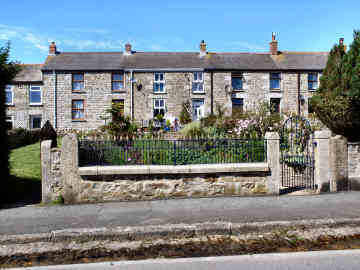
Although I had been near Troon - south of Camborne - on several occasions when seeking mining relics in the area, it was not until August 2007 that I actually drove through the village. On my way from Carwynnen Quoit to King Edward Mine, I found myself in what I think is Treslothan Road, part of the Pendarves Estate mining settlement. Although I know nothing else about the village - except that it boasts (or certainly has in the past) a great cricket team, I was so struck by the lovely terraced cottages and their long front gardens that I had to include an image of the street.
Troon - former miners' cottages in Treslothan Road
2 miles S of Camborne, by the road past the railway station
More in Towns & Villages
Truro
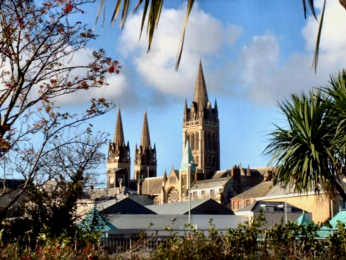
One of England's smallest cities stands where three streams meet to become the Truro River. From early times Truro was important, its port serving Cornwall's tin and copper trades - the Coinage Hall in the middle of the city is a reminder of those days. By 1130 it had a royal charter, was a stannary town, regulating the tin trade, and had prosperous merchant guilds. The port has gone but Truro is now county town of Cornwall with a cathedral. It is an attractive small city with a confusing street pattern, some fine Georgian terraces, attractive back-streets and alleyways, some pleasant parks and gardens and handsome old granite buildings. There is a daily 'Pannier Market' on Lemon Quay, and two farmer's markets. Shopping is good and there are many good restaurants, caf�s and pubs. Hall for Cornwall hosts theatre and music. We have attended a number of concerts there; seating is good but sound balance can vary. Best hotel is The Alverton, a comfortable country house only a few hundred yards from the centre of town. If you feel like exploring further on foot, you can follow the river for a couple of miles to Malpas, where the Heron Inn (there is a heronry in the woodland along the river) serves good food. Alternatively, you could take the water-bus which runs to Malpas, Trelissick and Falmouth. A mile from from Malpas, on foot along the creek (sometimes a little muddy in places), is the charming little settlement of St. Clement.
Tywardreath
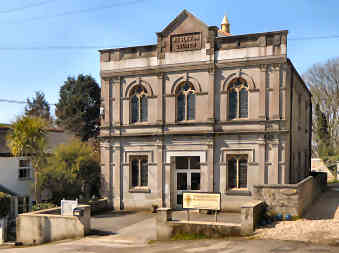
On a sunny day in late April 2016 I had an outing to the south coast to visit Carlyon Bay - to look at progress on "The Beach" (none) - Par Beach and Polkerris. On the way I stopped off in Tywardreath which, when passing through I had always liked the look of, but had never spent time in. The name, borrowed by Daphne du Maurier, translates as "The House on the Beach (or Strand)". As with most Cornich villages, the main feature is the church. St. Andrew's is set in a large sloping churchyard, full of wild flowers when I saw it. Consecrated in 1347, the tower and south aisle were added in 1480. Outside, to the left of the porch, loose stones include remains of a column that guided travellers across the estuary. Inside are Rashleigh memorials, a wagon roof with carved bosses, a decorated 14th century font, a carved pulpit which seems to have been made from either bench ends or part of the former screen, small remains of that screen and some fine bench ends (see the church's Visitors Guide for interesting explanations of these. The village has wide streets with some handsome houses and a pub, the New Inn. Halfway down Well Lane, the well has been sealed off. A little way down the lane on the right is the handsome, and quite unusual, Methodist chapel, still in use. Further down, another former chapel is now a day nursery.
Veryan
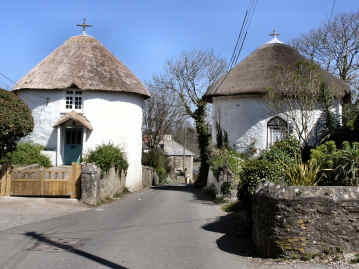
A charming little village on the Roseland peninsula, not far from tiny Portloe harbour, Veryan comes in two parts. Veryan itself has a pub, a church, a post office and stores and a lovely garden. Half-a-mile north-east is Veryan Green. Both are notable for their pairs of thatched round houses. They were built around 1815 by Veryan vicar Jeremiah Trist, as homes for his daughters. They are round to ensure there are no corners for the devil to hide in. Jeremiah's son Samuel built Trist House as his vicarage; its lovely garden used to be open daily from April to July, serving good cream teas. I have been unable to ascertain whether it still opens; pity if not. Veryan's church is dedicated to St. Symphorian and consists of nave and aisle with the tower standing alongside the nave. There seems to be some Norman work, otherwise the church is mainly of the 13t and 14th centuries witrh later Perpendicular window insertions. Inside, unusually, the floor slopes upwards towards the altar. A round walk from Carne Beach includes Veryan and Portloe