Veryan
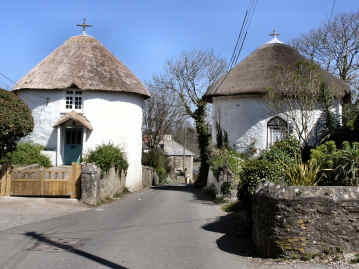
A charming little village on the Roseland peninsula, not far from tiny Portloe harbour, Veryan comes in two parts. Veryan itself has a pub, a church, a post office and stores and a lovely garden. Half-a-mile north-east is Veryan Green. Both are notable for their pairs of thatched round houses. They were built around 1815 by Veryan vicar Jeremiah Trist, as homes for his daughters. They are round to ensure there are no corners for the devil to hide in. Jeremiah's son Samuel built Trist House as his vicarage; its lovely garden used to be open daily from April to July, serving good cream teas. I have been unable to ascertain whether it still opens; pity if not. Veryan's church is dedicated to St. Symphorian and consists of nave and aisle with the tower standing alongside the nave. There seems to be some Norman work, otherwise the church is mainly of the 13t and 14th centuries witrh later Perpendicular window insertions. Inside, unusually, the floor slopes upwards towards the altar. A round walk from Carne Beach includes Veryan and Portloe
Signed from A3078 to St. Mawes, just south of Tregony
A pair of Round Houses in Veryan
More in Towns & Villages
Wadebridge
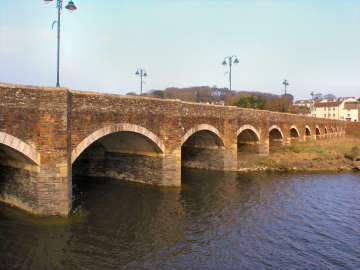
This is my own hometown. Nothing very much special about it but a very pleasant, convenient place to live. We chose Wadebridge because we wanted a good small town close to where Jane was raised in Trebetherick. It has everything we want: good local shops, a cinema, plenty of activities and, most importantly for me, it's fairly centrally situated giving easy access to the rest of Cornwall for my explorations. The town grew up on both sides of the lowest *fordable crossing of the River Camel (the original name was Wade from the Saxon gwaed meaning ford) and had a market by 1312. One of Britain's finest medieval bridges was built in 1468. Known as the Bridge on Wool, the popular story is that woolsacks were used as foundations, the truth is almost certainly that it was financed by wool merchants. Across the river, where we used to live, is Egloshayle (the name means The Church on the Estuary), once a separate village and probably older than Wadebridge. Until the 18th century Wadebridge was an important port, exporting corn and granite; apartments now line that part of the waterside. The railway once ran through here, linking the town with Bodmin in 1834 and later extended to Padstow. The railway is long gone but the trackbed is now the Camel Trail, a cycle route so popular that, in summer, it can be almost impossible to walk along it. *The Camel is still easily fordable in Wadebridge at low tides.
Warbstow
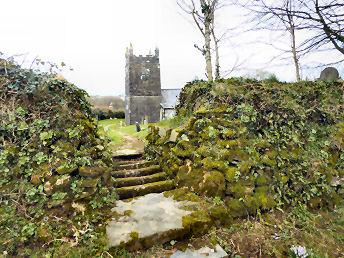
This expedition, in late February 2016, started as a revisit to Warbstowbury, a vast iron-age hill-fort not far from Camelford in North Cornwall, and Cornwall's second largest after Castle-an-Dinas near St. Columb. I enjoyed walking the circuit of the banks and ditches of the hill-fort and got some good photos of the views from there, taking advantage of the 800 foot height of the location to include such landmarks as the dishes and radomes of GCHQ Steeple Point north of Bude. I then moved on to Warbstow, passing through Warbstow Cross, a village of no interest. Warbstow itself is tiny, consisting just of farmhouse, ancillary buildings, church and a formerly occupied house, for sale when I was there in 2016. The farm's old barns, mostly no longer in use, are attractively ramshackle. One low building, which might have been a small piggery, has a small double-headed round window opening. The farmer describes it as Norman but it looks Saxon to me. Oddly, the village's name means "the holy place of St. Werburg", a saint normally associated with Chester. I was unable to gain access to the church but underatand it originally to have been 12th century cruciform, an aisle and tower added in the 15th Century and the south transept removed in 1861. Note the coffen stile through the hedge to the churchyard from a lane on the south side.
Warleggan
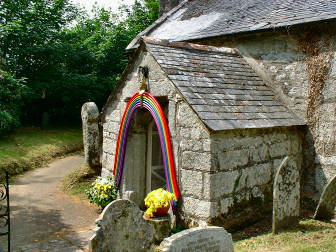
I first encountered the moorland village of Warleggan in June 2006 when Jane and I attended a flower festival there. It was a warm, sunny day and gardens were looking lovely and lush. I was next there in August 2011 in the course of a challenging 6� walk from a car park at the southern end of Colliford Lake, a walk that took me over Penkestle and Letter Moors, and by way of Lantewey, Warleggan and Carburrow Tor. Challenging for the stream crossing below Lantewey - the clapper bridge had collapsed in a flood - and the very steep, massively rocky track up between Lantewey and Warleggan. On this occasion, in late November 2016, I approached the village from the A38 at the Halfway House Inn and, on the way, discovered disused Tredinnick Chapel and an adjacent Cornish Cross. Warleggan is a fairly steep, one street village. There are some inaccessible big houses, accessible small cottages, the former village pump in front of Pixie Nook (ugh!) and the tiny church up a track off the lane. There is little to commend the church, which was (as so often) ruined by Victorian "restoration". The 15th century font of elvan stone bears no decoration. The poor box is old but stands on a modern column. There are no carved bench ends, done away with by the Victorians. To my mind about the only redeeming features are the Cornish Cross, once used as a gatepost, by the porch and the fact that you can park a car by the church.