Week St. Mary
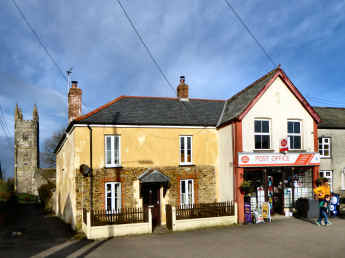
I visited Week St. Mary (originally Wyke St. Mary, the Old English Wyke meaning a dairy farm, St. Mary added for the dedication of the church) in late January 2016. My purpose was essentially to seek out the bare remains of what is claimed to be a Noman castle ringwork just to the west of the church. Certainly you can see some kind of earthwork in the field adjacent to the church but just what it was is unclear from visual evidence, whether castle or perhaps manor house. The village will have been in existence since before the Norman Conquest, after which the land belonged to William the Conqueror's half brother, Robert of Mortain. The market square is attractive with a couple of thatched cottages, a colourful cottage next to the village shop, and a view of the church tower. St. Mary's church, largely of the 14th and 15th centuries, is typically Cornish in that it has nave and north and south aisles, the aisles with wagon roofs. In the porch the floor is of vertically set slate tiles, reminiscent of a Lutyens garden path; underneath a bench is the original village stocks. Inside, the Three Martyrs window is by Kempe; the octagonal font has unusual crude carving; the pulpit has linenfold panelling and a nearby stall looks as if it was made from the former rood screen. The 1814 memorial plaque to Joseph Burnett records the death of the the oldest known official peace officer killed on duty. Note how the word duty has been at first omitted but later added.
Week St. Mary village square, church tower to left
Signed from A39 at Treskinnick Cross, south of Bude
More in Towns & Villages
Zennor
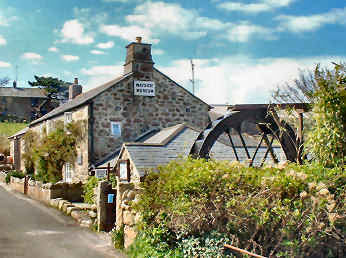
Just off the scenic north coast road from St. Ives to St. Just-in-Penwith is a tiny charming village, too easily passed by on your way west. Zennor consists of just an essentially Norman church, a cattle farm, the excellent Tinners Arms Pub, a backpackers hostel with tea rooms, a group of holiday cottages known as Post Office Row, and the excellent and surprisingly comprehensive Wayside Folk Museum. Legends attach to the church. One concerns its founder St. Senara, cast afloat in Brittany in a barrel and washed ashore in Ireland, returning with her son, Budoc, who was born at sea, via Cornwall where she founded the church. The short walk to the towering cliffs is rewarding, with views over Pendour and Porthzennor coves. By the coast path, it's a tough 6 miles to St. Ives and 11 to Cape Cornwall. However, you may like to consider the Zennor Churchway, an inland route between the two, with its return over the hills on the Tinners Way.
Altarnun
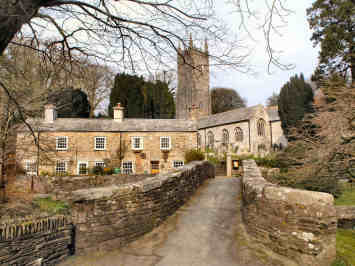
Altarnun is an attractive village, along with Blisland the most interesting on this part of Bodmin Moor. Aalong the main street there is a straggle of houses, stone or slate built, some slate-hung, one or two of them substantial Georgian homes. At the lower end of the street is the church, dedicated to the mother of St. David, St. Nonna, said to have founded this church in 547AD. Her Holy Well is just off the road that heads north. Known as ‘The Cathedral of the Moor’, the church is approached by a narrow and ancient packhorse bridge over the fast-flowing little Penpont Water. Outside, unexpectedly exotic trees thrive in its churchyard and a Cornish cross stands at the top of a bank. A little way up the hill in the village is a former Wesleyan chapel, over its door a stone likeness of John Wesley, a regular visitor, carved by local man Nevil Northey Burnard. Wesley stayed often in the nearby village of Trewint in Digory Isbell's home, now a museum to Wesley and Methodism. Altarnun, surprisingly, has three shops but no pub or teashop. Perhaps it doesn't really welcome visitors, although I felt welcome enough when enquiring about a trail leaflet for the Inny Valleys Walk, which I did in July 2006 - there wasn't one, nor a sign from the village which, for a walk shown as a trail on the Ordnance Survey map, really quite shocked me.

And Even More St. Mawgan
Mawgan