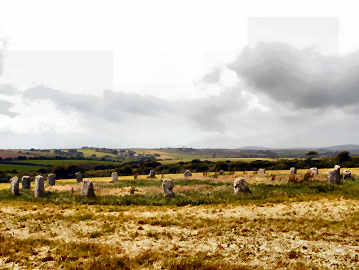
Lamorna - the area to the west of the village
Ever since December 2003, when my sister Mary and I did a round walk from Lamorna that included coast, Boskenna Cross and the Merry Maidens, I had been meaning to return to find the many other antiquities in the area. At last, in July 2007, I did it. After an early lunch at the Lamorna Wink Inn I left my car in their car park (with permission) and set out up the hill opposite to a path that took me west past three farms - Tregurnow, Rosemodress and Tregiffian - then north-west to Boscawen Ros Farm, the original home of the Falmouth's of Tregothnan. There I found my first standing stone in the middle of a field. Continuing north-west I found Boskenna Cross on the main road, then on up a lane to Moorcroft Cross. From there by a path south-west from Choone Farm for massive Goon Rith standing stone. On to the main road for Tregiffian Long Barrow (the cup marked stone is a concrete copy of the original in the Royal Cornwall Museum), then another cross, the Pipers standing stones and Merry Maidens stone circle, one of Cornwall's most complete with 19 regularly placed stones. Oddly, you cannot see one Piper from the other and you can't see the Merry Maidens from either, despite proximity. Yet you can see the Maidens from Goon Rith standing stone. Around 6 miles and very enjoyable.
For full directions of a longer walk see Coastal Round Walk 15
The Merry Maidens stone circle
You can park at Lamorna Cove or near the Merry Maidens
More in Antiquities
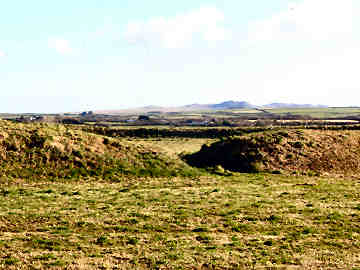
Lanteglos-by-Camelford - Castle Goff and St. Julitta's Well
Having passed close by, on the Camel Ramblers November 2008 AGM Day walk, in dull and wet conditions, I took the opportunity of a fine day soon after to return to Lanteglos to take a look at Castle Goff and also to seek out St. Julitta's holy well. Until 2004 the site would have been inacessible on Castlegoff Farm land but was cleared and is now managed under the Countryside Stewardship scheme. There is easy access on foot from Lanteglos village. Tha name Castle Goff is strange. It is thought to mean (the) smith's castle. Why? Was it a metal working site at one time? It is described as an iron age hill fort but, surely, was no more than a fortified farmstead. In addition to the 80 yard diameter circle of bank and ditch, there are traces of a western extension. Just quarter of a mile to the north-west is another ancient site, shown as 'settlement' on OS109. It's circular and several times the area of Castle Goff. A more recent track cuts across it. St. Julitta's Holy Well is in the grounds of Juliot's Well Holiday Park. Julitta was one of the many saintly offspring of the fecund Welsh King Brychan. To find the well just follow the drive till it becomes a green lane downhill. At the bottom, head left to near the second pond. You will find it there under a tree.
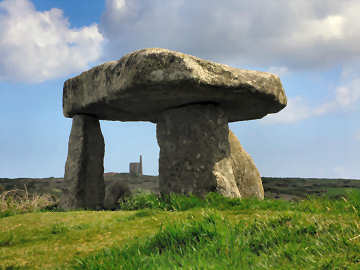
Lanyon Quoit
Located just off the road from Penzance and Madron to Morvah, Lanyon Quoit, along with Trethevy Quoit, is just about Cornwall's most accessible quoit. A late neolithic portal dolmen or chambered tomb, it was brought down in a great storm in 1815. When re-erected in 1824 one upright was broken so now it is like a tripod stool. Before the storm it was apparently possible for a horse rider to pass beneath the 13 ton capstone; now perhaps only a small child on a miniature pony could manage to pass beneath it. Lanyon Quoit, in the care of the National Trust, is only a few yards from the road and is approached by a stile. Park in the small lay-by just round the corner, north of the stile. The area just north of Lanyon Quoit is rich in fascinating antiquities. If you park at Bosullow Common, two loops could take in, to the west, Ch�n Castle and Quoit and Bosullow Trehyllys iron age settlement (on private land) and, to the east, Men-an-Tol, Men Scryfa, the Four Parish Stone, the Nine Maidens stone circle and Ding Dong mine. And a litle way down the road to Penzance you will find Madron Holy Well and Chapel, tucked away in light woodland a little way from the road. Altogether, an area well worth exploring by those interested in Cornwall's amazing antiquities.
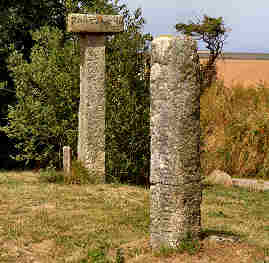
Long Cross Inscribed Stone
I encountered Long Cross inscribed stone - presumably an early Christian period memorial stone - on a round walk from Chapel Amble that took in St. Endellion church and the old manor of Roscarrock. At present I have been able to find out nothing about the stone but was entertained by its proximity to two later direction signs, one of the twentieth century, the other much older. The older has an upright with a flat square stone on top, each side naming a different destination; it is pictured here behind the inscribed stone.