St. Breock Menhirs and Pawton Quoit
and Pawton Quoit
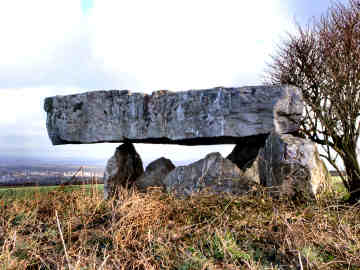
The closeness of the two menhirs on St. Breock Downs must have had a significance, though I have seen none suggested. Men Gurta, also known as the St. Breock Longstone and Menhyr Gun Sen Brioc, is the largest in Cornwall; though now less than its original 16 foot height, it is still estimated to weigh around 16 tons. What I call the Windfarm Longstone is not actually on the windfarm site but approached through it. Views from the stones are of Bodmin Moor from Men Gurta, of clay country from the windfarm stone. You can park off-road near Men Gurta. The Fiddler, also known as the Blind Fiddler, is a former standing stone, now fallen and much truncated. It lies two fields east of the A39, four miles south-west of Wadebridge and opposite the small turning to Tredinnick. Pawton Quoit tops a large long barrow, the ditch round it still recognisable. It has Cornwall's largest capstone, 15 feet long and 2� feet thick and weighing around 14 tons. It was once longer but the broken off part lies to the right of the tree in the photo. Views are to the coast and Bodmin Moor. Location is on the far side of the third field up the hill from Pawton Stream on the way to Haycrock Farm. Nanscow Inscribed Stone stands in the garden of Nanscow, half-a-mile south east of Tredruston Farm, reached by a lane from Whitecross near the Showground. It is inscribed on at least two sides; I thought I could see the letters VIRAC and SELE.
All on OS Explorer 106
Pawton Quoit, hazy Bodmin Moor in the far distance
St.
More in Antiquities
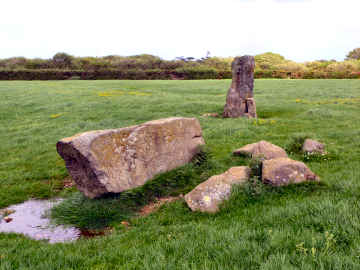
St. Keverne and the Surrounding Area
Keverne and the Surrounding Area
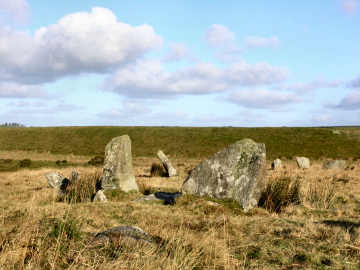
Stannon and Fernacre Stone Circles
On a cold sunny day in late January 2008 I set off to find three stone circles on Bodmin Moor - Stannon, Fernacre and Louden. Stannon is to the south of the china clay pit and I was able to park within 100 yards. From there I headed south-west for Louden Hill circle. I didn't find it this time but did find it later in the course of my Camelford Walk 01. So I headed for Fernacre circle, clearly visible from almost a mile. On the way I encountered numerous cairns and standing stones and two cists, the Steping Hill one visible from a distance. Then, after climbing Roughtor and exploring the settlement on the hill's south-west side, I headed off to Louden Hill for the logan stone. From Louden Hill, if you look across to the nearest hill westwards, you might think you see quoits and standing stones but the hill is a Stannon Pit spoil heap and they have been placed there for fun. But what I did find, at the western base of Louden Hill, close to the Stannon Pit boundary fence, was an impressive (I assume) hut circle, its walls two or three feet high and grass covered. Finally, I followed the boundary of Stannon Pit to find the impressive Stannon stone circle.
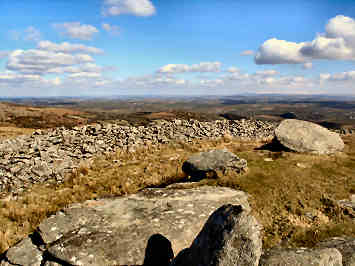
Stowe's Hill near Minions
The most concentrated group of interest on Bodmin Moor is on the south-eastern edge of the moor at Minions. A short walk north from the western car park will bring you to The Hurlers and Pipers, ancient standing stones. Legend has it that the three stone circles of the Hurlers are teams of sportsmen, turned to stone for playing hurling on a Sunday; the nearby two Pipers standing stones provided the musical accompaniment. A longer walk to the north leads to a fascinating area at Stowe's Hill. Here, south of the summit, is Daniel Gumb’s Cave where a simple stone-worker, self-taught mathematician, carved a Euclid theorem on a rock. Climb to the top of the hill, around 1300 feet above sea level, one of the moor's highest points, and you will find the quite amazing Cheesewring, a natural granite outcrop, precariously poised above a quarry. Beyond is a massive stone-walled pound, possibly bronze age, and beyond that a larger walled enclosure. Views over the moor are glorious; to the north you are looking to the high tors of Brown Willy and Rough Tor, to the south you can see the sea as far as Dodman Point, to the east you see Dartmoor. South of the hill, beyond a massive deep ditch, is first a degraded cairn and then the famous Rillaton bronze age barrow. The cist, where the gold Rillaton Cup (original in the British Museum, copy in Royal Cornwall Museum) was discovered, is visible on the barrow's east side.