Fowey
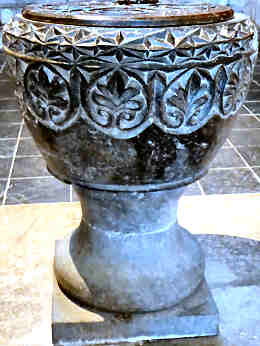
The church stands at the southern end of the town, not far from Town Quay. Behind and above it is Place, the ancestral home of the Treffry family, perhaps best known these days for the great viaduct and aqueduct over the Luxulyan Valley. St. Fimbarrus is described by Pevsner as "in the first rank of the county's churches but in most stylistic aspects very untypical of Cornwall". The first notable feature of the church is the large porch with, unusually, east and west entrances. the latter presumably because it allowed direct access for the Treffrys from Place. The interior is likened by Pevsner to both Brittany and Lostwithiel. Most striking inside is the sheer height and continuous length of nave and chancel. The south aisle roof is very un-Cornish but the fine Cornish wagon roof of the nave and chancel is supported by angels and decorated with bosses and shields of benefactors. A major restoration was undertaken in 1876 by J P St. Aubyn and roofs of nave chancel and south aisle were extensively repaired in 1932-4, mostly using original medieval timbers. The Norman font is of blue Cataclause stone. The fine carved oak pulpit dates from 1601. Stained glass is late Victorian, including nine clerestory windows. Fine monuments are largely of the local Treffry and Rashleigh families and include a large grave slab with three Treffry brothers in armour. In the north aisle a large marble chest monument of 1624 commemorates John Rashleigh, dressed in ruff and beret. Brasses, set in the floor near the pulpit, commemorate Rashleighs and others. More 15th century brasses, on the sill of the east window in the south aisle remember more Treffrys, including Thomas and Elizabeth who defended Place in the 1457 uprising at the end of the Hundred Years War.
Catacleuse Stone Font
St.Fimbarrus, Fowey
Carved Pulpit
Photographs
More in Churches & Holy Sites
Germoe, St. Germoc's Church
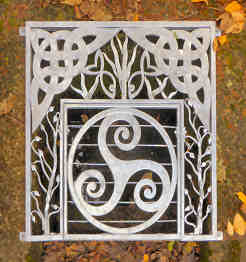
In mid-December 2018 I had an outing down west. First I visited Porthleven, for the charming Victorian St. Bartholemew's Church. I know Porthleven well but had not previously been in the church. Next I visited St. Breaca's Church in Breage, the church with the finest collection of frescoes in Cornwall. Finally, just a couple of miles west of Breage, I spent some time in Germoe (the 'G' is hard). Appropriately enough, since their churches are not far apart, Germoc and Breaca were brother and sister, Celtic saints reputed to have arrived from Ireland in the 5th century. Not having read my Pevsner before reaching Germoe, I was pleasantly surprised by what I found there, helped by a useful sign by the churchyard gate. The church stands at the centre of the little village, a tiny stream crossing a grassy area in front of it. Following the sign, I first took a look at St. Germoc's Holy Well. It has an interesting modern cover, installed in 1977 to commemorate the Queen's Silver Jubilee, and a small information plaque. I then followed the other sign to find "St. Germoc's Chair" at the eastern end of the churchyard, built into the churchyard wall. According to the respected antiquarian John Leland the structure was a shrine covering the bones of St Germoc. However, no trace of Germoc's or anybody else's bones were found under the structure. The most striking external feature of the church is the tower, with two gargoyles high on each face. A surprising amount of the fabric of the church is early, predating the 15th century. On the roof above the chancel arch is a pretty Victorian bell-cote. Inside, the nave ceiling is in a mix of styles; the chancel ceiling is of the Cornish wagon type. The altar is of local granite, the reredos being of coloured patterned tiles. The font is one of Cornwall's oldest, eleventh century with an irregular bowl and worn faces at the corners. At the west end of the nave is a 12trh century font bowl with cable moulding. The oak pulpit has a simple carved frieze. There are 18th century texts on wall-mounted boards.
Gerrans
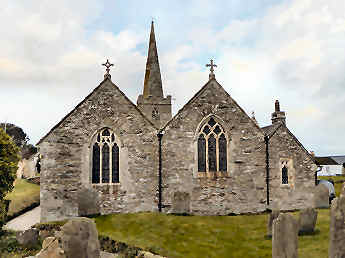
I have a particular affection for this corner of Cornwall, the Roseland Peninsula. It is where I spent family holidays as a teenager, it is where I met Jane and the church is where Jane's older son, Jeremy, married his Mimi. At the bottom of a long, steep hill is Portscatho with a small harbour at the southern end of the sweep of Gerrans Bay. It has to be said that it is not a very prepossessing church, though the octagonal spire is unusual for Cornwall. For me, the greatest attraction was the Cornish Cross near the porch; restored in the 19th century it had apparently previously formed part of the coping of the churchyard wall.. A fire in 1848 meant that less early and original work remains than I would like. For instance, there are only a few carved bench ends, one bearing the device of Catherine of Aragon. There is an attaractive square Norman font, standing on a fat central pillar with four slim surrounding shafts. There are few monuments though that to Edward Hobbs, of 1718, is described by Pevsner as carrying two allegorical figures "in garments as chastely undetailed as if they were of 1820". On the south wall, a slate tablet lists all Rectors of Gerrans since 1260. It is suggested that the name Gerrans derives from a saint of that name; it is more likely that it relates to King Gereint of Dumnonia, for whom Dingerein Castle at Curgurrel is named.
Gorran Churchtown
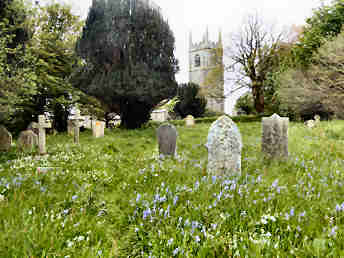
, St. Goranus,