Gerrans
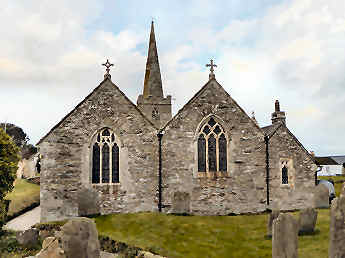
I have a particular affection for this corner of Cornwall, the Roseland Peninsula. It is where I spent family holidays as a teenager, it is where I met Jane and the church is where Jane's older son, Jeremy, married his Mimi. At the bottom of a long, steep hill is Portscatho with a small harbour at the southern end of the sweep of Gerrans Bay. It has to be said that it is not a very prepossessing church, though the octagonal spire is unusual for Cornwall. For me, the greatest attraction was the Cornish Cross near the porch; restored in the 19th century it had apparently previously formed part of the coping of the churchyard wall.. A fire in 1848 meant that less early and original work remains than I would like. For instance, there are only a few carved bench ends, one bearing the device of Catherine of Aragon. There is an attaractive square Norman font, standing on a fat central pillar with four slim surrounding shafts. There are few monuments though that to Edward Hobbs, of 1718, is described by Pevsner as carrying two allegorical figures "in garments as chastely undetailed as if they were of 1820". On the south wall, a slate tablet lists all Rectors of Gerrans since 1260. It is suggested that the name Gerrans derives from a saint of that name; it is more likely that it relates to King Gereint of Dumnonia, for whom Dingerein Castle at Curgurrel is named.
Note the, for Cornwall, unusual spire
Gerrans and Portscatho are signed from A3078 to St. Mawes
Golant, St.
More in Churches & Holy Sites
Gorran Churchtown
, St. Goranus,
Grampound
St. Naunter's Nave
Grampound, St. Naunter's Church
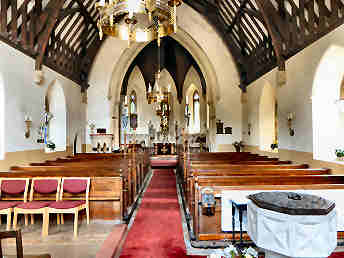
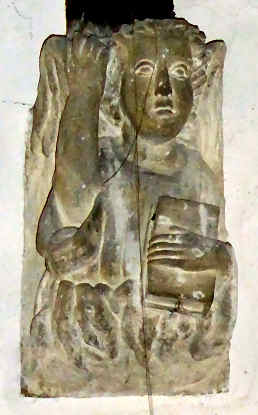
There are two Grampounds, Grampound Road on a north-south country lane and Grampound village on the A390, halfway between Truro and St. Austell. At first sight it appears to be a one street village, climbing a gentle hill from the infant River Fal. However, there is more development along side streets than on the main road itself. Near the river crossing is the Primary School, behind it a Community Centre, Village Shop and Playing Field. Opposite, Mill Lane leads to the disused Town Mill, once operated by a leat off the River Fal. On the main toad, halfway up the hill is the Dolphin Inn, where I have stopped for coffee. Just past the pub is the present focal point of the village, the village hall and church, outside them the remains of a tall (presumably) market cross, its head missing. The village hall is handsome small building with a slate hung clock tower. The adjacent church is surprisingly small. Built in 1421 as a chapel of ease to the far larger and more important St. Crida's in nearby Creed, St. Naunter's was in ruins by around 1820. It was rebuilt in 1869 and has an unexpectedly lofty interior and good 19th century fixtures and fittings. The chancel is most attractive with intricate reredos and colourful altar cloth. Roof corbels are angel figures. There is some pleasant stained glass. More images of St. Naunter's Grampound