Lelant
, St. Uny
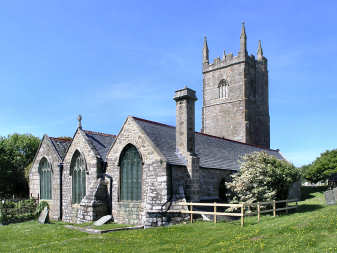
I had walked past St. Uny previously when on the coast path between Hayle and St. Ives. On this occaion in early June 2006 I was walking the first stage of St. Michael's Way, from Lelant or St. Ives to St. Michaels Mount, which actually begins at the church. So I decided I should start by looking in and around the church. St. Uny, also known as St. Euny, was one of those peripatetic holy men of Cornwall about whom nothing is known except the various dedications to him, in this case including the mother church of the parish of Redruth. Oddly, while the church is dedicated to Uny, the parish name may be taken from an earlier holy man named Anta. The present chuch dates mostly from the 15th century, though there is one original Norman arch to the Lady Chapel. Like churches at Perran Sands and St. Enodoc, St. Uny suffered regular inundation by drifting sand. Inside there is not a great deal of historic interest except for a couple of 17th century slate memorial slabs, a (probably) Norman font and rood stairs, not removed in restorations. The real interest is outside where there are several ancient Cornish crosses and the most wonderful views, taking in Hayle Sands, Godrevy Light and Hayle Harbour. Entertainingly, there is also a golf course which comes right up to the churchyard.
Some parking on the road outside. More Lelant
The church of St. Uny Lelant
More in Churches & Holy Sites
Lesnewth
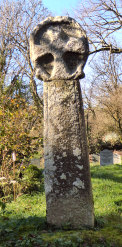
After revisiting St. Juliot's church with its Thomas Hardy associations, I went on to nearby Lesnewth. The name is a corruption of Lys Noweth or New Court. The village is but a hamlet with church, Old Rectory, Coach House, two farms and a few cottages. What I hadn't expected was to find a large Cornish Cross, its head a nicely cut wheel-cross. The church consists of three stage, pinnacled tower, nave, chancel and a vestry in the form of a double south transept. In the nave there are reported to be stained glass roundels (2003) by Caroline Henderson. I only noticed one, that of a bird on a twig, crosses on a hill in the background. On a wall an entertaining board records a grant from the "Incorporated Society for Building Churches". Elsewhere a slate memorial slab of 1680 carries an elaborate coat of arms. Pevsner says that in the porch are a Cornish wheel-head cross and a C13 grave slab with an incised foliated cross. I returned to check but I am afraid Pevsner is mistaken.
Lewannick
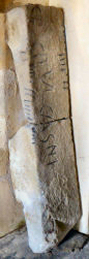
Lewannick is a fairly ordinary, but not uninteresting, little village, happily bypassed by the busy A30, just off the eastern fringes of Bodmin Moor. It has several buldings of interest including a house calling itself Lewannick Manor, but originally the Rectory; next to it a house calling itself Priory House; a former Police House, in that use from 1871 to 1950; and a pub named Archer Arms for the former local landowners. The church stands on an elevated site, presumably with an earlier non-Christian history. It consists of nave, aisles, porch and three-stage tower. The porch roof has some interesting carved bosses, including the one below right, and an old font stands there, too. The most important feature is the two inscribed stones, one in the church inscribed in ogham as well as regular script, the other south in the churchyard. There is an elaborately carved pulpit and the Norman font carries carvings of a labyrinth and two pentagrams. There is an unusual carved stone reredos and the altar is covered with a colourful cloth. A metal wall plaque carries figues of a lion and what looks like a Roman soldier.
Linkinhorne, Stoke Climsland and Lezant
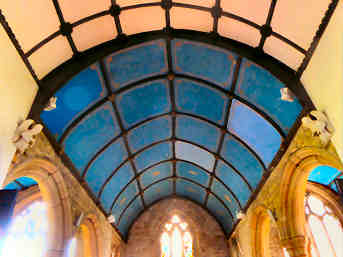
At the very end of December 2017 I made a trip down east to the general area between Launceston and Callington in order to take a look at the churches in Linkinhorne, Stoke Climsland and Lezant. I had been in the first two of these villages back in May 2007 when walking the Cornish section of the Land's End Trail heading west from the River Tamar at Horsebridge to Land's End. On this occasion I had gone to visit the churches in each village.